My cousin gave us some modeling clay to play with, and of course, the boy requested dinosaurs. Specifically, T-rex, stegosaurus, hadrosaurus, deinosuchus, brachiosaurus, and anklosaurus. Here are the dinos on parade!

Wow, what great comments and insight from the last post! I truly appreciate everyone who took the time to leave such thoughtful responses.
I remember a friend of ours who is an Anglo mother to a Chinese girl who told me once that because I am Indian, I don’t have to worry about what culture I bring to the children–that everything I do would simply be Indian because that is who I am. I didn’t initially buy this idea, as it seemed to me that simply relying on me would mean that my children would miss out on a lot of “Indian-ness.” But when I think about it, that is the worst kind of essentialism to reduce being “Indian” to a narrow box. Really, isn’t this what I said I don’t like about the culture itself? There are limitless ways to “be Indian” and it can of course mean many things to different people. I mean, it’s okay to be South Asian and hate Bollywood, and not understand why the aarti flames must go in a clockwise direction (or is it counterclockwise?), and drink pots of coffee and not tea. Not knowing any of those things does not make one less authentic. And it’s okay for my kids to learn that who they are is who they are without needing to “be” any particular thing.
But there are things I want them to know, and this falls into the “pick and choose” model. In terms of the things that would be thought of as traditional Indian culture, it’s hard to make a list of everything. Little things come up every now and then that are not native to majority American culture that I do want the kids to know. Things like folktales, and how to properly eat with your hands, and not touching books with your feet. And I agree with Sapana, in that visits to India formed much of who I am now. More than any particular “cultural” lesson, I learned that the rest of the world doesn’t look like America, which is an important idea I want my kids to know early on.
Which leads me to another related topic, that of American culture. Let me start by saying that I’ve never understood the “America has no culture” concept, or minimizing it to Fourth of July and turkeys and apple pie. (Which is my favorite dessert, by the way. I once pummeled Eric with a pillow because he ate a leftover slice of pie that I was saving for breakfast. Mmmmm. Pie for breakfast. But I digress.) I identify as American more so than I do Indian, despite what society here may consider me to be. The question then becomes what aspects of American culture do we want the kids to have? This becomes an interesting question for Eric as well, as oftentimes the America he grew up in and that his family inhabits is worlds away from the one that our family lives in now. I’ll expand more in a later post, but I’d love to hear your thoughts on that.
And what of adorable kid pictures and the occasional knit, you ask? Those are coming, I promise. The Steggie sweater is done and awaiting modeling. My camera is hoarding the pictures until my hard drive arrives and I can get all the old pictures onto that so that there is room on my computer!
Friends of ours recently gave us the book Part Asian, 100%Hapa. It’s a pretty cool little volume in which there are simple, stark faceshots of people who identify as mixed descent and their responses to the question “What are you?” that they likely receive on a daily basis. Of course, my kids will have to deal with this as well, especially as both of them appear very blended and are not immediately identifiable as one particular ethnicity. Part of me thinks that as time goes on, this will become less of an issue as more mixed couples have children.
A bigger question I ask, though, is what ethnic culture are we raising our children in? How do I want them to understand what it means to be Indian? What does that even mean to me? Growing up, I never really had a lot of Indian friends, despite living in a very diverse community. I often found that the younger generation of Indian kids often had a lot of the same restrictive boundaries that I felt the older culture to have. The community can be very disapproving if someone does not fit into a relatively narrow box.
As children, my parents would drag my sister and I to various celebrations and events. These were largely meaningless to me then as religious events and really were more of an excuse for a social gathering. I cannot tell you what one does for Diwali other than light firecrackers, nor what one does for Holi other than throw paint on other people (which was really fun, the one time I did it). Neither Eric nor I are religious people in the least, and I don’t think that taking the kids to Temple would acheive anything since, quite frankly, I couldn’t tell them what was going on. While I speak Marathi (just Google it if you don’t know what it is) and can even sort of read the Devanagari script, I’m far from fluent and wouldn’t be able to teach the kids the language. I’ve learned most of my Indian mythology from picture books that I’ve read to the kids.
Many of the blogs and articles I came across while doing a quick Google search on the topic deal with (most often) black/white children and the one that I found about an Indian/White child involved a man who was an Indian immigrant, which doesn’t really apply to me. Most of the other ones I found I just don’t relate to. There seems to be a fair amount of literature for children who are adopted across cultures/races, but not as much for first-generation kids raising children with a partner of another race.
There are clearly things that I was raised with that I want my children to have. Among other things: a respect for your elders, a respect for family, a respect for education, and of course the delicious food! I want my kids to travel to India and know what it is like there. Is that “Indian enough”? Or does it not really matter in the ever more blended society we are inching towards?
This post is woefully inadequate in terms of all the issues I’d like to bring up, but is long enough already so I’ll table those thoughts for another time.
Somewhere among the knitting, doctoring, and parenting, I managed to grow a little garden in there too.
By little, I mean little. In that little really grew. I fully blame the cloudy weather we had in the early summer, as the majority of the veggies planted are in between our house and garage in a east-west direction, so they only get about 4 hours of real sun a day. I refuse to blame my poor gardening skills and utter lack of knowledge. Last sunny summer, this was enough to get a nice crop of cucumbers, but not this year. I got most of my starts from a local woman who has a big sale on Mother’s day in her front yard, which in Denver is traditionally considered the first safe planting weekend. (All y’all living in Zones 7 and higher who plant sometime in February can just kiss off) All of these actually grew quite nicely, and the ones that I got from the greenhouse didn’t do as well. Don’t ask about the sad little dill plant I got from Home Depot on an impulse buy. I did manage to get quite a few tomatoes from one plant, and some cucumbers and basil, and a few other things.
 This beautiful little flower turned into…

A rather lovely eggplant.
In a fit of denial, I planted bell peppers again this year in the same spot, despite knowing full well that they don’t get enough sun. This is what the pathetic little suckers looked like last week:
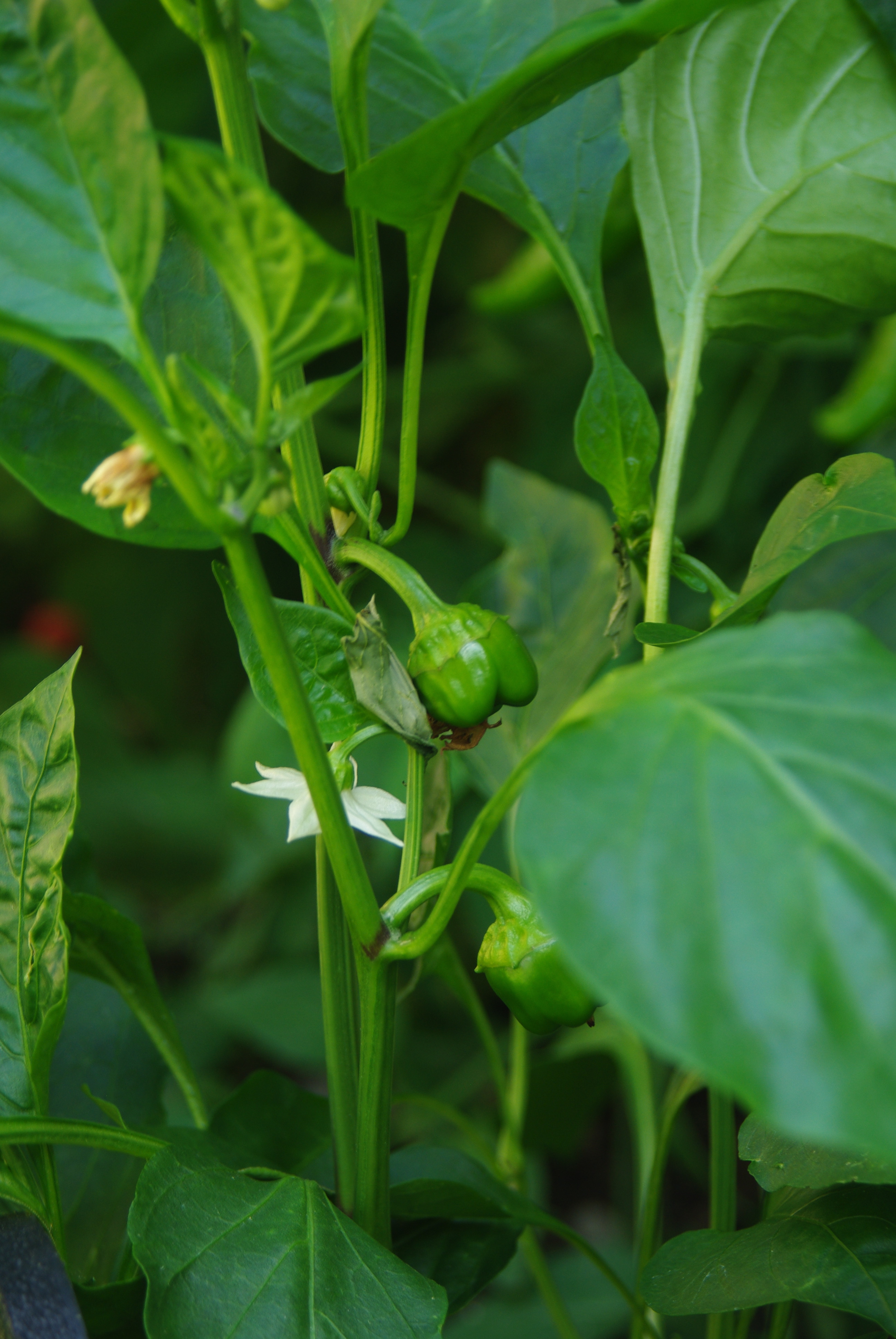
Yes, that is it. That miniscule thing that looks like a green butt. Obviously, my dream of fresh-from-the-garden roasted red bell peppers will not happen this year. Do you want me to let you in on a little secret, though? Next year….I’m planting in the front yard. You heard me right–ripping out sod, putting in veggies instead. Our neighbor just cut down the big cedar tree that used to shade and kill our grass, and now it just gets massive amounts of sun. Furthermore, it’s elevated from the street level which cuts down on dogs and such wandering through and urinating on our future food.
I did have more success with flowers, though. Check out some of the cool dahlias that grew:


Pretty, no?

The boy and his girl friend A took a trip to the pool over the weekend. As they lounged together, Eric overheard their conversation:
The boy: “Hey A, let’s play family!”
A: “Okay.”
Boy: “I want to be the mommy, and you can be the daddy”
A: “But I want to be the mommy!”
Boy: “That’s okay, we can be two mommies!”
Love it.
This post is a bit belated, I know. Anyway.
Every fourth of July there’s a children’s parade here in Denver. The boy rides his push bike and it’s a lot of fun. At the end of the parade is a picnic and a bouncy castle! Last year they had free ice cream cones, too. This year they had a 250 foot long ice cream sundae and handed people spoons to dig it out of a communal trough. We found this sort of gross and left before the kids started clamoring for a spoon.
Of course, it can also be fraught with peril, as this video demonstrates:
After a very quick recovery, the boy was good for the parade.

Part of the fun of the parade is that it’s a community gathering, and as such you run into many friends and neighbors. We ran into some good friends of ours who are the parents of one of the boy’s closest friends since infancy. At the park afterwards, they played together.

On the grid

Happy!

Bouncy Castle

Slide races
The water balloon toss was fun, too. You can just see the boy’s toes and hand in this picture on the right-hand column about the fifth person down, bright green shirt.

And the girl just hung out on the sidelines in her pre-walking days, finding other people’s smartphones and chewing on them.

This is our second year now and I think it’s going to be a yearly tradition, at least until the kids tell us they’re too old or cool for it.
My sister basically told me that my next post had better be cheerful after the last depressing one left her unable to move for the rest of the day, eating Junior Mints and watching “Million Dollar Baby” over and over, wallowing in the sadness.
So here it is. An early pick up from school, a hot afternoon, a great idea from Sapana, and here are the results:


The girl wasn’t nearly as impressed. After stepping into the grass with some trepidation:

She quickly realized this wasn’t for her

and found a more comfortable position.

All in all, a great way to spend one of the last few summer afternoons.

The other day I had a pre-med college student shadow me for a morning. Shadowing a physician has got to be one of the most boring things in the world. I mean, I walk around, I talk to people, I write in a chart, and I think. She gamely took a lot of notes and seemed really interested. I was struck by how idealistic she was about medicine, and sometimes she asked me questions that I’d long ago stopped asking.
Like, “How did it feel when your first patient died?”
My initial response was, truthfully told, “I honestly cannot remember the first patient I had that died. Most people who I see die are the elderly who are near the end of their lives, and in some ways it can feel natural. It’s hard when younger people die, those whose time isn’t really up.” I doubt I said it quite that well, but that was the sentiment.
Still, it bugged me not to remember the first patient I had who died. Then I remembered, not necessarily the first patient that died, but the one that affected me the most.
There was a young woman, J, in her late thirties, or perhaps early forties. She had woken up with a bit of a headache, sort of like her usual migraines, and not thought much of it. As the morning went on, the headache got worse and she went into see her primary care doctor. When she was there, he noticed that her face was droopy and she was slurring her words. He sent her into the emergency room, telling us that it was probably an atypical migraine. The CT scan showed a very different picture and by the time we went into see her, her entire right side was paralyzed, and she was terrified.
Her mother had died at a young age of a massive stroke, leaving J behind with her two sisters to be raised by a single father, not an easy thing in those (or any) times. She had recently started birth control pills, which unbeknownst to her had made her blood more likely to clot and caused the stroke. She likely had had an underlying blood disorder that made her blood more likely to clot alone, and the contraceptives just exacerbated it.
At that point in a stroke, it was too late for her to receive the potentially life-changing powerful blood thinner that can break up a clot–it is only given in the first three hours after the onset of a stroke, and J hadn’t sought medical attention immediately when her symptoms began as she quite reasonably didn’t even think of something like a stroke. At this point, there was nothing to do but admit her to the hospital and wait to see what happened.
Over the next few days, the extent of the stroke became clear. By the next day she was no longer able to speak coherently. Her husband, B, had been at her side the entire time she was in the emergency room, and now he returned with their three daughters. As the next day went by, J slipped further and further into a coma, and eventually was brain dead.
I remember the attending physician, the surgical resident, medical resident, and myself, at that time a third year medical student, huddling in the hallway outside of her room and looking at each other with grim faces, understanding that she was going to die. Everyone was monosyllabic in their sadness and sense of loss. The attendings were trying to decide who would go and speak to her husband. I remember asking, “Has anyone talked to him about organ donation?” The medicine attending looked at me and said, “That’s a good idea.”
I assisted the surgical resident in the macabre task of putting a central line (a large IV catheter) into J’s chest to continue delivering fluids and nutrition to keep her body alive until the transplant team could arrive. I don’t know exactly where all her organs went, but I know that she was able to donate her heart, kidneys, lungs, liver, skin, and possibly other things. Other than the massive stroke, she had been in excellent health.
The last memory I have is walking past the waiting room after the transplant team had come and gone, after J had died, seeing her husband in the waiting room holding their three daughters while his father-in-law watched over, not believing this most impossible repeating of history.
I’ve had an affair. With my knitting, that is. I picked up a quick, instant gratification crochet project that is nearly done. Don’t tell the needles I’ve been a hooker. (okay, okay, I can hear you groaning)
Back to the knits, though:
Here’s a sweater (ravelry link) that I’ve been working on for a while. I’m using Elsebeth Lavold Silky Wool which is, as you might guess, a silk/wool blend that is incredibly soft and also slightly tweedy at the same time.

I’m knitting both front pieces at the same time, which keeps the decreases symmetrical and the lengths exactly the same. It takes twice as long to get a finished piece but then, well, you’ve got two at once! As with the Steggie sweater, I pin them together in the middle so I don’t lose track of which side I’m working on. It’s a adult sweater that I’m knitting out of DK wool, so it’s going to take me a while, I know, but it’s a simple project and really, it’s very soothing to work on a large stockinette project as opposed to a complicated lacy thing.

I’m realizing that picture is a bit suggestive. Who says knitting can’t be sexy?
The Steggie sweater is coming along as well.


All random parts in the first and a closeup of the sleeve in the second with the spikes on top. If you click on the picture and zoom into the cuff, you can see the advantage of the invisible cast on. The ribbing looks like it just ends without a definitive cast on row and looks very cool.
I’m halfway through the second sleeve and then all I have to do is sew (yuck) them all together and knit the hood. The boy keeps bugging me about this–he really wants to wear it, and now that the weather is beginning to change I suppose I’d better hurry up so he can wear it for the fall and winter.
The girl is a little late to the world of bipedal locomotion, but has finally arrived and now there’s no stopping her! Unless there’s a blueberry around, and then she makes a beeline for the plump juicy blueness and proceeds to cram handfuls of them into her mouth at once.


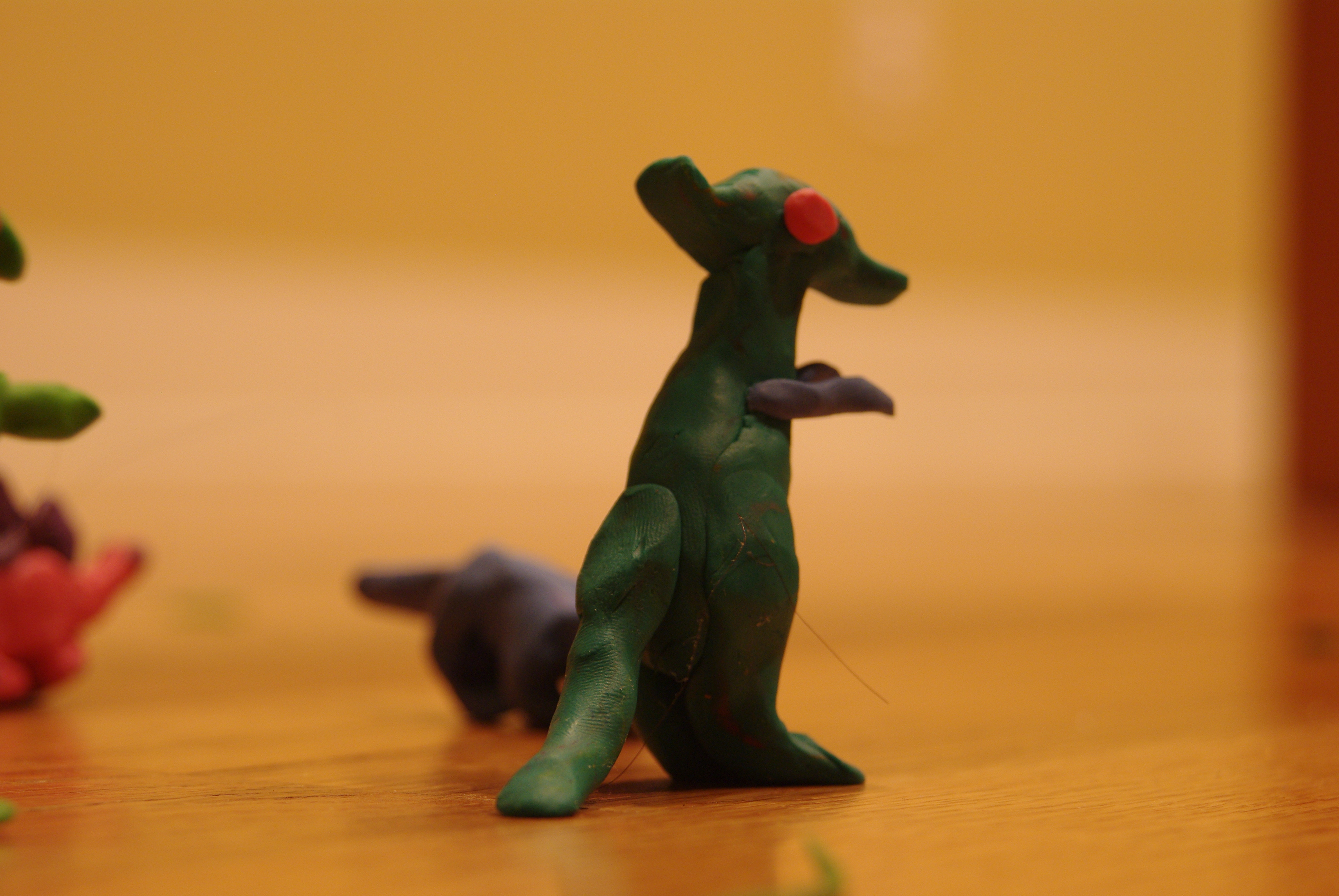

 fretzes on the loose