In which I learn a lot about rice farming, and drink something excreted by a cat

We awoke to have breakfast at the villa before our tour, a delicious choice of nasi goreng, pancakes, or an omelette served with juice and coffee or tea. The kids have developed quite a taste for tea on this trip and have a cup of black tea with milk and sugar every morning. I asked a doctor if this was okay by looking in the mirror and saying, “Self, is it okay for the kids to have black tea?” And then doing what every doctor does when they don’t really know the answer: I googled it. I’m sure that’s not very reassuring to some of you, but it’s the truth if we don’t have access to UptoDate. Google told me it was okay. Mostly.
We met our fantastic guide, Putu and we were off. This was the second or third Putu we had met, and I’d also seen many businesses with the name Kadek and Ketut around Ubud. I asked if these were common names, and Putu told us that in Bali, names are given according to birth order! Putu/Gede/Wayan is a first born, Kadek/Made is second, Nyoman is third and Ketut is fourth. They also have a given name which follows the order name, but everyone is called by their birth order name primarily.
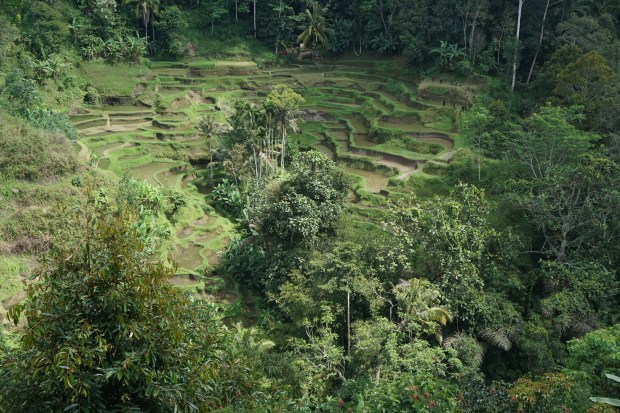
We first went to the famed Tengallalang rice terraces. These are absolutely stunning, not only in their beauty but also their engineering, which is mirrored in all the rice terraces seen in Indonesia. THe girl loved these and frolicked about jumping up and down the levels,until she plunged knee deep into a mud pit. She took a mini bath in the little waterfalls that dot the terrace.

img_1102

The rice fields are terraced in an ingenious method of overflow irrigation. Given that Bali is a wet country with much rainfall and many sources of natural spring water that come from up high, there are irrigation ditches dug around the towns everywhere. I initially thought these were open sewers as this is how they look in India, but it’s actually clean spring water and you’ll see people doing laundry or bathing in the water. The small fields have little outlets dug into the edges to allow water to flow into each subsequent paddy, finally meeting at the bottom in a river. The farmers manage the amount of water each paddy needs by opening up or closing the little outlets with some more mud.  You can see one of the openings in the picture below.

img_1101-1

There are strict water rules in Bali, for instance damming is forbidden as all people need the water flow to feed their rice paddies. The large fields at tengalalang are owned by a community of more than 50 farmers, but most fields you see around are owned by fewer. Once the rice is planted, it doesn’t need a lot of work until it’s ready for harvest, and so most farmers have another skill, such as a handicraft, to earn money since the rice planted in these fields is used mostly to feed their families and is not sold.
After this we visited a coffee plantation and visited the civets. As you may know, the civet is an aggressive jungle cat that eats coffee berries and then poops out the bean a short while later and supposedly the process through the digestive tract makes for a delicious pot of coffee. They collect the beans, clean them, roast them and grind them into a potent coffee. There are concerns over the treatment of the civets – they’re kept in relatively small cages and really, they don’t look happy. My curiosity won the better of me though, and I had to try a cup. I found it to be very dark and almost syrupy in texture, and for an hour or two I felt particularly virile. Rawr. Behind the plantation was another spectacular rice terrace.
DSC03283.JPG

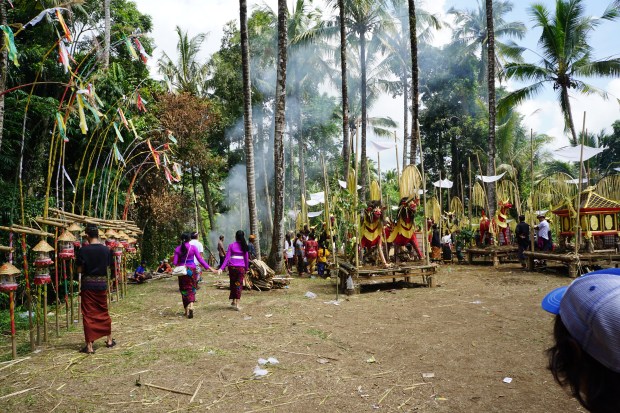
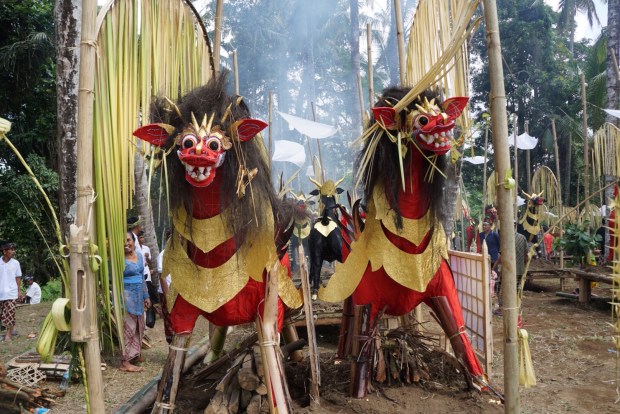
On our way to the first temple, we happened upon a village having a cremation and stopped to visit, more successfully this time, with Putu along to explain. Turns out the large papier mache animals are what the disinterred bones are put into for burning. Each platform is what becomes the pyre itself, and the drawings on the sides of the platforms are meant to represent hell so that we are reminded what happens if we do not behave well in this life and suffer bad karma. It was clearly a large town gathering and many of the village’s residents were out in their dressed up clothes for the event. There wasn’t any actual cremation taking place, because they don’t start the burning until after noon. Aha! This is why nothing was happening at the Ubud cremation either! We were too early.


DSC03298.JPG

img_1103-1img_1104

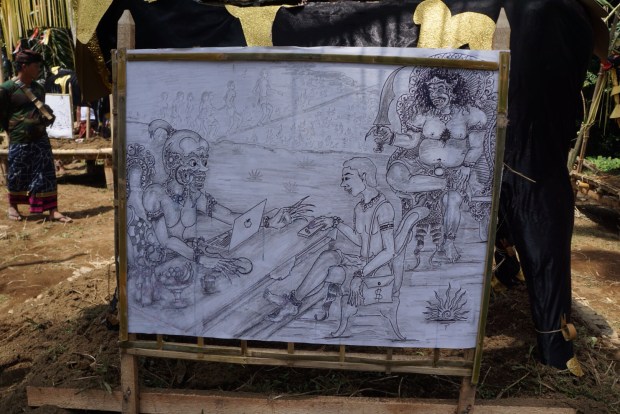
I particularly like this depiction of hell, where we give money to the devils who run the internet.

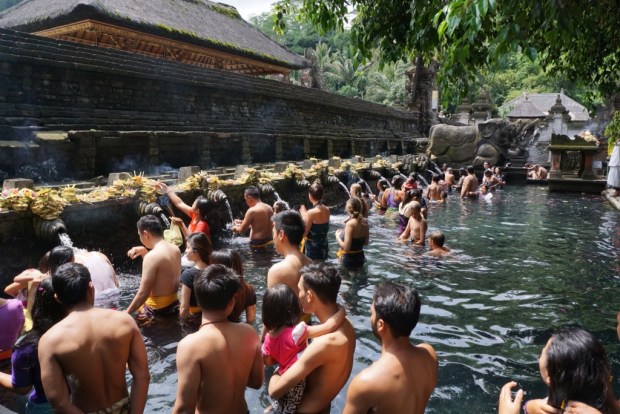
After this we visited the holy spring water temple, where fresh spring water comes pouring out of a row of pipes into a pool, and Balinese and tourist alike come to make their ablutions.
img_1105img_1106-1

These temples are living temples where Balinese regularly come to worship and leave offerings for the Gods. What I found interesting is that on the offering piles to all the Hindu gods were plenty of roast animals! Unlike India, where most Hinduism comes with a side of vegetarianism, that aspect did not make it to Bali. I guess when Ganesha tires of having ladoos and moduk for prasad, he makes his way to Bali for some roast duck!

img_1107-1

The whitish tower in the picture above is carved from pork fat and little satay skewers of roast pork surround it, not to be outdone by the whole duck in the lower part.

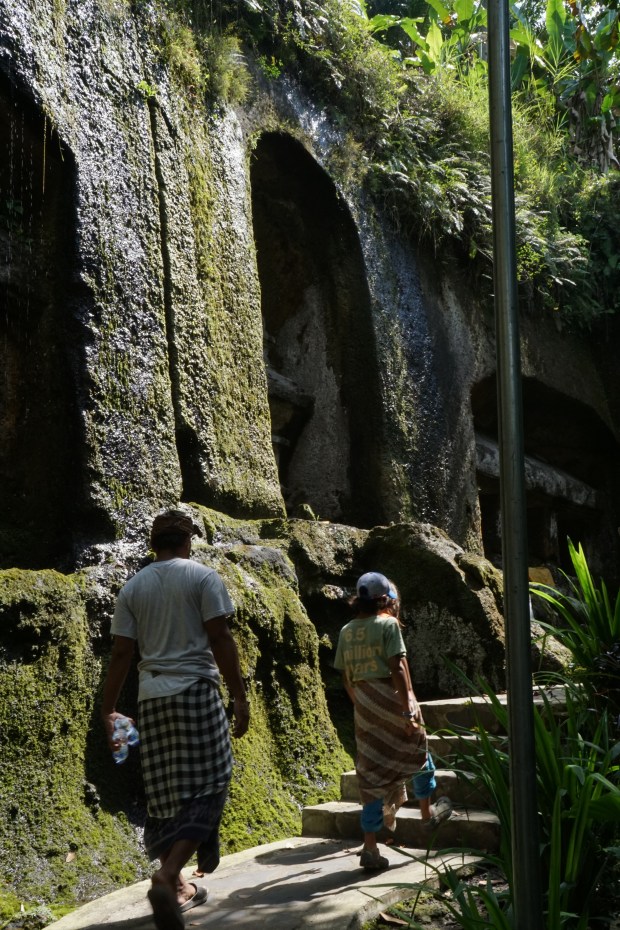
Then to a second temple – the rock temple, an ancient temple carved out of the existing stone with many stone steps to take us downward. This is one of those off a movie set, where decaying stone walls are covered with moss, rivulets of water flowing down the side.
DSC03321

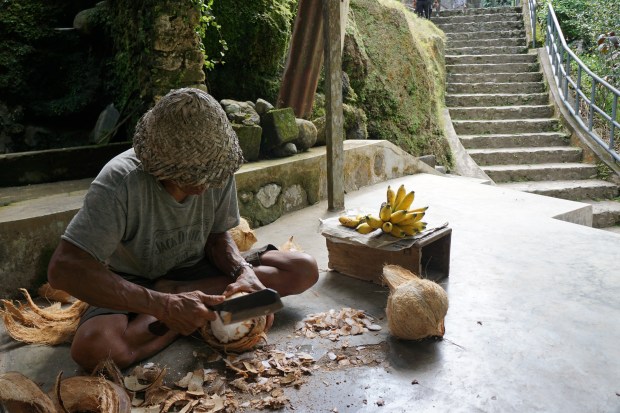
Honestly, we were getting a bit templed-out at this point. It was hot and humid and we felt like we were melting with our clothes sticking to us. On the way out, I purchased a coconut and drank some refreshing water and then nibbled on the meat.
DSC03338.JPG

Our next stop was to the woodcarving area of Mas, where we had driven by on our way from the Airport and fell in love with the large slabs of wood seemingly carelessly stacked in an open air warehouse. How would one of those look as a dining table, we wondered to ourselves? Hmmm… We took a few price quotes and left to ponder the decision.

img_1108

During the day, Putu told us much about Balinese culture and philosophy. All of Bali is focused on your bandar, or community group. Every community has a meeting area and a temple and the rules for how one becomes part of a community through marriage are specific. As Eric talks about in his post about Bali and driving, one of the reasons that we don’t see the aggressive and angry driving you see in the States is because there’s a chance that you may know the other person through few connections, and you’re just not rude to your neighbor. We had a later discussion talking about divorce in the community, which is a difficult thing. The woman fares the worst – first, the couple has to go in front of the elder at the community meeting and discuss the divorce in public. If there is no success with reconciliation and the divorce is granted, the woman is left without a house and has to leave the community as well. If her children are under five, they may be able to stay with her but if not then she would lose custody as well when she had to leave the community. I can see how this can help to stabilize the community, but I couldn’t help but wonder about women who were in truly difficult situations and how trapped this would leave them.
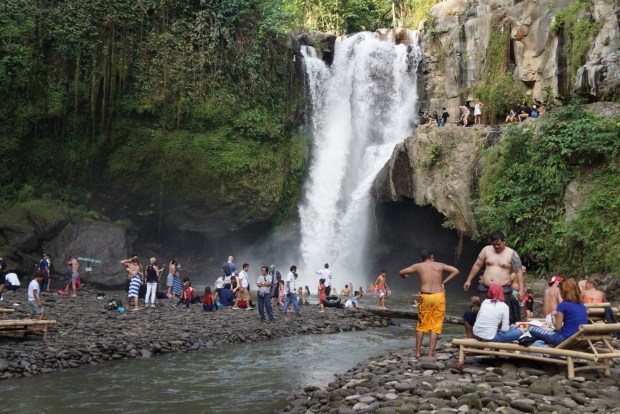
Last place to visit was a waterfall swimming hole. This was awful – there was no place to swim because there were so many people in the swimming hole, plastic trash floated about the base of the river. The tourists there were loud and partying in a most obnoxious way. We took one look, walked around the site and left. Especially after the beautiful and clean swimming holes in Australia, this was not a place we wanted to spend another second. We hustled back into the car to return to our peaceful villa for the night.
img_1109

-s

In which I follow the signs and apologize to the crocodiles.

Well, what can I tell you about the Litchfield park tour that the kids haven’t already done? The crocodile feeding part of the tour was touristy for sure – I did read ahead of time that the jumping action that is exhibited is a natural one for the crocs. They also feed them very little for a crocodile and make them work for it, so it’s not their only source of food, and of the over 6000 crocs in the river there’s only about 150 that feed from them and even those feed sporadically with the tour, so there’s plenty of wildness around. I loved the experience, and especially seeing the raptors feed up close, though I have to admit I feel a little weird about the whole thing hence the need for me to justify myself. It’s just not totally natural. But, oh man, I will never forget the sound a crocodile’s jaws make when they snap shut. 

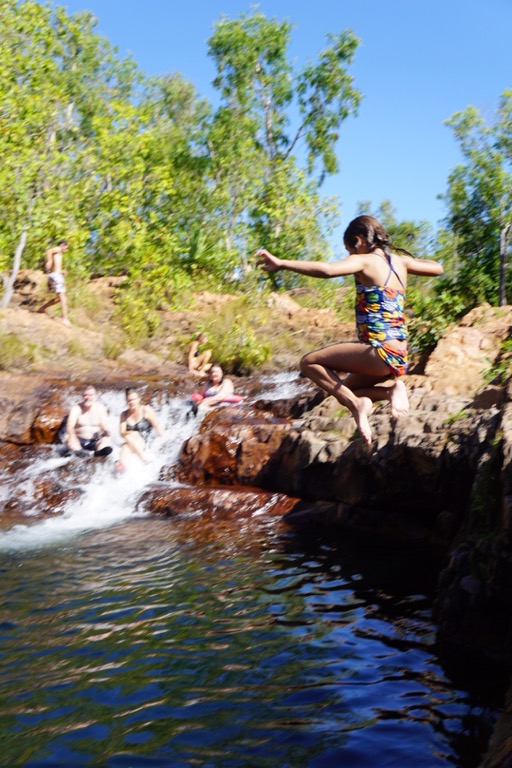
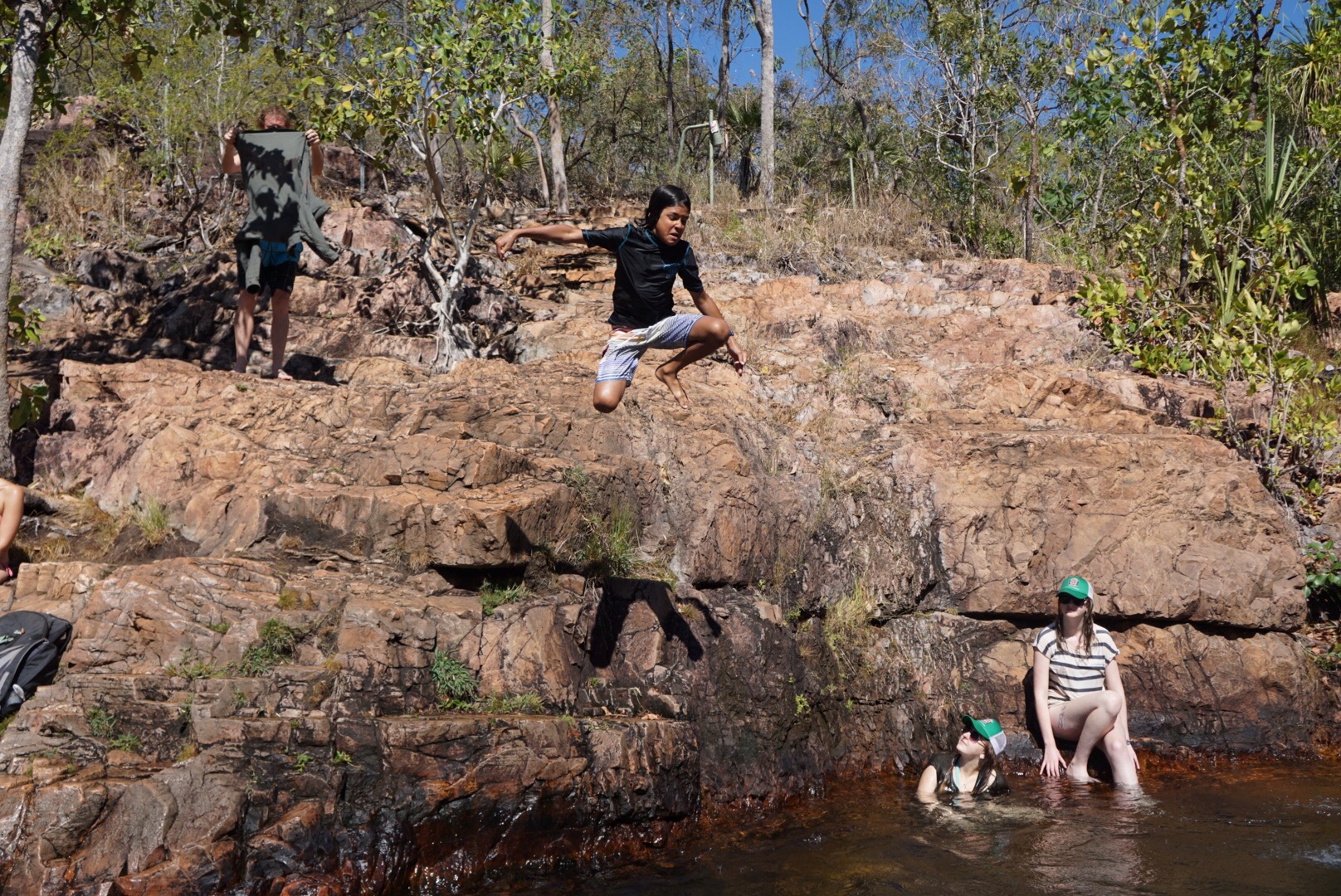
The other part of the trip was visiting the swimming holes, which were absolutely stunning. I’ve never gone somewhere where you jump into a natural pool surrounded by waterfalls that feed into it. Fun fact: it’s the dry season and hasn’t rained in months, but the waterfalls are fed because the stone surrounding them is a porous sandstone that soaks up water during the wet season and then releases it during the dry! The second stop was especially nice, where there was a 10+ meter deep pool that the kids could jump into, and they did, over and over. 


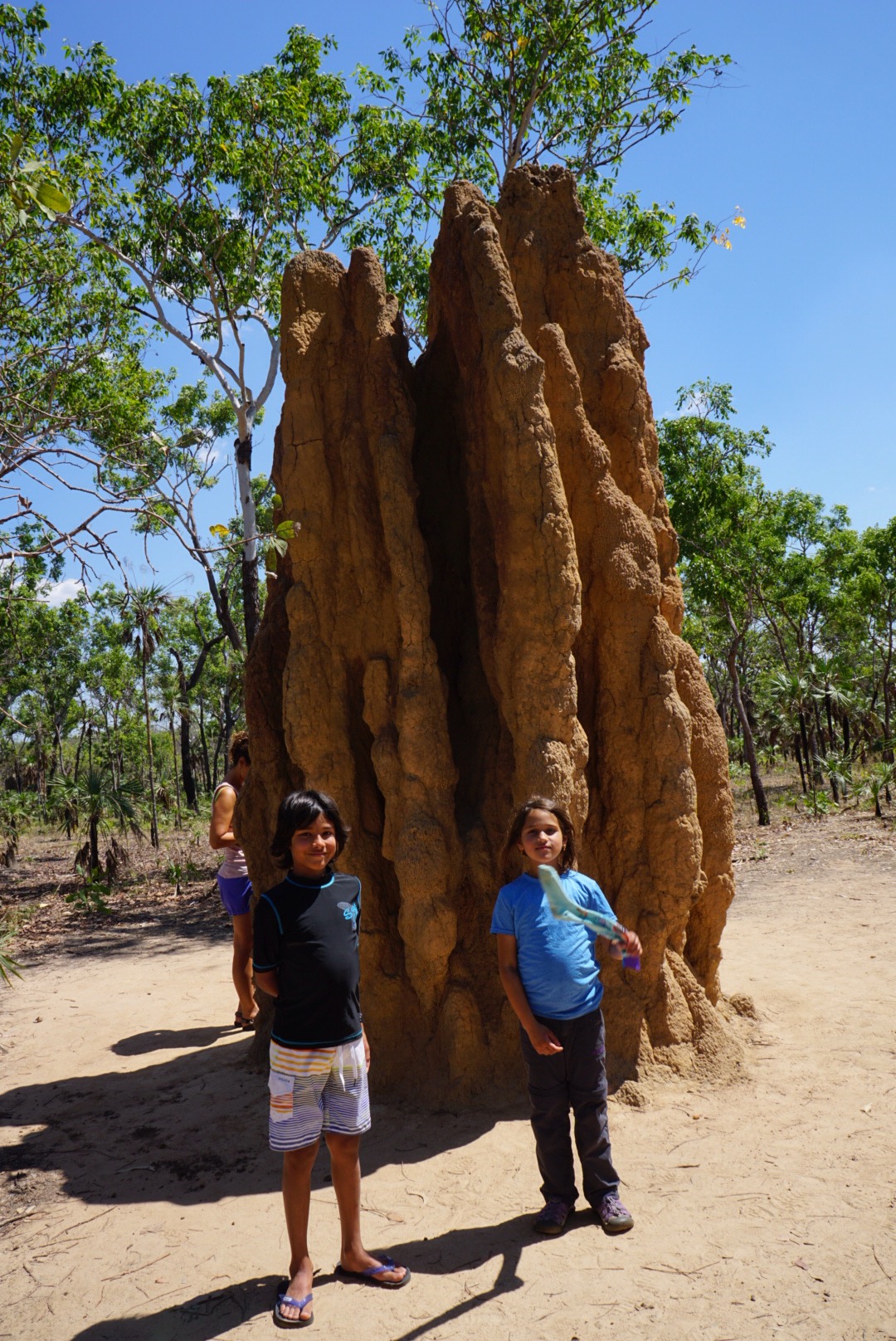
And seeing the massive termite mounds was a thing to behold! There were some fresh areas that the guide crumbled away to reveal scurrying termites, who would have the hole repaired in fifteen minutes. 


The next morning we went to the excellent Northern Territory Art Museum, which has wonderful examples of indigenous art both historic and contemporary. You can really see the differences in the art from different areas. Northern Territory art was done on eucalyptus bark, and used natural pigments and many fine lines as well as larger figures drawn with the same fine outlines, whereas more centrally was the dot paintings which I talked about earlier. Upstairs they had an exhibition of Aboriginal art award winners from a yearly contest – here is one with the artist’s explanation. I love the mixing of modern heroes and ideas into with the traditional dots and plants/myths. 

What we did in Australia was the equivalent, geographically, of flying from San Diego to Seattle, then to Utah, then to Chicago. Think about how different all those places are from one another, and it’s not hard to see the ground we covered here. It’s a big continent! I loved Sydney, Port Douglas and Uluru. Alice Springs was a good place to visit but I wouldn’t want to stay there long. Darwin, our last stop, I found somewhat charmless. Perhaps its the large number of tourists, but people there weren’t particularly friendly overall and the town is poorly laid out. That was the one place I wish I’d done a bit more research on before just staying there for 4 days – I would have instead done a longer jungle tour for a few days or maybe a 2 day tour into aboriginal country instead. One little thing I want to remember to mention is that in Oz and NZ, every single plug had it’s own little on /off switch attached to it. You couldn’t just plug something in, you had to turn on the actual outlet. I wondered if this saves any electricity or not, because if not it was an annoyance. 
Something my dad pointed out to me which I hadn’t realized is that with my trip to Australia, I’ve visited all the continents except Antartica! I guess I know where I’ll be going the next time I take off for an extended trip! 

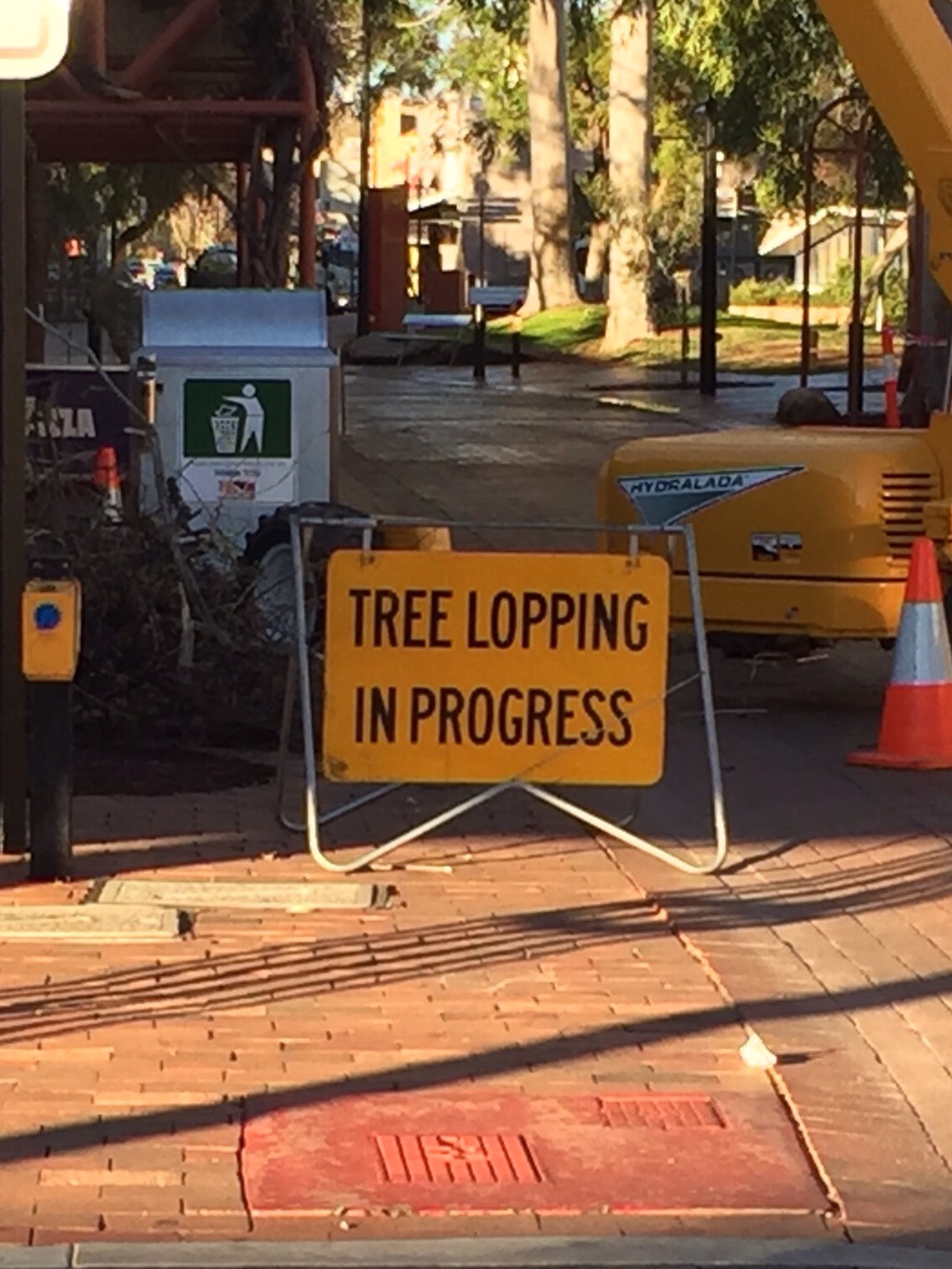
I’ll leave this post with some of the road signs I’ve seen along the way so far, and will then catch up with our trip in Bali.


Doesn’t lopping just sound refined? Also, I think the crane and chainsaw would have been a giveaway even without the sign. 


So, there’s trucks on the road? Imagine that. MIght have been nice to see this sign BEFORE i had to pass ten of them. Then I could have been mentally prepared. 

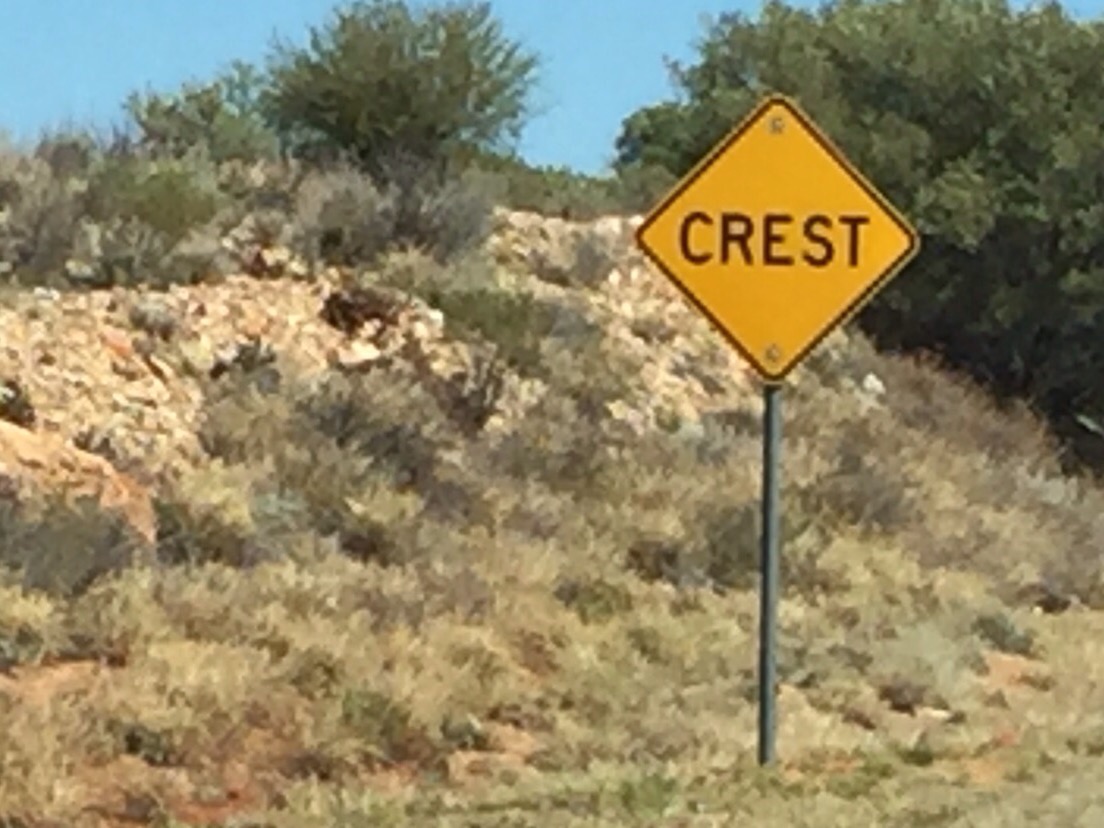
The road! That hill! There’s an end to it! and usually it was about 100 meteres up ahead. I really thing this is a stealth campaign by proctor and gamble to break the monopoly that Colgate has on the Australian market. 


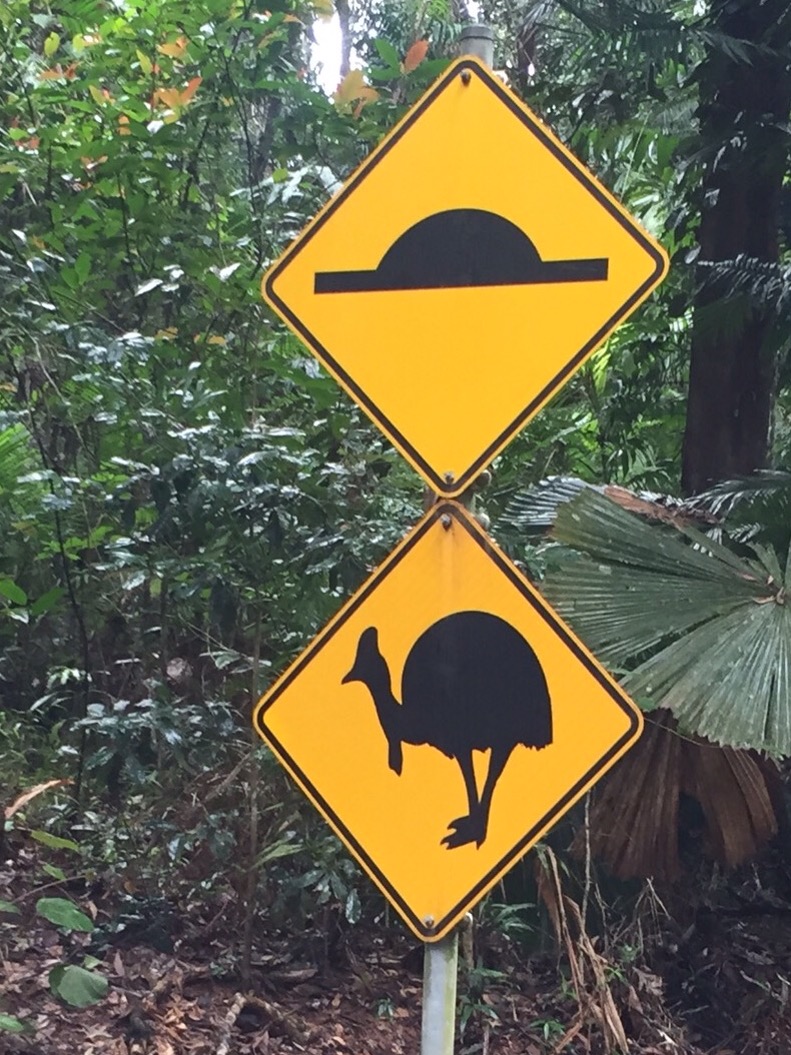
Speed bumps and cassowaries. You know, the usual. Driving skill: making sure the cassowary doesn’t become the speed bump. 

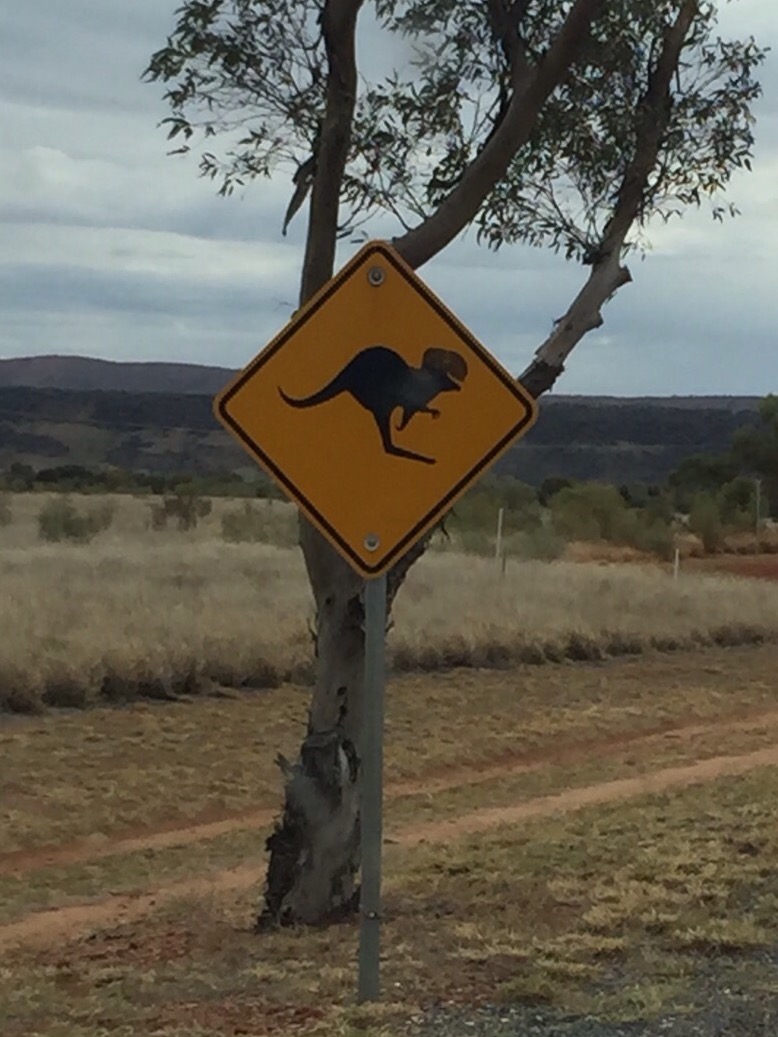
We saw neither scale of T-rex nor hair of wild kangaroo, despite the signs. It was a disappointment not to see either. 
 

-s

In which I reflect on what’s worked so far, and what hasn’t. 

We’re in Darwin now, at the tip of the Northern Territory in Australia. It’s true tropics here – 88 degrees and humid. In our time in Australia we’ve gone from the damp cold winter of Sydney to the warmer tropical Queensland, then to Red Centre Desert and finally here. I’ve realized that our days fall into one of three broad categories : Traveling, in which we are on the move from one place to another; Touring, in which we are actually looking about at things; and Vacation days – where we just chill for a day and do very little of anything. Yesterday was a travel day, today is a vacation day, so I’m going to use it to talk about some other travel details of what’s worked so far and what hasn’t, inspired by a friend’s recent post of the same. 
What’s working, in no particular order. 
1. Travel cubes: The little travel cubes I purchased to keep our clothing compartmentalized in our backpacks are a dream. Without them, everything would be crammed into one large compartment and it would be impossible to pick out something you needed without destroying the contents. I bought one cheap set off ebay for $10, but the zippers are cheap and I think it’ll break. I spent a bit more – $20 on 2 more sets from Amazon and they’re much sturdier. Great buy. I thank every travel blogger who suggested them.

2. The backpacks: I’ve been very happy we have these as opposed to suitcases. One thing I didn’t anticipate is that in Australia and New Zealand, all packs have to be less than 7 kg to carry on. We made this happen for the first international flight by switching stuff around, but since then have been checking mine and Eric’s bag for the domestic flights and making sure that the boy’s backpack is under. 

3. The clothes: For the most part, the clothes we bought have worked out very, very well. The only time I’ve been disappointed in what I brought was when we were in Sydney and I felt woefully unfashionable and really like an American Tourist (fanny pack and all, see below). I suspect I’ll feel the same once we get to Tokyo too, though I’m guessing I could wear the most stylish clothes I own and still feel like a frump. 

4. Trip pacing: NZ was a bit fast, but expected. Everywhere else we’ve had one day after travel to have a down day and then start touring again. This has worked very well for us overall and as such we aren’t feeling travel burnout. Yet. I just asked the kids and Eric and they all said that this is their #1 thing that has been done well.

5. The degree of planning: Again, for the most part not having things entirely booked in advance has worked out very well for us and allowed us to maintain flexibility – if we weren’t up to a tour one day, we didn’t have to do it. In Darwin, I do wish maybe I’d booked a couple days out at Kakadu National Park, but perhaps it will all work out for the better, see “trip pacing” above.

6. Food: we mostly eat dinners in because it’s easier and it saves money, at least here in Australia and NZ. We’ve had some delicious food out as well, but when we can plan simple dinners at home especially after a long day of doing stuff, everyone is happier, including the parents! (Side note: everything here is made with full cream, real butter and while delicious, is also giving me a bit of a spare tire. Oof. Guess those pilates classes really were helping me at home.)

7. The technology: Discussed in an earlier post. Caveat – I couldn’t justify the money but I do wish I had a lighter ipad to truck around. It is by far my heaviest item. 

8. The kids: Have really been fantastic the entire time overall.  They have their moments, sure, but no more so (and possbly less) than they would have at home. Lesson #1 – Make sure to keep the boy fed else he turns into a gremlin. Of cranktaculousness. Yes, that is a real affliction. 

Things I wish I’d done differently:
1. Products: In the largely humid environments, bringing any sort of facewash/lotion/etc was a mistake. Our skin and hair is completely different then in arid Denver, and everywhere we’ve been has provided anything we’ve needed. This was an unnecessary source of weight. Some of the pricey ones I brought have been shipped home.

2. Bags: Eric’s backpack has a small zip off backpack he can use for when we are in cities, which mine doesn’t have. We brought a second small backpack but it’s cumbersome when traveling to wear that one on my front for the plane and then the bigger one on my back. It would have been nice to have a mid size one strap backpack for moving about that I could put my camera in also. I bought a cheap messenger bag at a Kmart here and that’s been better, but not really ideal. I have a smallish travel purse that can be and I have, sigh, converted to a fanny pack. It is SO much easier than having a purse flopping about you and my hands are free. 

3. Journal: I brought a journal to write in. Who am I kidding? I don’t write in journals. I put most everything here. Aspirational but heavy. Haven’t sent back yet, will see. 

4. Weather: Man, it was colder than we expected the first week through Sydney. We had warm enough clothes and all, and knew it was winter and wouldn’t have changed going there, but we were definitely glad to get out of the cold. 

Things lost:

1. Kiwi printed gloves, purchased in NZ. Left on the plane by the girl in a fit. 

2. The boy’s kindle, twice, recovered both times. I was wrong about who would lose theirs first! 

3. Once left in a rolled up sleeping bag, once left in a hotel room. We are TERRIBLE at sweeping hotel rooms when we leave. You’d think we’d have learned better by now.

4. A very nice headphone jack splitter with 6 out jacks so we could all watch movies/listen to audiobooks together. This was a bummer. We’ve bought 2 smaller splitters we stick together to give us 3 outs, but it’s not as good. Left on the plane from US. 

5. Nice set of markers, the girl’s. Who knows. 

6. One electronic toothbrush, the boy’s, left in Raglan. 

7. My wallet – not really lost. Forgot I’d put it in my checked luggage and had a very nervous flight from Cairns to Alice Springs. See above about sweeping hotel rooms. 
Things given away:

1. All warm weather clothes after the Uluru trip, as we won’t have cold weather until October. We brought clothes specifically for this purpose – gloves the kids were about to outgrow, fleece sweater same, and a warm hoodie I have but is hideously ugly. Salvation Army in Alice Springs, thank you. We did not get a tax receipt. 
Things sent home:

1. All souvenirs bought up until now, except for a boomerang which didn’t fit in the box. A few shot glasses, snow globes, mug, some books, aforementioned hair and beauty supplies, woodcarvings, clothes we didn’t want to give away. The painting we bought shipped separately by the gallery. Total cost $40. Let’s hope it all makes it home. 🙂
-S

In which we drive for five hours to hear rock music in the desert

We picked up our rental car first thing in the morning given that the drive from Alice Springs to Uluru was supposed to be 5-6 hours and we wanted to get there before nightfall. The car rental company rents out complete camping kits – stove, water, pots, pans, sleeping bags and a “swag” or bush bed, which Lulubelle describes in her post here. 
We had a stop at the grocery store to pick up food for the trip, then breakfast and we were on our way! The drive is beautiful, and feels a lot like driving across the Utahn desert landscape. We have a strict no screen policy in cars – we passed the time by alternately reading, listening to the Harry Potter audiobooks, and of course looking out the windows. Street signs warned us of crossing kangaroos, but sadly, none were to be seen the entire trip. Eric drove the entire way, mostly because he doesn’t really trust my driving on fast highway sections. I didn’t complain all that much, truth be told. 
Most of us have seen pictures of Uluru at some point, a large monolith seemingly rising out of nowhere on a desert landscape, so I thought I knew what to expect. I couldn’t have been more wrong. You can’t stay in the national park itself, but there is a resort just outside with hotels and a camping area. After setting up camp we hopped back in the car and drove over to the park itself. 
As you drive into the park and see Uluru rise above you, it is a humbling sight. It is unexpectedly beautiful and solemn at the same time. 


You are aware of some sort of presence there, and it’s easy to understand why this is a sacred site to the Anangu people. We first stopped at the cultural centre which tells the creation tales woven into the rock itself, the ancestors who claimed and fought and crawled through the rock, leaving their marks in the shape of dark lines and caves upon it. I read an article that compared gazing upon Uluru to reading the Iliad and indeed, it is an epic. 
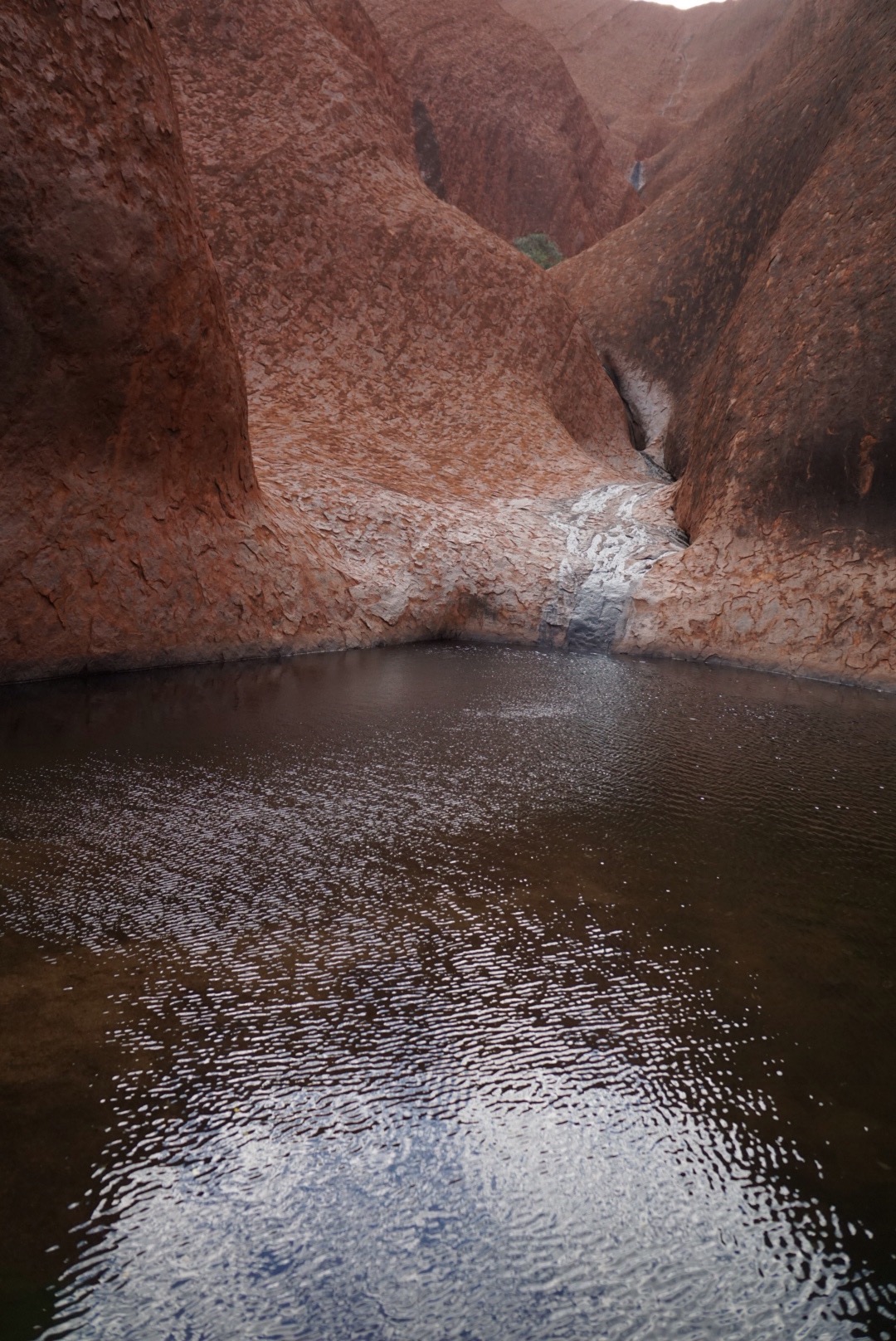
We took a short hike to a watering hole on the side, where ancient aboriginals would gather for the much needed resource. Around Uluru there are many of these sites which were known to the nomadic people during times of need. The landscape of the rock itself changes as you walk around it, with small formations found everywhere, and placards telling you of the myths of how they were created. You feel the being of the rock inside your heart the closer you are. 


After this, we drove to the sunset viewing area to watch the changing colors of the rock as the sun goes down. It is a stunning sight, and quite possibly the most beautiful sunset I’ve ever seen. As Eric mentioned, the boy was inspired to play “Space Oddity” to the monolith at the site, and while he’s posted a picture, here’s my particular favorite. 


 We headed back to the campsite and had a simple dinner of noodles before settling into our swag beds for the night with the sky as our only cover. It’s winter here, so none of the dangerous reptiles or insects are out at night, and it was a peaceful sleep until the morning cacophony of desert birds awakened us. At least for myself and the kids – Eric found himself constrained by the beds as he is a being of unusual size and didn’t sleep much. 
The following morning we took the guided Mala walk around the base of Uluru which Eric goes into great detail in his post here and then in the afternoon drove to Kata Tjuta, an area 40 km to the west of Uluru where there are multiple large rock formations and just as many myths. Kata Tjuta is traditionally a men’s only area – the aboriginal culture is very separated by gender roles and areas – however all tourists can hike through. We chose to take the valley of the winds walk, which is well named! The breeze whipped through the air around us, and I learned that the myth of the wind is that of a snake god blowing air through the valley. 
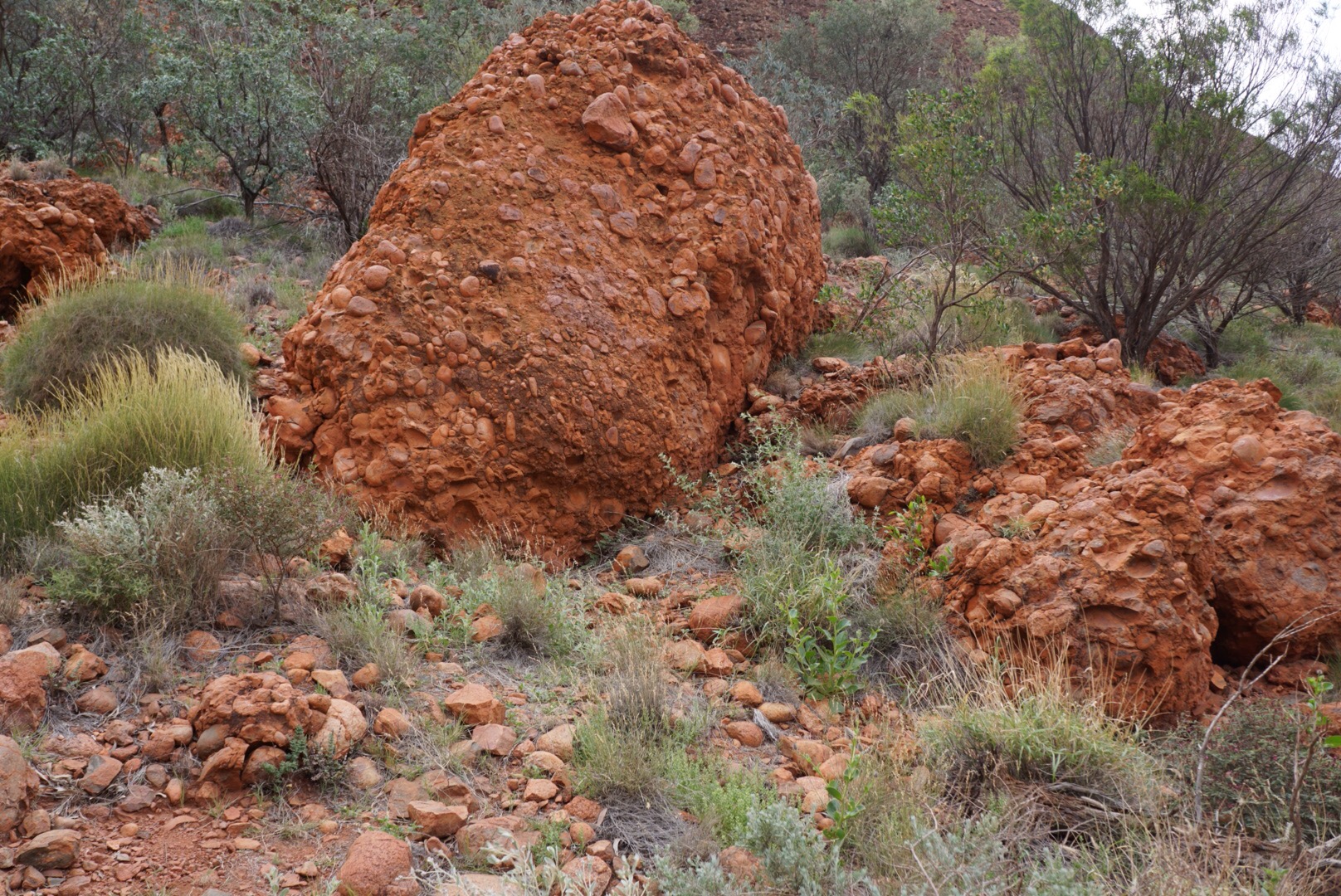
These formations are spectacular as well, and so different from the smooth sandstone appearing Uluru. There are large rocks seemingly stuck together by a dirt cement which comprise these formations. 


I later read a book on the geology of the rocks – Kata Tjuta was formed by the rapid buildup of mountains in what was once a seabed and then the surrounding areas eroded away. The seabed was wet and muddy, trapping the larger rocks in it as geologic forces pushed up the rocks. After a scramble over some rocky slopes, we arrived at our lookout point to see the vast flat landscape in front of us, dotted with large domed shapes in the distance. 


Later that day, back at the campsite, I started to get dinner together. The boy had gotten pasta and sauce…but when I looked at the jar it was actually triple concentrated tomato paste. I heard the theme song to MacGuyver play in my head, and said to myself, “Self, challenge accepted.” I crushed some crackers in a pot and added a bit of milk until it was a smooth paste. Then I melted cheddar cheese and parmesan cheese, added salt and pepper and a spoon or two of the tomato paste and ended up with a fairly serviceable tomato cream sauce! Not bad for camp cookery! 🙂 
In the morning, we took another short hike around the base of Uluru and then back into the car for the drive back to Alice Springs, all of us wowed by the three days we had just spent there. 

-s
In which we arrive at the Red Centre, and I regress to being an anthro major

We’ve been in the Red Centre of Australia for five days now, and have had two completely different trips during that time. We started our stay here in Alice Springs, then rented a car and drove the 500km (300 mi) to Uluru (Ayers Rock), camped there for two days, then back again. For me, this has been the most profound leg of our trip yet as it has also been for Eric, who writes about it beginning with his post here.
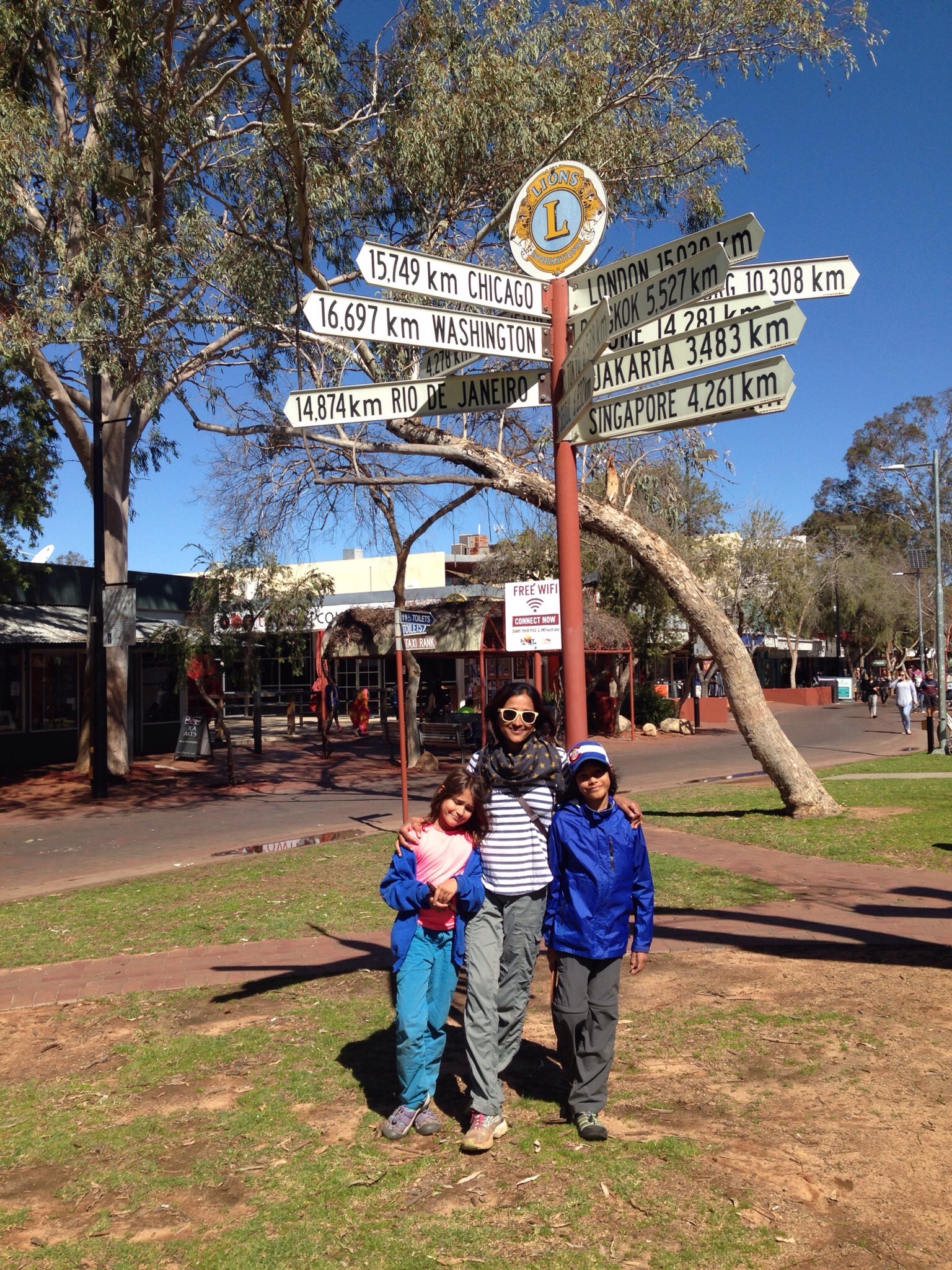
Alice Springs is a town of 28,000 people almost directly in the center of Australia. We landed in Alice Springs on a warm morning, found our hotel and wandered outside to have a look around. Tourist Alice Springs largely focuses on a pedestrian mall in town that covers 5-6 blocks and is lined with restaurants, souvenir shops and aboriginal art galleries.

just a little far away from home


 The most striking thing I noticed about the mall, however, was the clear demarcation between the tourists (almost all white) and the aboriginal people walking around. Despite it being a weekday during which school is in session, there seemed to be many young aboriginal children walking around with their families. There generally seemed to be a lot of aboriginal people walking around doing, well, not very much of anything, and obviously very poor. I had known about aboriginal people prior to coming to Australia inasmuch as I knew they existed and had been oppressed. I didn’t know much about the current socioeconomic state of Aborigines at all. (Side note: While I’m aware that there are many different language groups of Aborigines and they are not all the same, the problems facing them are similar enough for my purpose here.) 
While I’ve traveled plenty to developing countries and seen the absolute destitution of communities there, it is always shocking to me to see that degree of poverty in a developed country. The closest I’ve gotten to seeing it in the US was when I spent a month at Whiteriver, a Native American reservation in Arizona. 
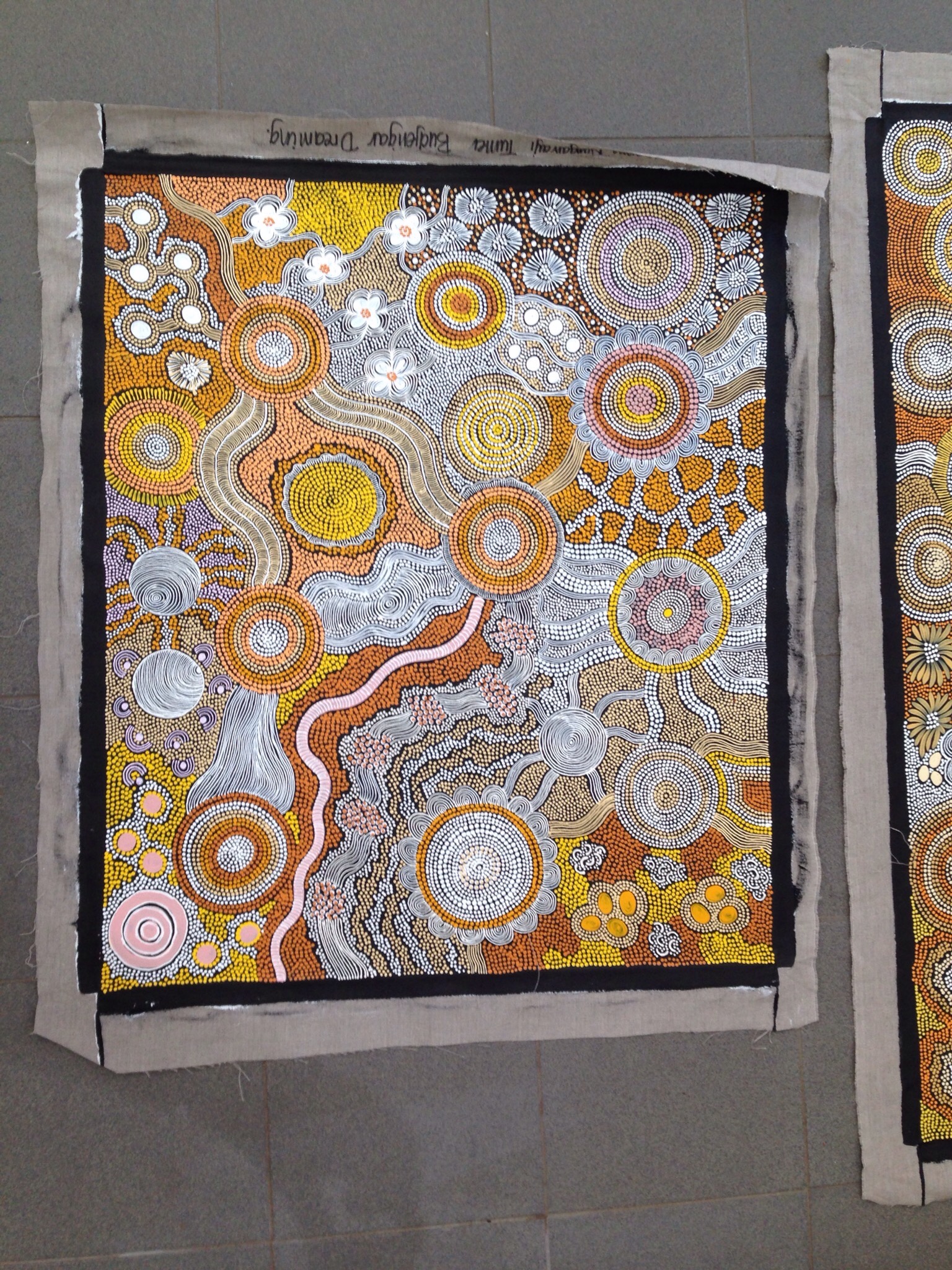
On this day we walked around the mall, finalized our car rental plans for the next day and then went to a wonderful Aboriginal art gallery which was marked by a focus on cooperation with the artists, so that they were fairly paid for their work. We spent a lot of time talking with the owners, Ric and Karl, about the art in their gallery, Yubu Napa, and how they approached the artists in a fair and respectful way and how many of the gallery owners in town would be dismissive of the artists or pay them a pittance or worse, in alcohol. We fell in love with a beautiful piece of art, titled “Budgerigar Dreaming” and bought it for our home. It represents how the indigenous people would search for waterholes in the land and the walkways between them. As it turned out, the artist is the one currently in residence at the Uluru gallery, and we were able to meet her later there, which was very cool. 

The history of Aboriginal peoples begins, over 30-40,000 years ago, though for the purposes of the current situation it starts with the entry of the British population. The nutshell version of this is that the Aboriginal people had been doing quite well for themselves until the arrival of the British in the late 18th century, who brought diseases that decimated the native population and regarded the Aboriginal people as less thaqan human. The British also began to annex land for themselves as they did not feel the Aborigines had any concept of land ownership and then drove the Aboriginal people off their prior territories. The Aborigines were nomadic to a degree but largely stayed within their territorial area – while they did not have a specific home as we think of one now, they did have a large area which was their “home base”. British people brought grazing animals to the land, which reduced resources for native animals and plants the Aborigines depended upon, and provided easy hunting for the Aboriginal people which enraged the settlers. 
Later on, many mixed race aboriginal children were forcibly taken from their families to be sent to educational “camps” and instructed in the ways of the civilized Europeans. Needless to say, these were not pleasant places to be and stories of abuse are rampant. The practice ended only as recently as 1969. Aboriginal people didn’t have the full right to vote until 1964! Does any of this sound familiar? It seems to me nearly identical to what happened in America with the Native American population there, at least when looked at with broad strokes. 

Aboriginal populations today have high rates of poverty, poor health, and a shorter life expectancy than non-Aboriginal populations. Only 59% complete education to a 12th grade level. Substance and alcohol abuse are rampant in the communities. More darkly, domestic violence, child abuse, and sexual abuse including sexual abuse of children is rampant, and felt to be under reported even so. Even worse, some of the articles I’ve read suggest that this is now so entrenched in culture that it is felt to be normal and not seen as bad by many communities. A few articles I’ve read have said that even prior to colonization, violence and abuse were part of Aboriginal culture, and that it has only magnified with the poverty and alcoholism of the current community. 

Our tour guide at Uluru, James, who is of the Anangu, said that the school in the area only went to 6th grade – for further education they would have to move to Adelaide, and even then the school located there was of poor quality. Many aborigines today do not possess a high degree of literacy, which prevents them from having jobs. Moreover, there are cultural issues which don’t mesh with the western world’s expectations – James told us of an example where he put in for his two weeks leave to go home for a ceremony. Six weeks later, the ceremony was still ongoing and had not completed, however he had to basically tell his grandfather that he had to leave else he would lose his job. When he came back, there had unsurprisingly been a lot of tension with his bosses – where had he been for those four extra weeks? Amazingly, he didn’t get fired – I can’t imagine any job where you could just not show up for four weeks! The government has now authorized “ceremony leave” for five days at a time, which doesn’t seem enough for man Aboriginals. To me, this anecdote demonstrated the significant cultural gaps that exist. Still…it’s a largely western world that we live in now and there has to be some way to find a balance between the two. 
I’m aware that all of this is from a outsiders perspective, and that I’m sure I’m barely scratching the surface of anything. The overall impression I have of Aboriginal culture is that of an impenetrable society, and yet it’s deeply sad to see people living as many of them currently are. I’m not invoking the idea of the noble savage or to suggest that Aboriginal peoples lived in a pristine world in harmony with nature and themselves before the white man arrived, but only to say that the current situation is troubling. 
-s
 

In which we find ourselves alone in a rainforest

The last thing we wanted to see in this area was the Daintree Rainforest. Listed as an Unesco world heritage site, it is the largest rainforest on the Australian continent and contains an impressive number of species in it. 
There are many tours to take to the rainforest, and while I considered these for the guided aspect, they are not cheap. Given that we’d spent a lot of cash on the Reef tour and that we could go through the rainforest on our own, we chose to drive up and see ourselves about the place. 
The rainforest is only accessible from the south by driving your car onto a ferry which ports you across the river. Immediately after you cross the river you are in dense rainforest. You can’t see further than maybe 10 feet into the forest in any direction, other than the road ahead. There’s signs all over like this: 


Which mean, “Cassowary crossing”! I’ve been taking pictures of fun signs I’ve seen here in Australia and will compile them all at some point. 
We took the first turn off and found an area with a guided Boardwalk tour and also a 2.7 km hike through the rainforest which the sign said was for “Adventurous people only.” Well, are we adventurous or not? Off we went into the muddy red trail. About 5 minutes into the trail, you are in deep rainforest. You hear loud cackling birds, small cheeps, song birds (one sounded like “pomp and circumstance”) and occasional scurry sounds. The forest floor is cool and shaded, with light just peeking through the upper canopy layer. There are no people around at all, and there were times I was pretty scared, especially when there would be a loud kee-rak cry just off to my left. The eerie thing is, because the animals all live in the canopy, you don’t see any of them, just hear them. 


We drove a bit further down and went onto a couple more boardwalk trails which are well trampled by people. My favorite was a strangler fig, a tree which grows when a bird poops in the canopy and its seeds push roots all the way down to the floor to take root and then the seeds put out vines to encircle the tree. Eventually, the original tree rots inside as the fig kills it, leaving only the sculptural cage of the fig. So beautiful.


Near the end, it seemed that we weren’t going to see a cassowary in the wild after all, despite all the road signs, but then just off to the side there one was! We pulled over to get a picture but didn’t want to get too close. There was a small cafe there and the owner and her friend came out to see, asking each other, “Is that Nelson?” “No, it’s a female.” I love that they have names for the cassowaries in the park. Lulubelle talks a bit about cassowaries in her post

That night we watched Michael Phelps win his 20th gold and the stunning USA gymnastics team, before turning in for the night and for an early morning flight to Alice Springs and our camping trip to Uluru. 

-s

In which we swim with the fishes, and live to tell the tale

As I’d said previously, the main reason I came to this part of the country was to see the Great Barrier Reef! Once we got here, it turns out that Eric doesn’t like boats and thus didn’t want to go along! He instead took a side trip to Mossman Gorge, which he talks about in his post here. 
The Great Barrier Reef is the largest coral system in the world, and is about the size of the country of Japan! It is constantly under threat from pollution, tourists (like me), overfishing and most importantly, climate change. This year there were headlines all over the world about another possible mass bleaching event due to warmer than usual ocean temperatures. Coral bleaching is when the coral, due to stress, expel the algae that lives within it and with which it has a symbiotic relationship. While bleached coral isn’t dead, it’s more vulnerable and may not recover. I was worried about heading out to the reef only to see massive fields of bone-white coral, but that thankfully wasn’t the case.
The kids and I boarded a boat and headed out. The wind speed was 20 knots or so which means nothing to me other than that the ride out felt like a roller coaster! None of us got seasick, thankfully. On the way out, we saw 2 humpback whales breaching off to the right! So amazing to think of these large creatures making their way in the ocean so close to us. It’s one of the things I love about snorkeling so much – on the surface all you see is brownish water, and the minute you put your head underneath an entire hidden world opens up to you. I’ve gone scuba diving once and loved that too, but you have to be 12 for that so it wasn’t an option this time.
We snorkeled at 3 different sites on Opal Reef. The boy did fine but the girl had some difficulty with her gear for the first dive, and kept stopping and yelling to me, “I’m having a very salty experience!!” She ended her snorkel session a bit early, which I have to tell you was fine by me since it meant I could really enjoy the rest of it. Parents, you know how it is – you can’t always fully pay attention to whatever it is you’re there to see if half your attention is on making sure your kid is okay and not, oh, drowning in the Pacific Ocean. It was beautiful underwater. There were bright parrotfish, sunfish and some little iridescent blue fish that swum about in waves. I saw giant clams, clownfish, and sea cucumbers! 
The coral, well, it wasn’t all that brightly colored to tell you the truth. Not bleached, but not brilliant. One of the tour operators gave a talk on this later – as it turns out, the bright colors we’re used to seeing in pictures are obtained by using a strobe flash and can’t be seen by the naked eye, especially on a cloudy day. If you can see bright colors underwater, that is bad and a sign of stressed coral. All the coral we saw were largely healthy shades of pale orange, pink, green and brown. I’ve read some reviews of other snorkel sites that say the coral is very bleached, and I wonder if it’s because they wrongly think, as I did, that we should be seeing luminous colors underwater. 
The second dive site was also pretty. I gave my underwater camera to the girl so she’d be more into it given her tough time the first dive… And then all of a sudden I looked down and saw one of the batteries fall out and sink to the bottom of the ocean. The camera flooded with water as did the SD card, and all the pictures I took on my first dive were lost. Sigh. I began to be frustrated by this, but then realized that I could either focus on the frustration of the loss of the camera or let it go and enjoy myself, and I had to choose the latter. Which means, dear readers, no pictures from this outing! 
By the third dive, the girl had gotten the hang of things and the sun came out and we could really see more colors of the coral! I had really wanted to see a reef shark or a turtle, but none were to be found this day. I stayed in the water as long as I possibly could, to just feel like a fish for one day and see them darting through the coral. We rode home, briny, happy and tired. 

-s

In which we finally get to warm weather and are captured by the Australian Authorities (in a way) 

We had a travel day from Sydney to Cairns, our first domestic flight of the trip! The most salient feature for me was that not a single person checked my ID. Anywhere. We arrived in Cairns and immediately felt an unfamiliar sensation…warmth. After 10 days of drizzle and cold this was a welcome change. We went to find some lunch, when the boy said his stomach wasn’t feeling well. We all knew by now where this was heading, except for Eric who said “I think your stomach doesn’t feel good because you need to eat more.” I asked, “have we learned nothing from our experience last week?!” And the boy ate nothing, which turned out to be a wise decision shortly after this. 
My main interest in going to Cairns was to be able to snorkel the Great Barrier Reef. However, whenever I told people I had planned to go to Cairns, the universal reaction was a groan of disgust. An Aussie friend of ours told us that we should at least go to the Daintree rainforest if we were going to go there. I did a little searching and found that there’s a town called Port Douglas up the coast from which one can do rainforest and reef tours, and booked there instead. Thank God. We pulled into Cairns just for a bite to eat and immediately hated it. It had all the charm of the Jersey Shore, and I don’t mean the nice part of the Shore. No one was friendly, the buildings were ugly, and you know how you can just get a feel from a place? Cairns did not have a good one. 
We got out as quickly as we could and drove to Port Douglas, with a slight pullover for the boy to throw up, after which he was much improved and immediately starving. Weird bug. Our hotel in Port Douglas is an incredibly nice 3 bedroom suite overlooking 4 small pools and with a hot tub on the balcony! Sweet! Port Douglas, as it turns out, is a tony little resort town where we fit in juuuust fine.

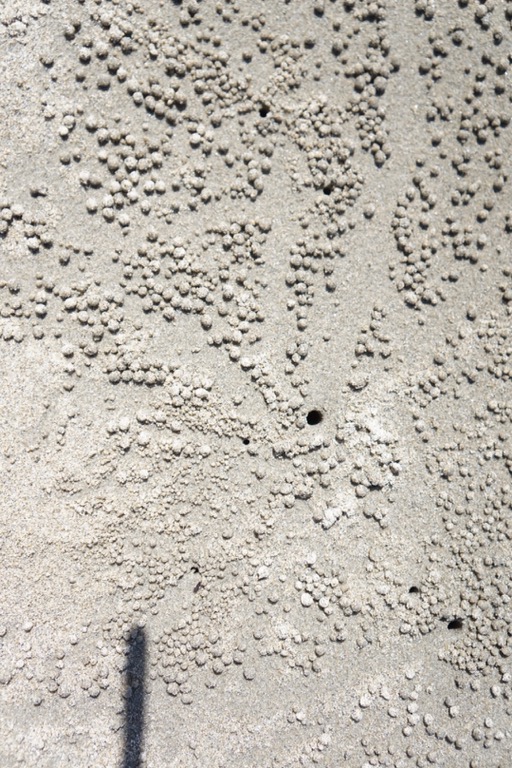
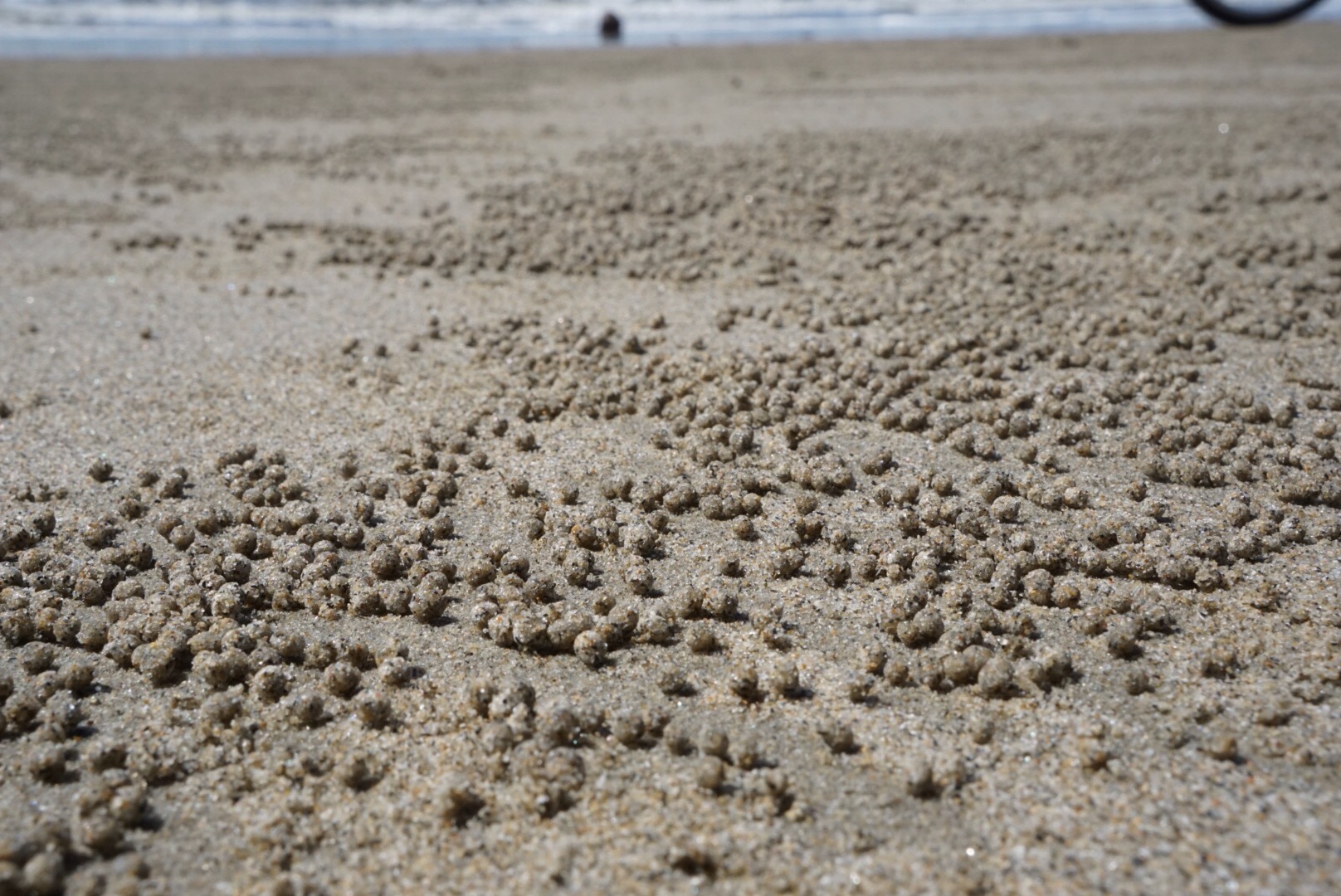
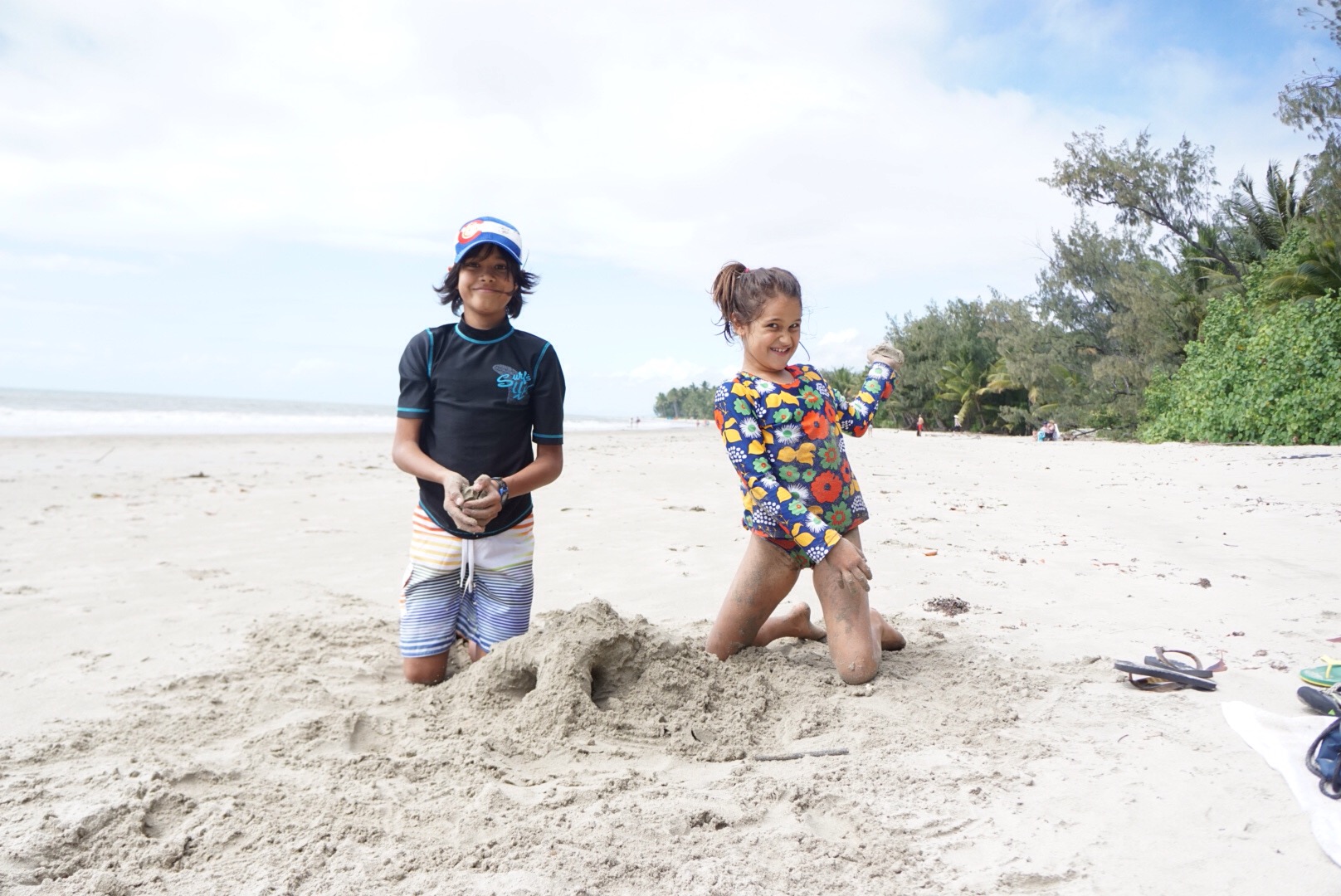
  The next day we took a day off from ‘traveling’  and just went to the beach, where we saw all these cool patterns made with little sand spheres! I later learned that these are made by creatures called sand bubbler crabs. I thought they made the little balls by digging their holes and then spitting out the sand, but it turns out this is how they eat! During low tide, they emerge from their burrows and sieve the sand for meiofauna which they eat, then expel the unwanted sand in neat little balls. As they do this radially from their burrow hole, it forms incredible patterns in the sand. They’re efficient little critters and can cover the entire beach in a few hours of low tide. 


We’ve been spending our evenings watching the Olympics, which is another experience in Australia! Given that the focus is on Australian athletes we’re seeing all sorts of fun events that are not featured at all in the US. Our favorite has becomes women’s rugby sevens! I have NO IDEA what is happening during the game, but there is SO much action on the field it is fun to watch. Also, those women are tough as shit. Especially when you compare them to the lame men’s soccer players who seem to whine and cry when they stub their toe every five minutes, it’s impressive. We’ve also watched a fair amount of fencing, horse jumping, trap shooting, and water polo! 

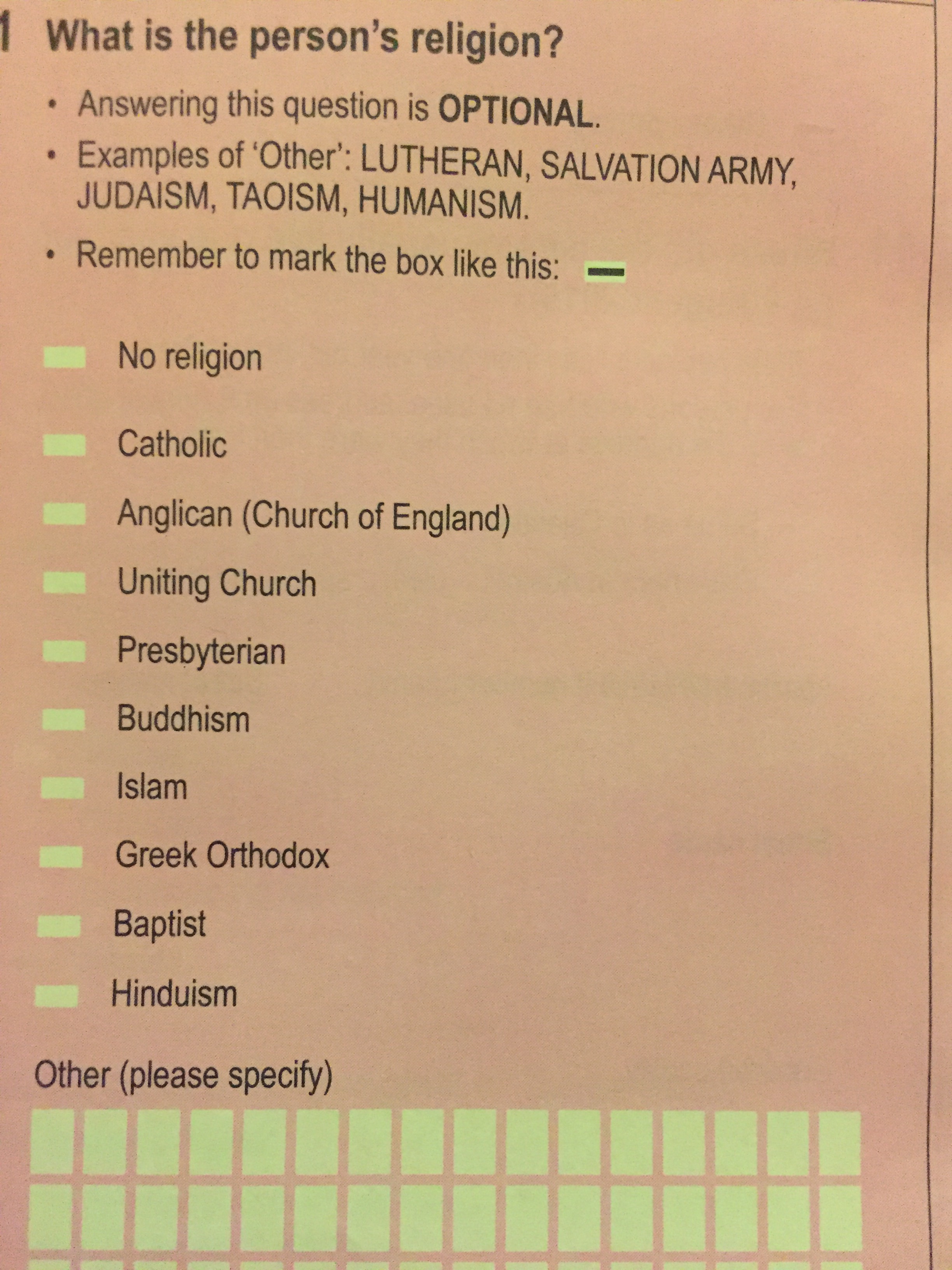
We also happen to be here during the Australian census time, and apparently even international tourists are supposed to answer! Here’s some of my favorite questions: 


So many white ethnicities! Eric answered “German” and “Czech.” I like that there’s just “Australian”. We don’t have that option in the States, now do we? I also liked how Salvation Army is a common enough religion to be on the main list. 

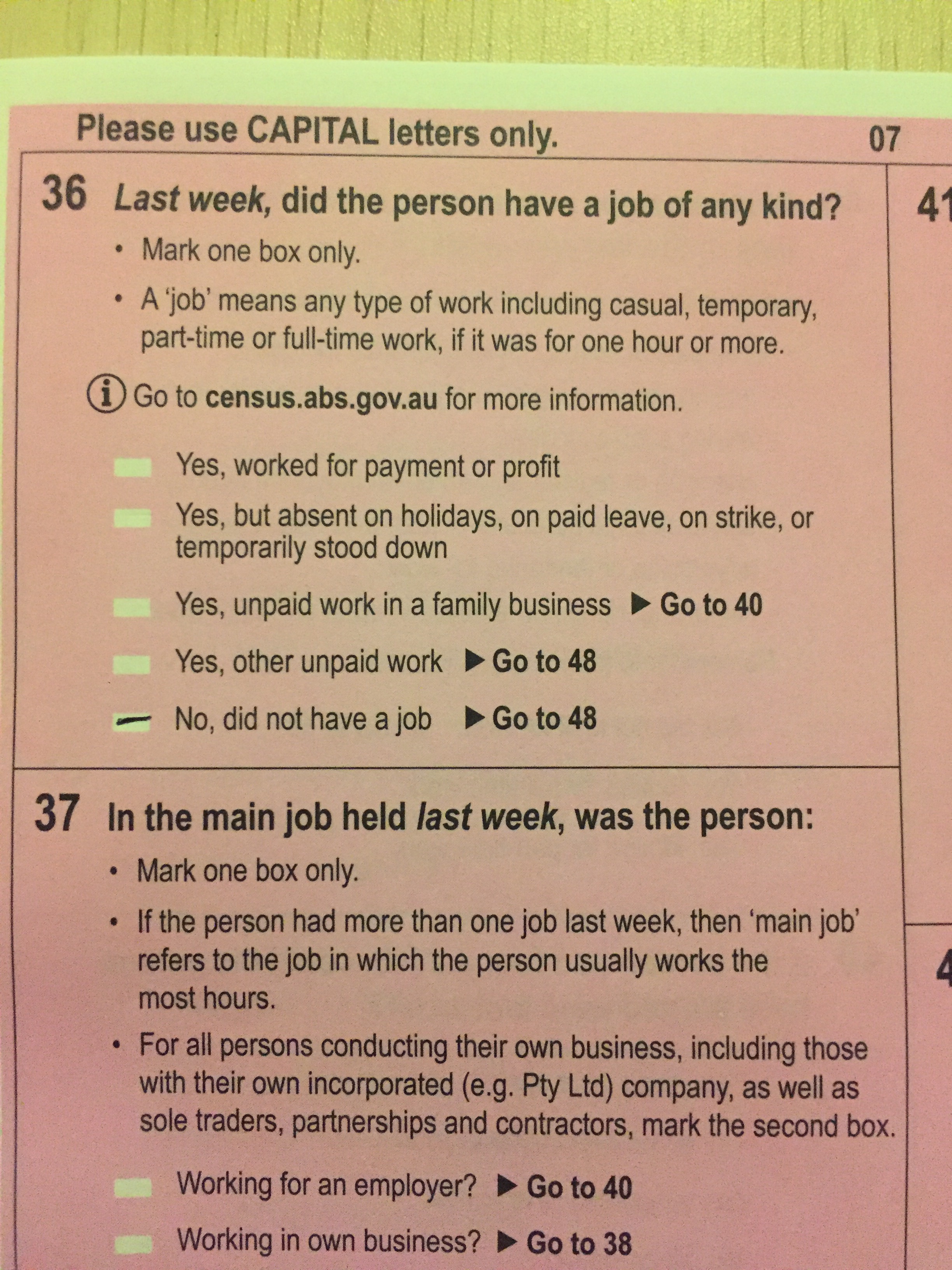
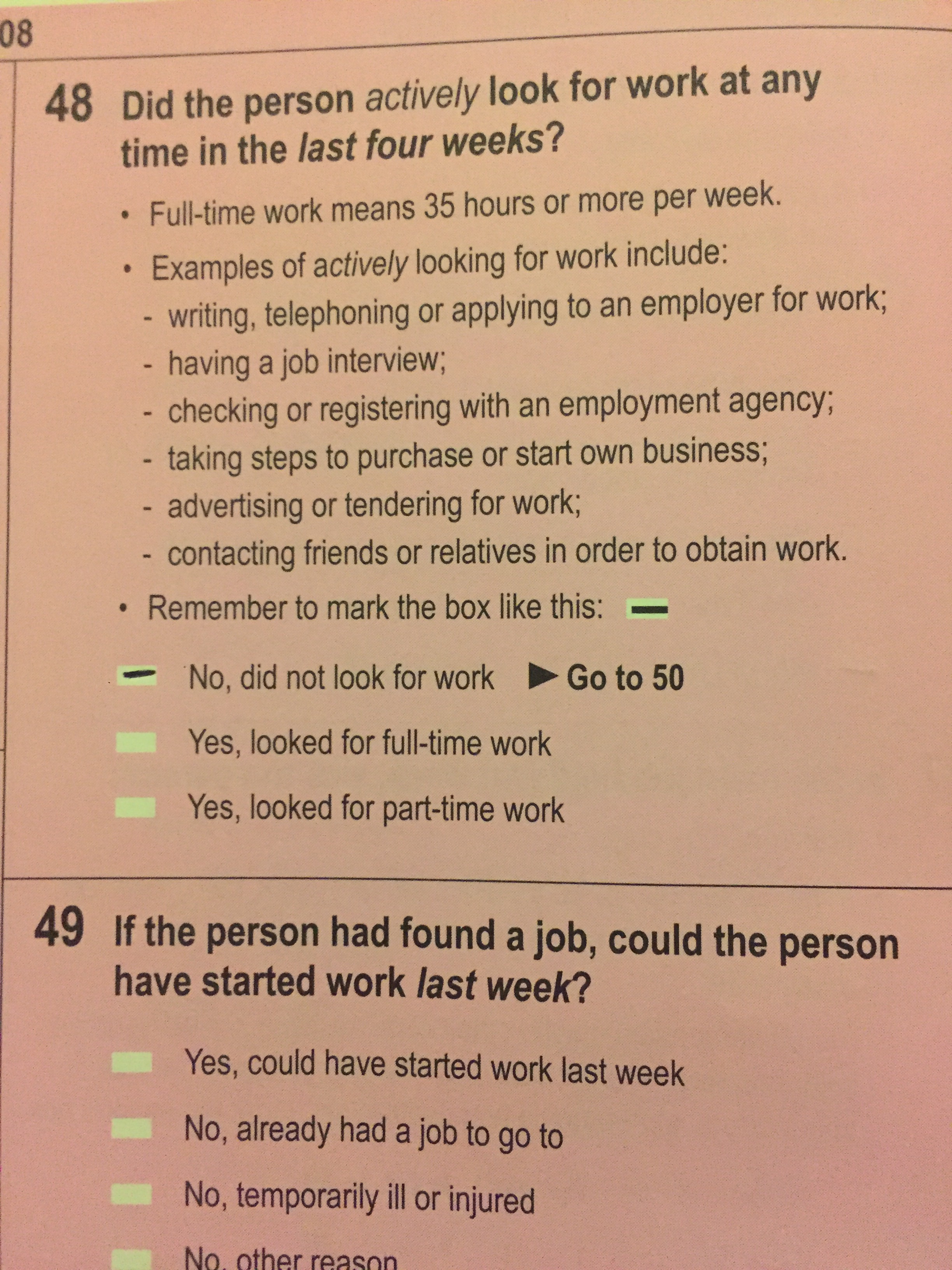
And I’ll leave you with my two favorite questions.


No comment required. 🙂

-S

In which we visit the Rocks while the family is on the rocks. 

As Newton once said, for every action there is an equal and opposite reaction. So it goes with our trip – after the bliss and fun of yesterday, came one where everyone seemed to snipe at each other constantly. Even in the midst of this though, there were some gems to be had. 
I really wanted to spend some time at the Rocks, the oldest area of Sydney and where they have a weekend outdoor market. The market was so fun! The kids and I have been listening to “The Hitchhiker’s Guide to the Galaxy” and ever since we started the boy has been begging me for a towel, as he says he just doesn’t feel right without one. Thankfully, they had a stall selling Turkish towels and he was able to pick one out, so he now feels like a right hoopy frood. The girl picked up a heart locket charm for her charm bracelet and we munched on something that resembled a Turkish quesadilla from a street booth. The other stalls sold anything ranging from wooden kangaroos to semi precious stones, cupcakes and indigenous art, and of course one of those people who make space-y looking art from spray paint. There must be some rule that one of those must exist at every outdoor market. 


The Rocks Discovery museum is also there, a small place completely worth a visit. It goes through the history of the Rocks – from the first aboriginal peoples, the Cadigal, and their lives through their decimation at the hands of European disease then to the settlement of the area and it’s ill reputation due to being a naval port and then through to the 1970s, where the government wanted to demolish the Rocks and put in high rise buildings, displacing the traditional working class residents. A grass roots movement called “The Green Bans” which succeeded in preventing large scale redevelopment of the neighborhood. It retains a mix of old and new building as a result. The famous Harbor Bridge was largely built with the sweat of Rocks residents as well. 

The rest of the day involved getting back to the flat, more sniping, dinner and bed. I was glad to get to sleep, knowing the next morning it would be better, and it was. 
Let’s talk a bit about how the technology has worked so far – to start, the kindles have worked really well. All of last year’s Lonely Planet guides are available on Kindle Unlimited, which I got for the trip. There really aren’t many other great books to read on it, unless you’re a fan of Scottish bodice-rippers, so I’m not sure I’d recommend it otherwise and will probably cancel our subscription once we get to Ireland or Romania. We are still able to get Denver Public Library books though, and have been using that to get new fiction to read. Even with the guides, the world of travel has opened up considerably because of the Internet, Google maps, Yelp, Air BNB and Tripadvisor. Most places we haven’t opened the travel guide other than to get an overview for sights and things we may want to see, and I did this before I left by reading travel guides checked out from the library anyway. Instead of being limited to the places mentioned in the guide, we’re able to look ahead of time. You might think this prevents us from finding new and exciting places, but I’ve found the exact opposite. For example, we never would have found that tasty crepe place or even ventured to that neighborhood of Auckland without Yelp. 

I’ve booked all of our places online mostly through Air BnB or some variation thereof and they have all been fantastic, though need at least 24 hours notice as I’ve learned. Less than that and it’s a motel for us. For restaurants, we’ve either asked people, just walked around, or in the cities used Google maps to find places. Yelp isn’t used as much outside of the big cities – I think it’s more American. In the small towns, places don’t have reviews, but we just go to the busiest place on the Main Street and that’s served us well. 🙂 Only one of our restaurant findings has been truly disappointing, and this was one where one of us wasn’t feeling well and we just had to pick the nearest place.
In terms of phone and Internet use thus far, NZ was a bit rough. Wifi is not commonly available or is limited in time or MB. For our phones, we ported our phone numbers to Google Voice so we don’t have to change the numbers we’ve had for over 10 years. If anyone calls this number I should technically be able to get the voicemails sent to my email, but really, no one calls me. For other contact, I use whatsapp, Facebook messenger, and for calling FaceTime audio or video works well over wifi! In every country I’ve been getting a SIM card so I have a local number and can receive and make calls in the country, which has been useful. The best way to decide which SIM card to get is to ask the most teenager-y looking person about which is the best one! One thing I didn’t realize was that you can’t forward your US Google Voice number to an international number, but this really hasn’t been a big deal. In NZ the SIM card I got had only 250mB of data for the week! I used it all by the last day. Here in Oz I have 4 luxurious GB to use for 2 weeks, but even then don’t have good service everywhere! Wifi was plentiful in Sydney but I’m thinking it’ll be less so in the outside areas. I was hoping to not even need a SIM card but with the poor availability of wifi, it has been a necessity for directions at the very least and looking up restaurants and such as well.
I’m immensely grateful that I got a keyboard for my iPad before we left. It has become a second laptop and essential for typing out blog posts. I have an old 2nd gen iPad so it’s heavier than I’d like, but I couldn’t justify the expense of getting a new iPad Air just for that. But for now it seems to be working just fine. 🙂

-s

In which we have a lovely day and learn not to take romantic advice from a crocodile

After the explosive events of the day before, the girl woke up and felt just fine. Eric, on the other hand, caught whatever bug she had and was out for the count. Sitting on the couch downstairs and occasionally croaking out a request for some tea, he wandered in and out of an achy consciousness. It was shaping up to be another wet day and the kids and I made a plan to go to the Aquarium and Wildlife Sydney, a small zoo in the middle of downtown which features Australian wildlife. 
This was, all in all, a fabulous day. We hopped a bus to Darling Harbour and made our way to the Aquarium. On the way we had to stop for the kids to use the bathroom and found ourselves in a lovely cafe where we decided to return for lunch, as described by the boy in his post
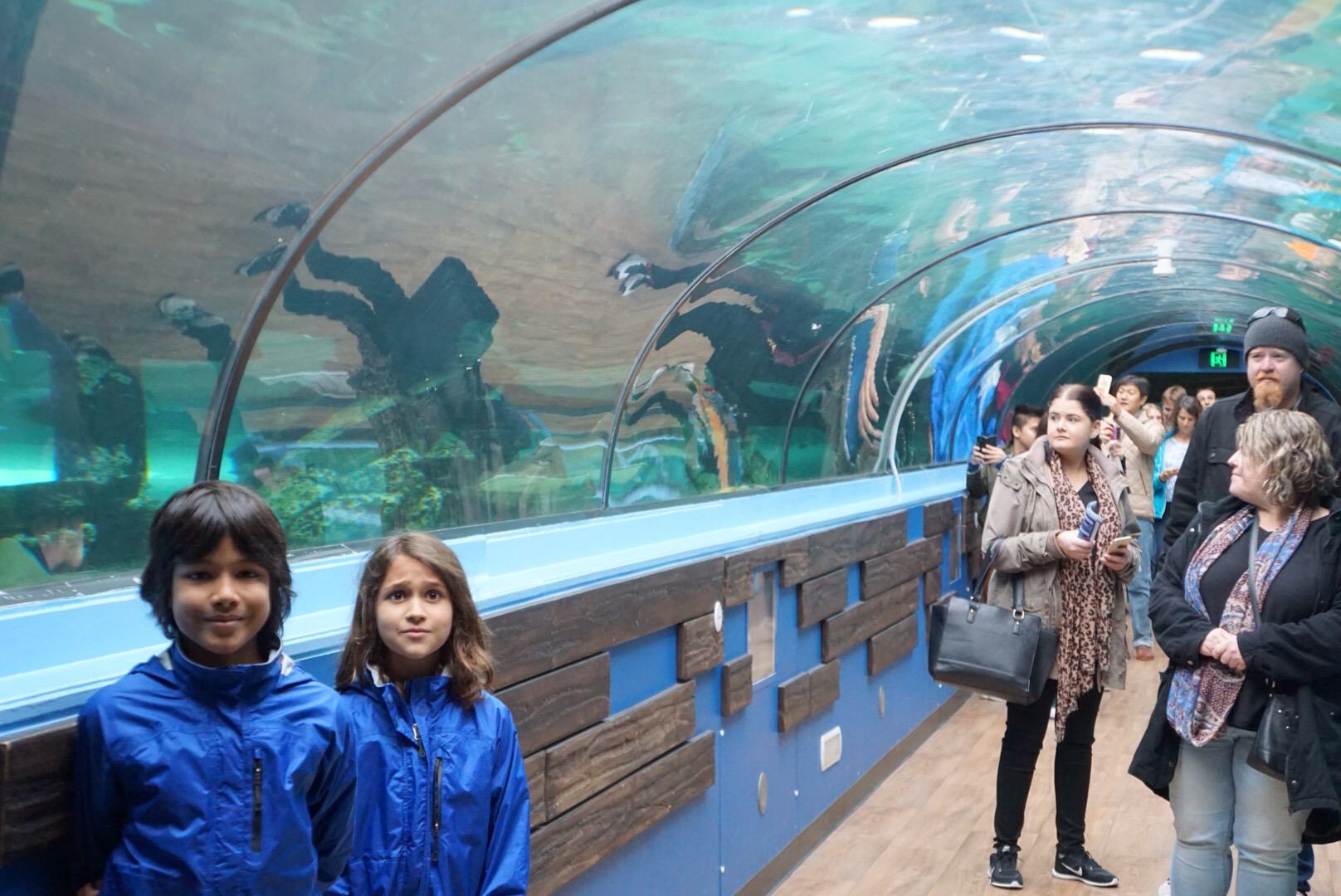
The Sydney Aquarium is set up pretty nicely as it walks you through various underwater environs of the Australian coast. We walked through a series of “underwater” tunnels where the rays, sharks and other sea life meandered overhead. When we stepped in, I began to say, “You know, there was this scene in Jaws 3 where-” “NOOO!! NOO!! Don’t tell me! Not until we’re safely out of here!” the boy interrupted me. He then scurried through the tunnel as quickly as he could, waiting for cracks to appear. I keep trying to get them to watch Jaws before we go snorkeling at the Barrier Reef, but they keep rebuffing my attempts. Can’t imagine why. 


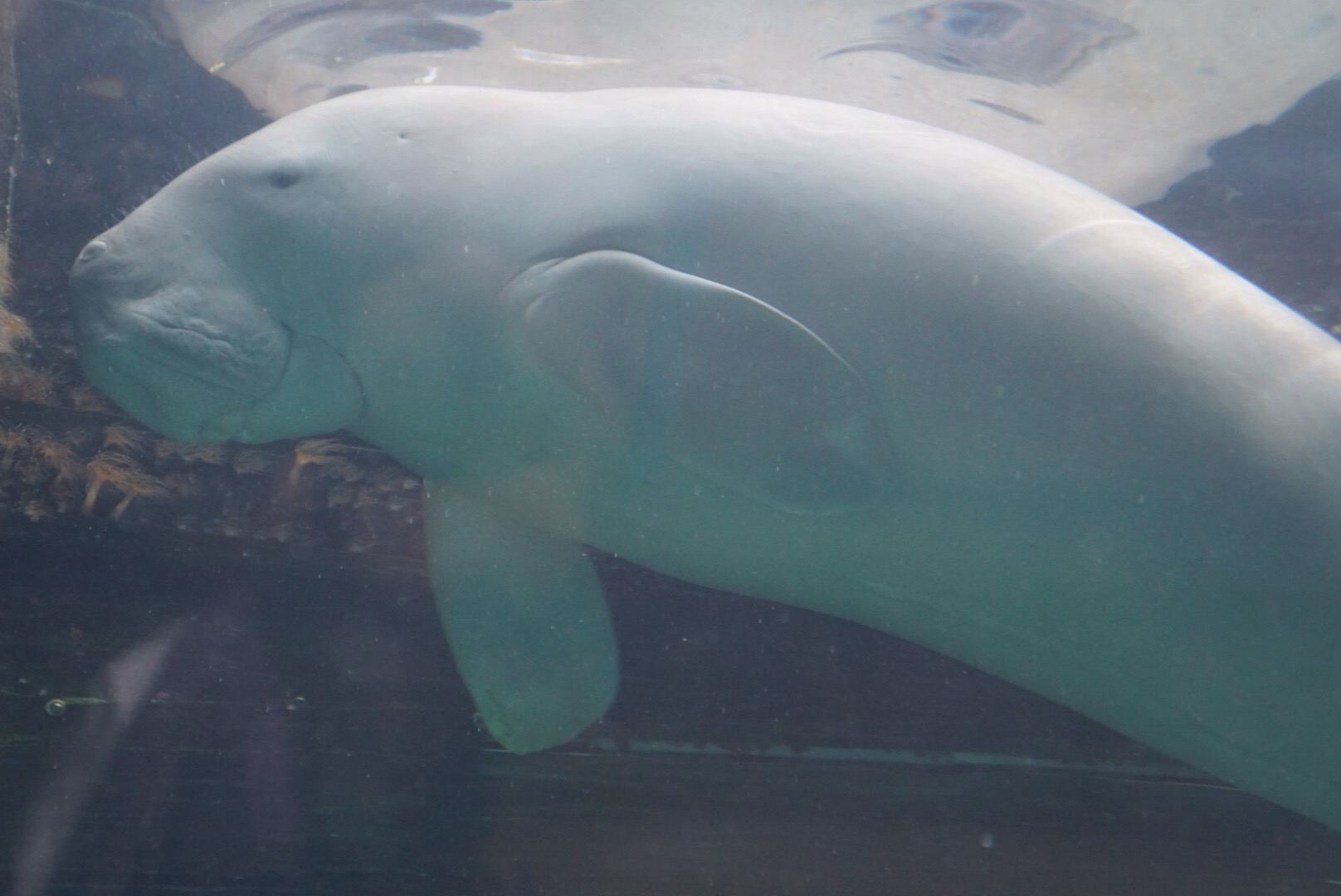
The newest animal I’d never heard of is the dugong, a sort of uglier manatee-like sea mammal. Yes, uglier than a manatee. 

The Wildlife Sydney was really fun. I’d never seen an echidna before! They’re so adorable, like a hedgehog that got hit with an enlarger ray. As one of the 2 known egg laying mammals, I’ve always been fascinated by them.


 And the platypus! They had platypuses swimming about in an underwater habitat! The other egg laying mammal! Suffice it to say, there was a lot of squee happening. But then we got to the koalas! And even more squee! Fun fact about koalas I learned: when the males are in heat, they develop a musky cologne on their belly that they rub on the trees to attract the lady koalas. The zoo also advertises the largest saltwater crocodile in captivity. We rounded the corner to the habitat and looked for several minutes, wondering if the dark shape below the surface of the water was the croc. After a good five minutes of staring, I looked up to see a small sign that read, “Sadly, our crocodile Rex died.” After this we stood back and watched the other tourists search in vain for the crocodile also, which was good fun. We read the other signs around the habitat, including one that told us that Rex had been a solo croc after EATING the two lady crocs they brought in to mate with him and try to make more little Rexes. Clearly, no one had ever tagged Rex in the “love your spouse challenge”. 
That afternoon we had a tour of the Sydney Opera House and I learned there was a children’s film festival happening there that night so we got tickets for that too! Eric dragged himself down to the Opera house for the tour, looking a bit peaked. The Opera house tour was fascinating – even though the building is a famous one that we’ve all seen pictures of, seeing it in person was spectacular. On the tour, we learned that Utzen, the Dutch architect who designed the building, was fired for coming in over time and waay over budget – initial estimate $7 million, actual cost >$100 million. I don’t know why Sydney was so surprised by this; anyone who’s ever gone through a remodel would have told you to expect it. I also loved learning that there are several different types and finishes of tile that go on top of the building to maximize brilliance but cut down on glare so you’re not blinded by the roof in the sunlight, just dazzled. 

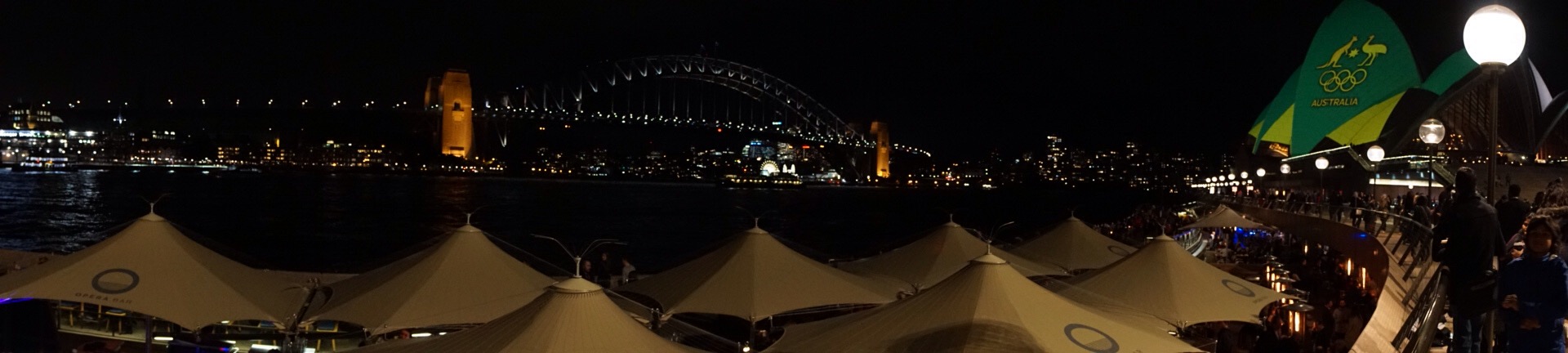
We returned in a few hours for the film festival, to find the Opera house lit up for the olympics.  So pretty. 


The children’s film festival was delightful! We caught the opening night gala and watched a series of short films either geared toward or made by children. One of my favorites was Johnny Express where an interstellar delivery guy has a package to deliver to a new planet, only it turns out that he’s a giant on the planet and unwittingly causes mass destruction of all the little green people with every step! The kids’ favorite was a film called “Bunny New Girl,” about a little girl who starts at a new school…and wears a homemade bunny mask out of a paper plate her first day. Can’t imagine who that reminds me of.