New Friends


On Wednesday I came home and I finished my homework.  I went outside to play with my brother and then I played with two other girls in my estate.  We just skated around the Estate and had so much fun. And I saw one of my classmates then she joined in with a Polish friend. Everybody’s from Poland! When I went inside I had dinner and couldn’t wait for tomorrow. Then I had even more playdates.


LB is back!!!!!!!!!

-LB


In which we wander around Belfast, old and new

Belfast is a lovely little city, at the foot of the bay with the River Lagan running through it.

Belfast today, as seen from the banks of the Lagan. Sheep fields in the near distance of this compact city.


 My favorite little encounter there was at the museum shop, where they had papyrus for sale. Actual papyrus! I went up to the shop clerk and asked “Is this real papyrus?” To which he looked at me, raised his eyebrows and quipped, “Well, it’s not imaginary is it?” The museum, by the way, is excellent,  with a nice selection of dioramas, a walkthrough all of Irish history from prehistoric times, and lots of hands on stuff for kids. They had a replica of a penannular shawl pin,  used in the Medeival period,  and we could finally see how to actually put one on! 

My other little story about Belfast is from a coffee shop we went to in the morning. The guy sitting in the chair next to us was speaking loudly with a thick Bronx accent into a flip phone “Did you find the DNA on the body? Because I know who did it! And if you find the DNA it’ll prove it!” We assiduously avoided eye contact while trying to maintain ear contact. The police on the other end were clearly trying to stay professional and saying they couldn’t give him any info. He later came over asking if we could help him text, and at first I and the boy were like “Sure! We can help! We are nerds! We know lots of things!” And then realized that we were going to help someone who clearly a) had mental issues and b) may or not be involved in something unsavory. I looked at the boy, widened my eyes and shook my head slightly and he mumbled some excuse about not knowing how to text on flip phones and the guy walked away.

——
The day before we took an all day tour of Belfast, focusing on The Troubles. For those who may not be aware, a little background on the history of Northern Ireland. As a child, I remember knowing that you didn’t go to Ireland because of bombs and terrorism, but I can’t say I knew much about it other than that until now, and I suspect that most non-Irish people my age and younger would say the same. Side note: the history of Northern Ireland is as fraught and complicated as that of Israel/Palestine. My goal here is to share what we saw on the trip and talk about the history in very simplified terms to provide background. On both sides were many different official and splinter groups often at odds with one another in their practices, and tensions and emotions are high to this day over who did what and what the proper terminology is. For the purposes of this post, I refer to those who supported British rule as “Loyalists” and those who supported a politically unified Ireland as “Republicans” or the IRA, Irish Republican Army, for short. There is also a religious component in that Loyalists were Protestant and Republicans Catholic, however it is still controversial what degree religion itself played in the struggle.


Ireland was a British Colony until its Independence in 1920-21. At that time, Northern Ireland was partitioned off and remained in the British United Kingdom as a majority of citizens supported continued British rule. From 1920 to the late 1960s there were sporadic events of violence, riots and peaceful marches protesting not only British rule but the curtailing of Catholic (essentially Irish) rights. The violence escalated dramatically in the late 1960s until 1998, and this period is known as the Troubles ending when the Good Friday Agreement created a power sharing government in Northern Ireland.
In one seminal event, riots broke out over a few days in late 1969 across Northern Ireland after a Loyalist parade near a Republican area resulted in fighting and then violent military suppression by Loyalists. A system of forced internment was put into play to stop the violence. Purportedly for agitators from both sides, for the most part only Republicans were interned. A peaceful march against forced interments on January 30, 1972 ended when British soldiers opened fire and killed 14 people, in the event known as “Bloody Sunday.” [Yes, this is what the u2 song refers to.] Both the forced internments and the brutality of Loyalist police and paramilitary to peaceful marchers did much to recruit support for the IRA.
Over the next 26 years, Loyalists and Republicans battled, sometimes in overt firefights, and more often through terrorism including bombings, kidnappings and outright executions. Paul’s tour took us through Belfast to understand what happened during that time and what life was like.

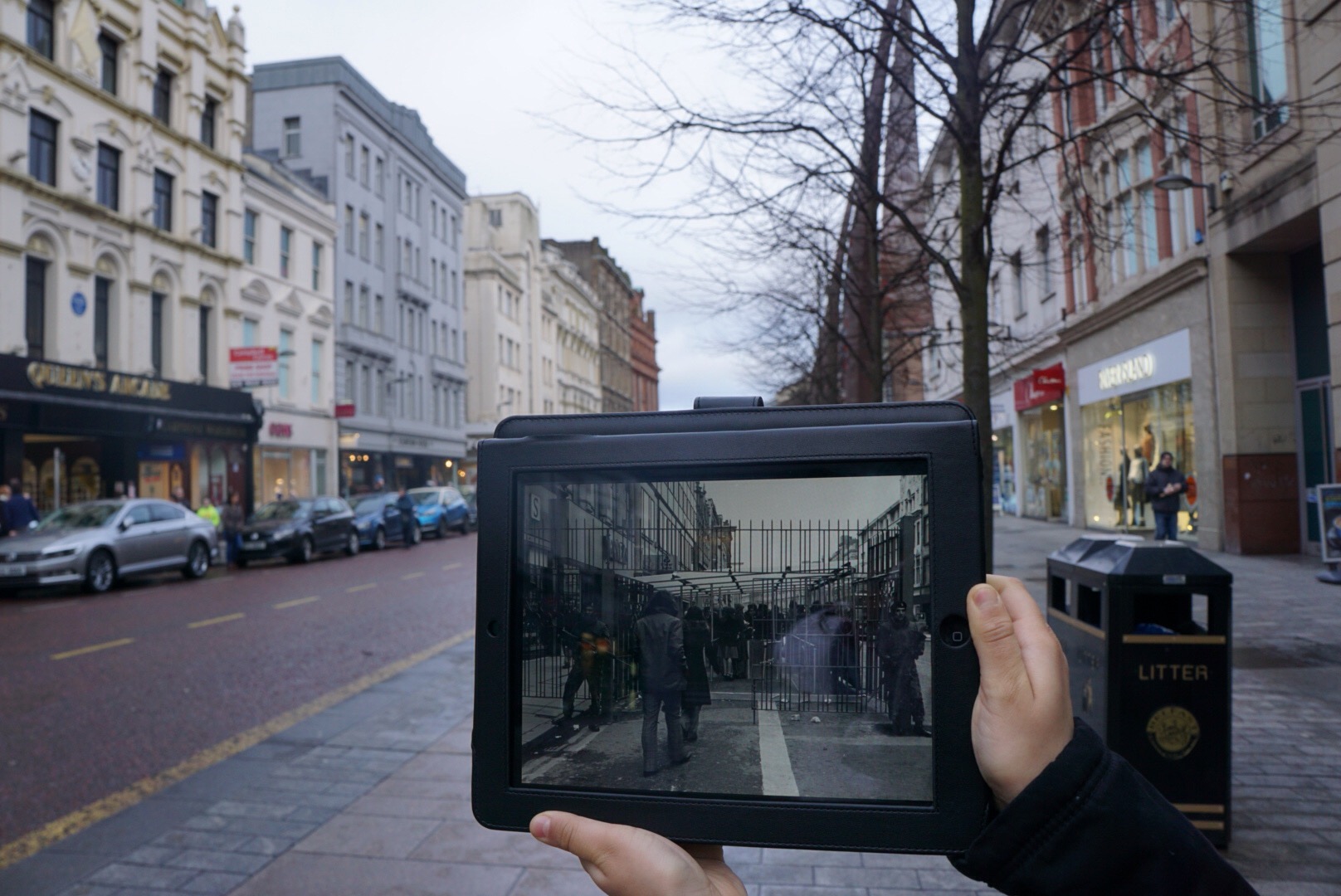
On what is now a bustling main street in Central Belfast was a second-story nightclub, popular with young people and packed to the gills one weekend evening in the early 1970s. Two IRA members had planted a large bomb in the lobby, and were arming it when they were surprised by two off duty British police officers. The IRA members fled, one being shot in the spine and paralyzed from her injuries. The other made it around the corner where he was shot and killed. Accounts vary – the police insist that he was a threat, other eyewitnesses stated that he was already on the ground. The frightened patrons were either led out past the active bomb, not knowing when it would go off, or jumped from second story windows in panic, breaking limbs. One of the aftereffects of bombs such as this was to create an oppressive atmosphere of fear that lingers to this day in its aftershocks. The street now is filled with fast food restaurants and convenience stores, but many of these shut down in the evening and no one is out.

Main street, city center then and now. Barricaded checkpoints at the entry to search for weapons

Due to the constant threat of bombs and weapons, main streets were barricaded with checkpoints. Entry required a full search. The picture above shows what that street would have looked like in the 1970s, complete with metal bars. Paul impressed upon us the mentality of living in a police state, accepting of curbed liberties and always in fear of death from a bomb.
Here used to be an indoor promenade, lined with shops. One day a young woman working in the shops suddenly died when the bomb she had been assembling in the back went off early. Other IRA members had been smuggling in pieces bit by bit through the checkpoints. All of this, again, created an atmosphere of fear.

Then and now, an old shopping arcade where a bomb exploded by mistake, killing the assembler

It often seemed to me that the IRA bombings were indiscriminate in that the people killed could just as likely be Catholic as Protestant. Paul tells us of another story, when a bomb that perhaps was meant for an officer’s bar was hurriedly disposed of in a busy family restaurant shortly before it detonated. This bomb was one that got the British Government to talk to the IRA, so the logic went if one bomb can do that, well, let’s make it bigger to get a bigger government reaction. In addition, the bombings were retaliations for aggressions and killings of Republicans by Loyalist groups.

Belfast now, with lovely art filled spaces tucked into the city

In the afternoon we headed to West Belfast,  while Paul spoke of July 21, 1972 when the IRA set off 22 bombs throughout central Belfast, and the sky was blackened with smoke, people running in panic to try and find somewhere safe, only soon to realize that there was no safe place to go to.

British soldier standing guard over a bombed building in Belfast


I realize that much of what I speak of here is IRA fueled violence, but Loyalist violence was damaging as well. Catholic civilians who may or may not have had any association with militarized groups were killed, disappeared, or thrown into internment camps.
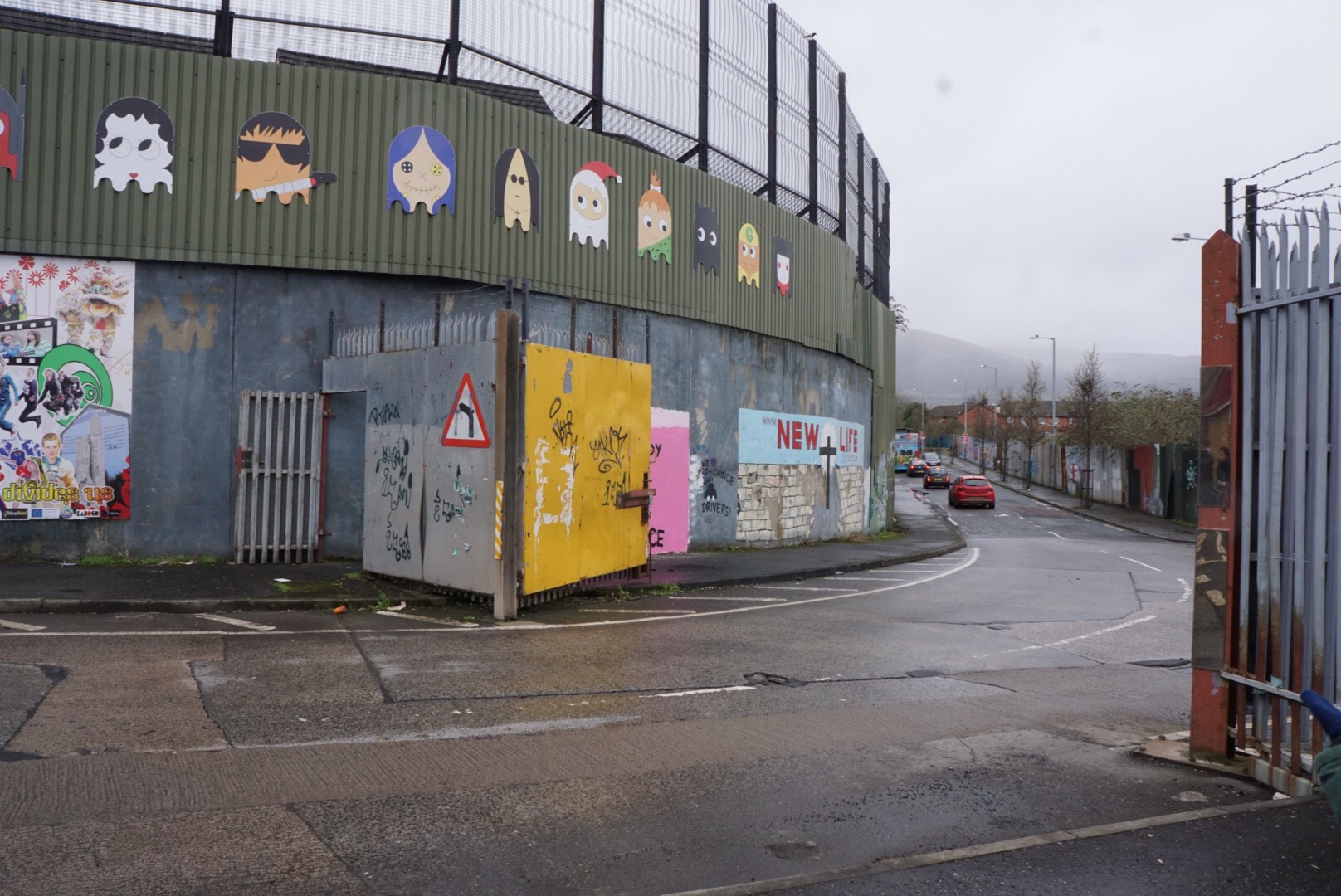
One of the lasting legacies of this time was the construction of “Peace Walls” between working class Catholic (largely Republican) and Protestant (largely Loyalist) neighborhoods, which are still in place today. This blew my mind – in 2017, there still exist cities in which the populations are separated by literal walls. The gates of the walls are closed at 6pm most days and open in the mornings. According to some, the communities still feel safer with the walls in place, uncertain what true unification and open crossings would bring.

The peace wall as it stands today, separating Catholic from Protestant neighborhoods. Cartoonish artwork seems to try to “prettify” the harsh structure.

Today, Belfast is a city which,while rising,  still clearly bears the reminders of the bitter struggle, and in someways is ongoing if not violent. The recent election saw a rise of the Republican Sinn Fein party to near equal numbers in the Parliament, meaning that politically the two sides must come to agreements. If they can’t, there’s a possibility of Britain taking over direct rule of the North. It made me think, too, of the current divided States of America – nearly 20 years after peace in Northern Ireland, it is nowhere near true unity – and I wonder what it will take for the US to achieve that.
–s

In which we spend some time in the North and walk in the footsteps of giants

Last Friday we, along with a bunch of Eric’s college students, boarded a bus to Belfast. Crossing the border into Northern Ireland, which is part of the United Kingdom and not politically part of Ireland, is somewhat underwhelming and mostly notable for the road signs changing into miles instead of kilometers. We made a few stops to check out sights along the way.

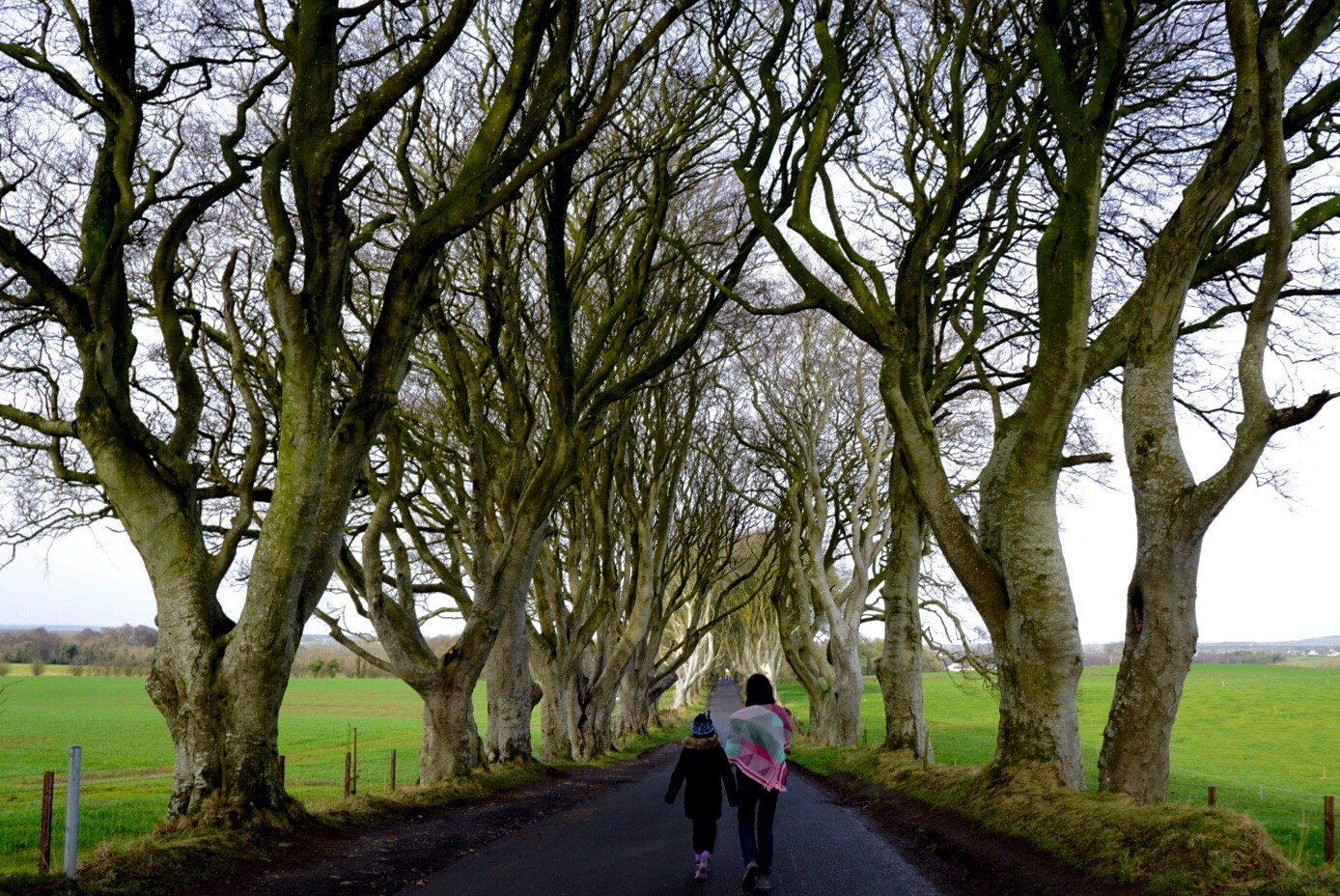
First stop was the Dark Hedges. Beech trees twist and arc overhead to create two colonnades along a small patch of road, an arboreal tunnel to welcome you to the Stuart estate. Charles Stuart first planted the trees in the 18th century for this reason, simply to impress visitors to his manse. It’s better known now as the escape route Arya Stark takes from King’s Landing on Game of Thrones. When backlit, the trees form an ethereal walkway, and I half expected to see fairies meandering past. 


Next stop was Carrick a Rede rope bridge. A tiny island sits just off the coast of mainland Ireland at the edge of a bay. Shoals of salmon used to swim by, and a small rope bridge allowed fishermen access the island so they could set their nets. Nowadays, salmon populations have plummeted and the bridge is no longer used for fishing, but solely for tourism. Walking across what is now a relatively stable wood slat bridge with secure ropes and netting on either side of you is harrowing enough, especially if you look down to see the surf crashing on the rocks. I can only imagine the fortitude of fisherman of yore, who used to scramble across a swaying bridge which had only one rope handrail, the other side a steep drop to the ocean, guiderope held in one hand and the other clutching their nets and lines. Many tourists have made it across but have found themselves unable to stomach the return journey, needing rescue by dinghy. 

True bravery on display

The little dock to the right is where they would save those who couldn’t cross twice, though it seems even more harrowing to me.


The last tourist stop was the Giant’s Causeway. The tour bus spit us out at the top of a cliff overlooking the beach. We walked a paved pathway that curved downwards, and saw … more cliffs and craggy beach. Pretty, sure, but hardly unique. What was the big deal?

The faces of the unimpressed


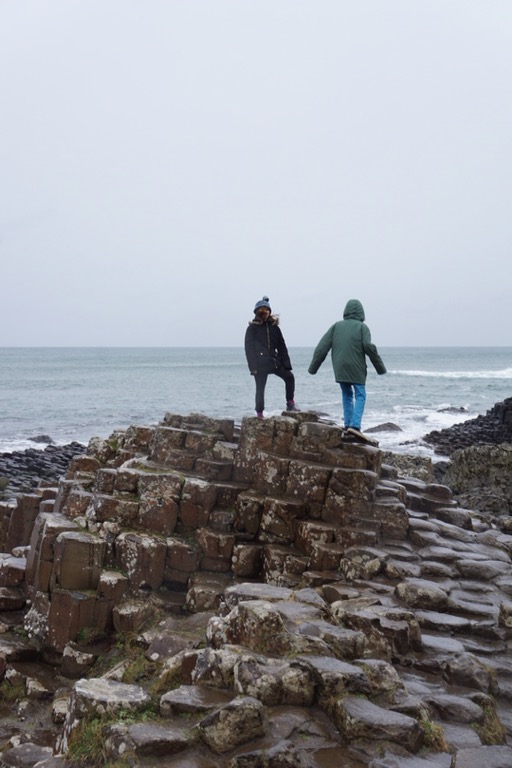
Walking further down, though, we soon saw the landscape change into well demarcated hexagonal columns that rose into hills as they came inland and then seemed to disappear into the surf. The kids took off to scamper among the formations, while I cautiously stepped around them because those things were slippery. Now, I could tell you that the geological origin is from ancient volcanic activity that breathed out the basalt columns, but where’s the fun in that? 

Irish legend tells a much different story. Fionn McCumaill (p. Finn McCool) is a mythic giant of the North Coast. Scotland is just across the water here, and the Scottish giant Benandonner threatened to attack Ireland. Fionn swore to protect his land, and threw chunks of the coast into the water to create a road, or causeway, to Scotland where he intended to fight Benandonner and save Ireland. On his way over though, he caught a glimpse of Benandonner, realized he is truly massive and Fionn hightailed it back to his house in Ireland. Benandonner meanwhie is still up for the challenge and followed Fionn back along the new road and headed to his house, asking to see him for the fight. Fionn’s wife, Oonagh, has realized what’s about to happen and cleverly dressed up Fionn as a baby. She greeted Benandonner at the door, and told him Fionn is currently out but would you mind holding his beautiful baby. Benandonner took one look at the “baby,” and thought in fright of how large the father must be to sire a baby of this size, and fled back to Scotland. As he ran back, he destroyed much of the causeway so that Fionn couldn’t chase him home. 

Look between the layers to see coins people have stuck in, left to decay in the saltwater air and melt into the stones themselves.


-s

In which I finally get to tell someone off about my name and commune with prehistoric Ireland

I know I’ve already said this, but it bears repeating: I think the weather is really getting to me.  I remember living in Michigan where Harrison’s Roadhouse had a signboard out front which proclaimed ” XX days without sunshine” and would update the number every day. If I remember correctly, and my Michigander friends can help me here, it once got up to the low 40s before a spot of sun was seen. Then, as now, it’s a depressing world without sunlight.

I also have to admit that I find Ireland to be isolating. I know that’s contrary to every single thing you read about Ireland, where the place is described as merry redheads waiting on street corners to invite you into their house for a drink. Wait, that doesn’t sound quite right, but you know what I’m trying to say. Some of this is just the difficulty in moving to a new place and trying to make friends, which always takes more time as an adult. And I can’t quite figure out the mom culture here. An example: the girl has singing club on Tuesdays, and one of the songs they sing is “When I Grow Up,” from the musical “Matilda.” Whenever she starts singing this in her off-key warble, I dissolve into tears.  Something about that little voice singing about growing up and what that means just destroys me. So when I went to pick her up last week at the end of class, I said to the two other moms there, “It just makes me tear up when they sing ‘When I Grow Up,’ you know? It’s just so cute,” accompanied by a fluttering open palmed hand in front of my chest.  They both stared at me as if I was mentally deficient, and were entirely silent. I tried to recover from feeling entirely foolish by mumbling, “I cry easily,” to which they murmured something and then turned away. Eric assures me that this is atypical Irish behavior. Seriously, I dare anyone who is a parent with a heart to listen to the link above and not get weepy imagining your kid singing the same song.

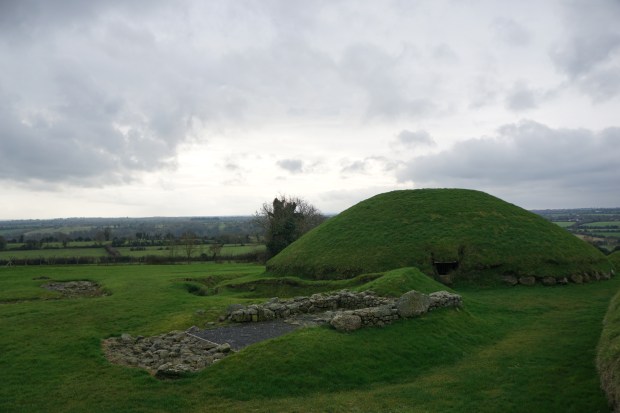
In more fun news, one of the classes I’m taking on the Archaeology and History of Newgrange took a field trip to Newgrange as well as Knowth and Dowth, two other passage tomb sites nearby. Passage tombs were created in the prehistoric era, around 3000 BC, and so called because a central enclosed tomb area made with stone walls was entered along a stone passageway. The finished tomb area was covered in small stones to create a large mound over the whole thing. After the Bronze Age, in 2200 BC, the sites were no longer developed, perhaps because they had achieved a sacred status. Much later, in 700 AD, Knowth actually became a residential area for kings, eventually following into disuse again. Over the years, the tomb was buried in the rubble and dirt of ages and resembled nothing more than the usual rolling Irish landscape. It was rediscovered in 1699 by a farmer who excavated the area to scavenge stones from what seemed to be a nondescript pile of earth and found the doorway to the tombs. The sites have been under excavation and reconstruction from then until relatively recently.

dsc05877

A word here about archaeology in general. I love the imagination of archaeology, as much as I take it with a grain of salt. No one really knows exactly how the tombs were used nor what they were used for. Newgrange is aligned with the winter solstice, but the other ones really aren’t unless you squint and lean over at certain times of the year. I’m often reminded of the book “The Motel of Mysteries” by David Macauley, which I read as a child. In this, a modern-day motel is dug up by archaeologists in the future, who hilariously imagine our world entirely wrong. See, for example, the sacred ritual headdress they found upon their excavations.

mystmotel

All this to say that I take all archaeology with a grain of salt, and remind myself that despite all the technology at our disposal, much of it is still conjecture.
img_0201

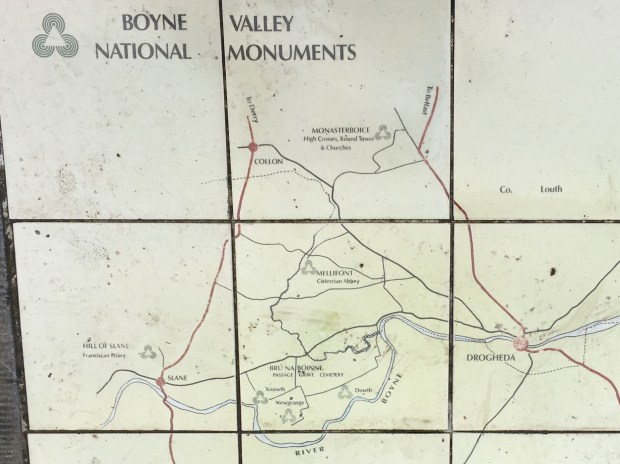
These three big sites rest along what’s known as Brú na Boínne, or The Bend of the Boyne River. Legend has it that Boann, a goddess, broke a taboo regarding a wellspring. In protest, the spring rose up against her, washing her away through the plains of Ireland until she reached the sea, leaving the river in her wake. The river was critical in terms of moving building supplies to these three sites, as many of the large stones were transported from some distance away. The thinking is that they would be dragged or rolled to the river then transported on rafts to the final construction site. It’s a wonder of engineering, to think to 3200 BC and how they could have transported the ten-ton stone blocks which make the walls to the passageways (called kerb stones). Much like the stone blocks of the Egyptian pyramids or the standing heads of Rapa Nui, it is not entirely certain how these blocks were moved and put into place, only to know that it must have been a vast coordinated effort of many, many people.
DSC05882.JPG

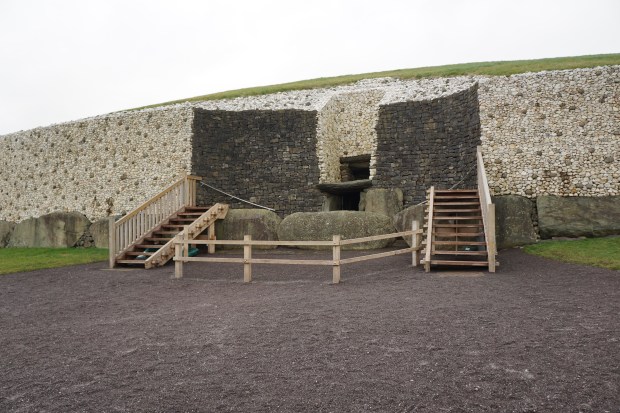
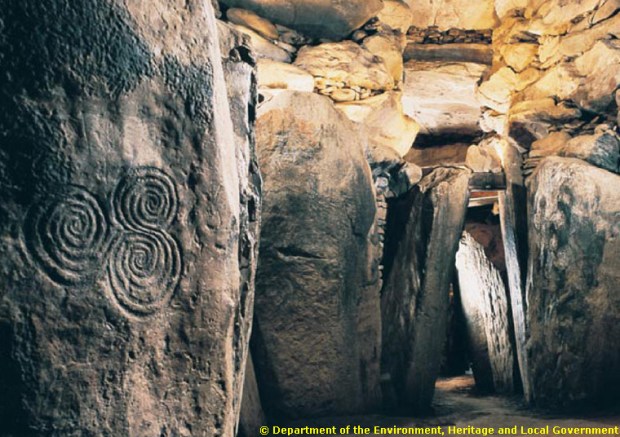
The passage way is a narrow, low roofed tunnel through large stone walls hemming you in on either side. No pictures are allowed so any interior pictures are from the web. It ends in a chamber with a high conical roof, made by overlapping large stones filled in with smaller stones which over the years crushed into a sort of cement. Interestingly, drainage paths were built in as well going down the side of the monument, done so well that the interior of the tomb area is entirely dry, no small feat in this rainy country. Several burial areas inside contained cremains that seemed to be grouped by family members, some of which contained jewelry, pottery and weaponry. On the walls is scratched in graffiti from Irish punk kids from the early 1800s, a later addition.
newgrange-interior

When you stand in the central passageway, the guide turns on a small light to simulate the way that the rising sun creeps directly along the hall on December 21, or the winter solstice. What I’ve learned in my class thus far is that this was either a signal of well-wishing from the gods, or that this is when they would use the light to go in and bury the dead and perform rituals. This seems like a bit of hogwash to me, given that the sun is rarely seen at sunrise and even less so in December, but so it is told. The construction of the passage is at a slight angle up, so that there is the main door along which light enters and goes part of the way up the passage, and then an opening above the door which light can enter straight through and meet the center tomb area, which you can see in the picture above.

Perhaps the most famous aspect of Newgrange is the striking white quartz wall that surrounds its face. Michael O’Kelley, the main archaeologist of Newgrange for many years, insisted that the white quartz found around the site was stacked up in this wall formation. Though his theory was controversial, it sounds like he was enough of a pompous windbag to insist on it and the wall was constructed. Never mind that the qualities of quartz and the landscape make it architecturally impossible that such a wall could have been constructed at that time.
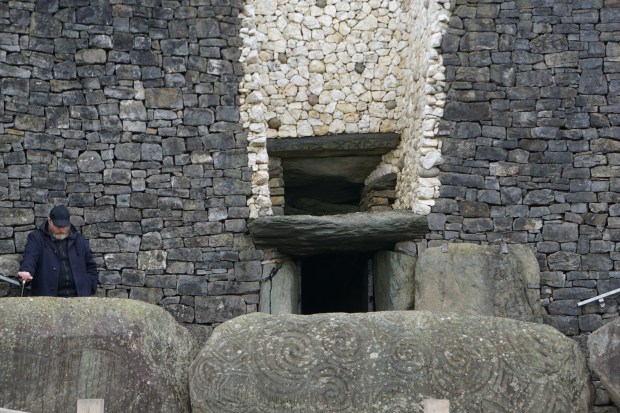
dsc05885

closer picture of the entrance door, the light box entrance over the doorway, and the decorated stone at the front


dsc05893

Getting professed about the carvings on the kerb stones

dsc05895

What passes for a warning here. The small white sign says “no climbing”

Knowth is another passage tomb site, in my mind more interesting than Newgrange because of the many smaller passage tombs that dot around it. It’s also known for its heavily decorated stones that line the tomb, here sadly wrapped in blue plastic until its official spring opening time. There is no agreement about what the pictures mean, only that it’s noted that swirly curvilinear drawings are more common doodles for people who have taken drugs, and hallucinogenic mushrooms grow wild in the fields.  You draw your own conclusions. The chief archaeologist for Knowth also saw quartz stones laying about, surmised they may have formed a carpet and left them alone, not wanting to make the same mistake as O’Kelley and Newgrange with the wall. Knowth is also interesting for the reconstructed timber henge, thought to have been used for public rituals. Passage tombs are too small to accomodate more than 10-15 people, so perhaps these areas were for people to gather in.

dsc05915

Woodhenge down below

dsc05933

House footprint in the foreground

Knowth isn’t built much for sun times, as it’s off the equinox by about six days. Some archaeologists have been able to twist dates around so that they say it matches up with a lunar calendar, but this seems to me the archaeological version of retconning. The surface of Knowth is dotted with flat rectangular areas that are the footprint of old houses for kings in the Bronze Age, as above.

dsc05923

Having deep thoughts about the history of the passage tombs

While we were rummaging about Knowth, one of the American students on the trip, M, said to me “We think you should have a nickname! How about ‘Sid’?” Internally, I felt my hackles rise and thought, “Oh no you didn’t!” in the way that the sterotypical “sassy black girlfriend” does in movies. Also, SID?! (As I type this, I realize he thought my name was “Sidatha” so maybe that makes sense. STILL.) “No.” I replied flatly. He then went on to babble something about getting my name right. For the last time, my name is NOT HARD TO SAY. It is three consonants separated by three vowels. For people that can somehow easily figure out that “Sean” sounds like “Shawn” and when you’re in the land where “Caiomhe” is pronounced “Queeva,” this is especially rich. Of course, he can’t stop and then proceeds to go on about how he was a paramedic and would take care of “urban blacks with weird names” (his words) and then, THEN! Starts talking about the racist urban legends of the names “Orangejello” (or-ANJ-elo) and of course, “Shithead” (p. sha-teed). I look at him and say “Those are urban legends, and not real names.” How dare he compare my perfectly normal and good name to racist mythical names? It largely ended there, until next class. He walks in and says “Sujata! I got your name right!” “You got it!” I reply. Again, he can’t shut up and says “I still prefer Sid, but you say you don’t like it.” To which I say “Or you could just learn to say my name the way it is instead of twisting it around to make it convenient for you, because frankly it’s offensive.” He doesn’t talk to me in class anymore, which is fine by me.

Our last stop was Dowth. By this point, we were a little passage tombed out. Dowth however is cool in that it’s just on a plot of land owned by a farmer, free to walk into as you wish, and largely unexcavated so you can see how these places looked before anyone knew they were there.
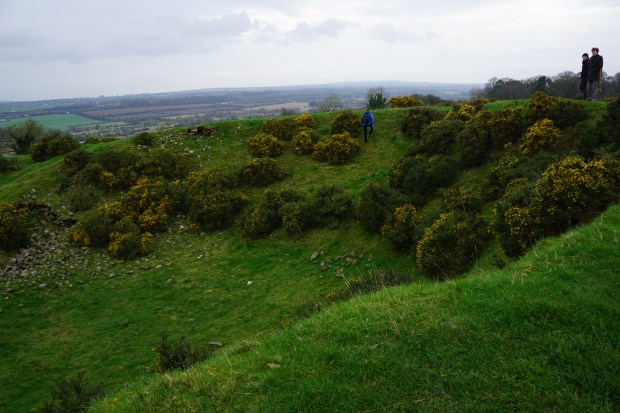
dsc05971

The wild and wooly hill at Dowth, which looks like every other Irish hill.

The sun did make an appearance over the land, and after the clouds you got a sense of how the ancients saw the gods bless them when it shines.
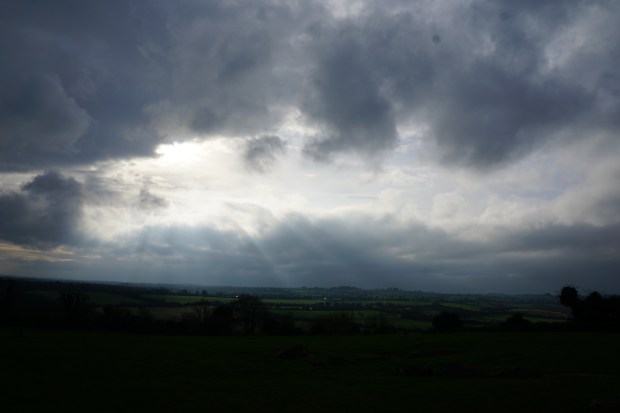
dsc05958

-s

In which I show you a bit of Maynooth, and make a small confession

It occurs to me that I haven’t taken you all on a trip around our tidy little town of Maynooth. That’s not just me calling it tidy, I’ll have you know, but all of Ireland, at least for 2016. 

Maynooth is situated on one of the branches of An Sli Mhor (pronounced ‘sleemore’), or “The Great Road,” created some thousands of years ago, and people settled at various points along the ways, one of them being Maynooth in what is now County Kildare.
It also is situated along the Royal Canal from Dublin, another important source of trade for many years from its creation in the 18th century. This now lives as a biking and hiking trail and Eric and I took a little ride last week to get to the Garda station to register with the police, as we were told to do. The canal way is a lovely path along water, with reeds and waterbirds along they way, who seem somewhat annoyed at the human interlopers of their homes.


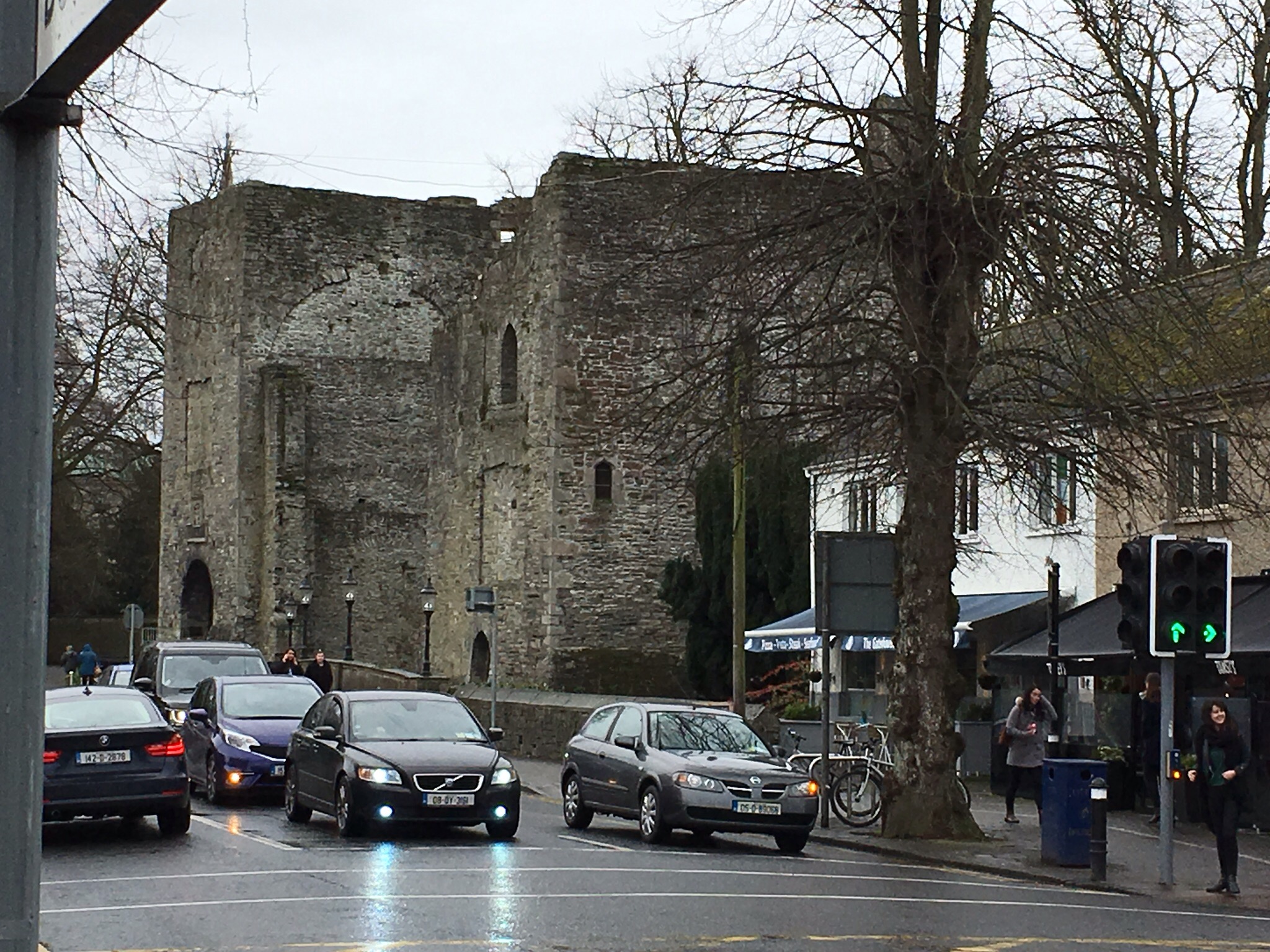
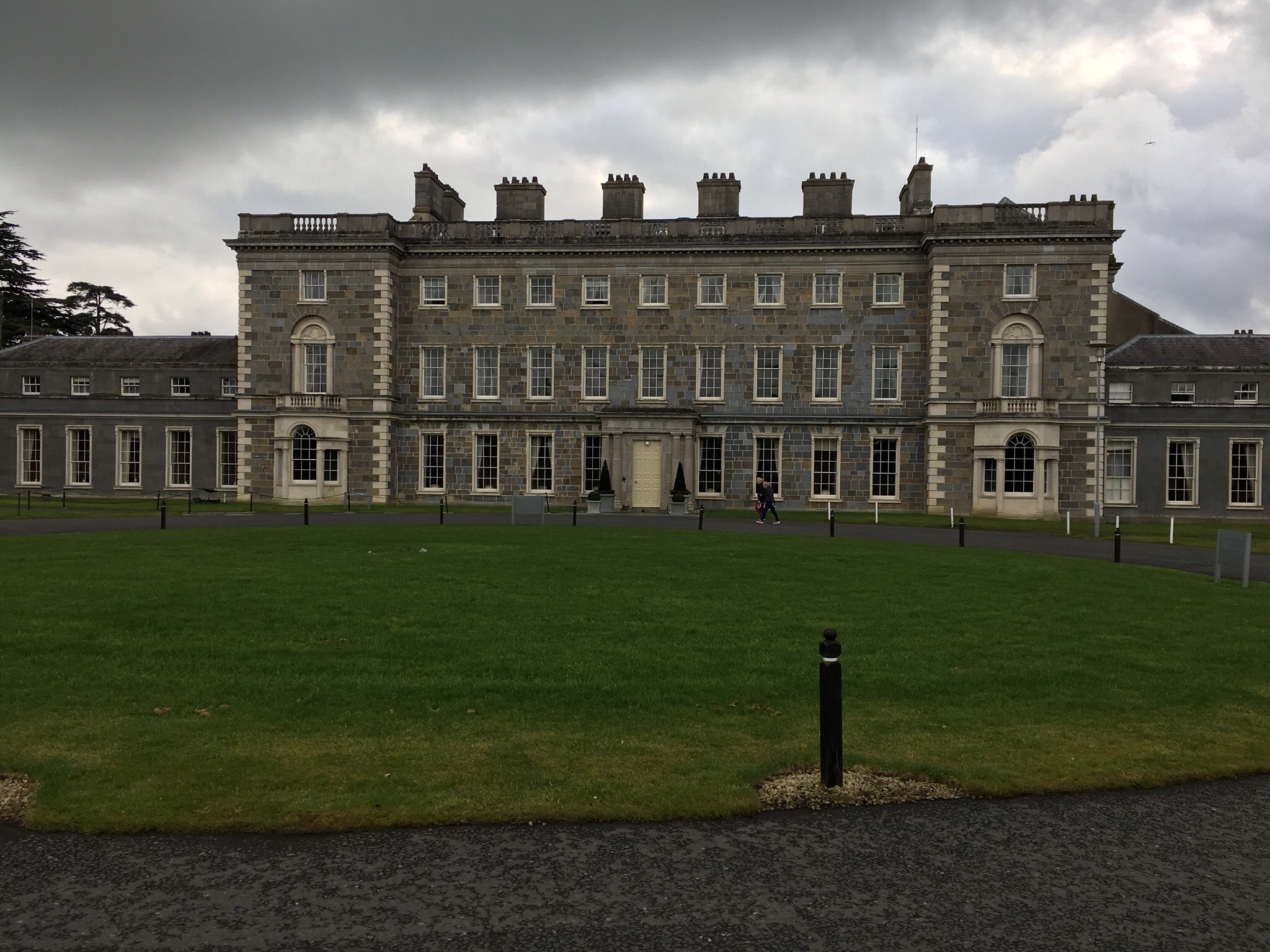
In the Norman era, late 12th century, County Kildare was given to the FitzGerald family by the ruling Norman Richard “the Strongbow” Clare. The Fitzgeralds built a castle on the great road, strategically located for defense and promptly took up residence and rule of Ireland, largely ignored by their British overlords. They continued to buy up land around Maynooth and further to the south. Maynooth then, could have been considered the capital of Ireland for several centuries. In 1534, however, Thomas FitzGerald, also known as “Silken Thomas” for his lavish clothing, decided he’d had enough of even nominal British rule and rose up against Henry VIII, leading the English to storm and destroy Maynooth castle. For his efforts he was executed, and the Fitzgeralds moved out of Maynooth to a castle down the road and then to Carton House, a Palladian style estate built in the 1700s on the land acquired by the Fitzgeralds during their long rule. 

Castle Ruins, as seen from the main road


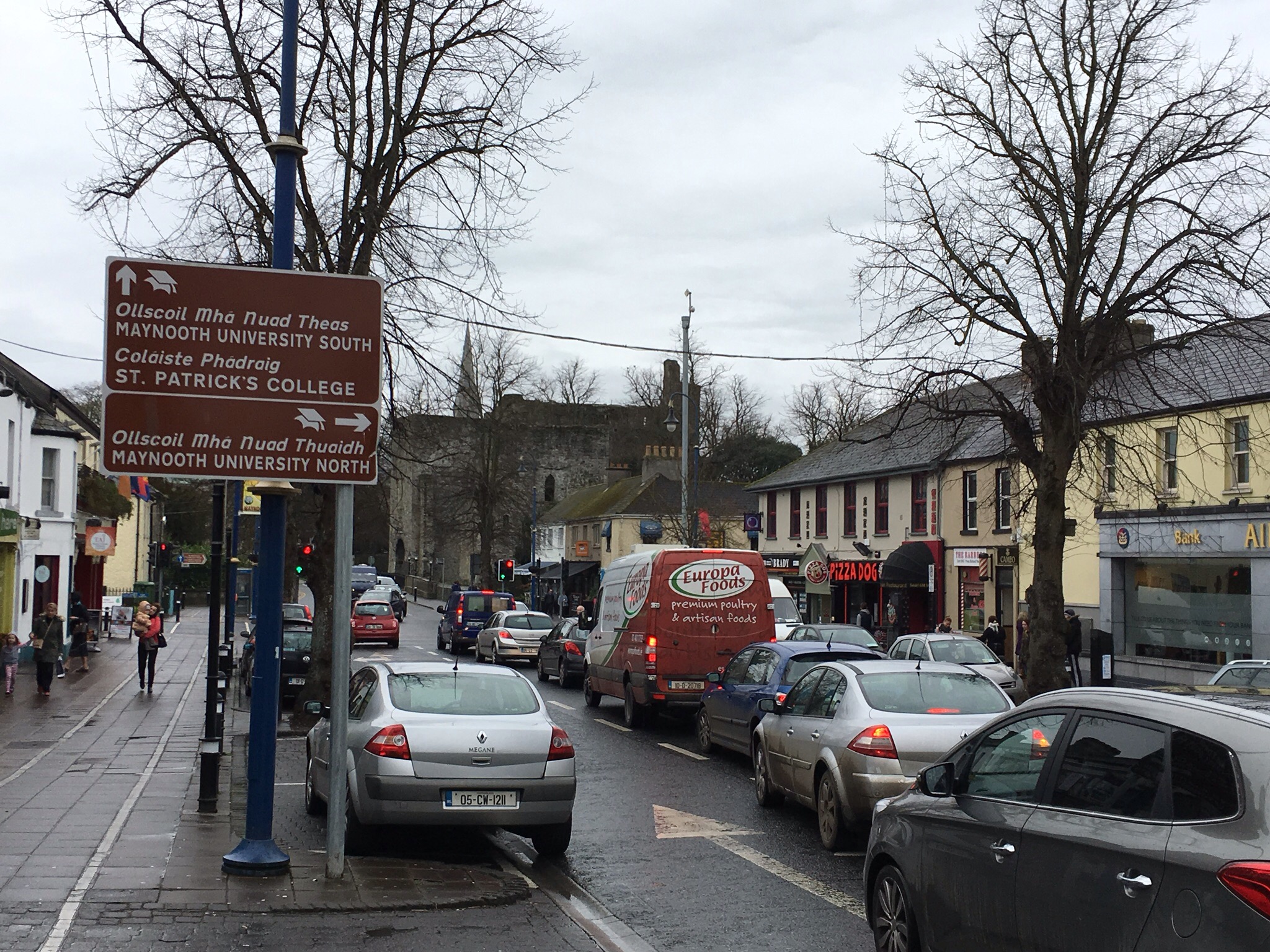
The main road in Maynooth is then capped by these structures, the ruined castle on one end and Carton house on the other. The castle is a tourist attraction, open in the spring, and Carton House is a hotel and golf course. 


The boat house on the grounds of Carton House, with a lovely golf course and nary a golf cart in sight


St. Patrick’s College/Maynooth University is a huge part of the town, and when school is in session the population of the town doubles from 15,000 to 30,000. St. Patrick’s College was established just beyond the castle as a Catholic seminary in 1795, so that young priests wouldn’t have to travel to France for an education and thus be swayed by the happenings of the French Revolution and get any pesky ideas about freedom. In the early 1900s, secular education was added. I’ll share more pictures of the campus in a different post, as I’ll be going to the old library next week. 
As for our Maynooth, it’s a modern small town. There’s a main street with restaurants, pubs, a bookshop and the library. There’s one main intersection running through, the north south road takes you out to our house. Here’s a series of photos showing the ride from one end of main street to our house!


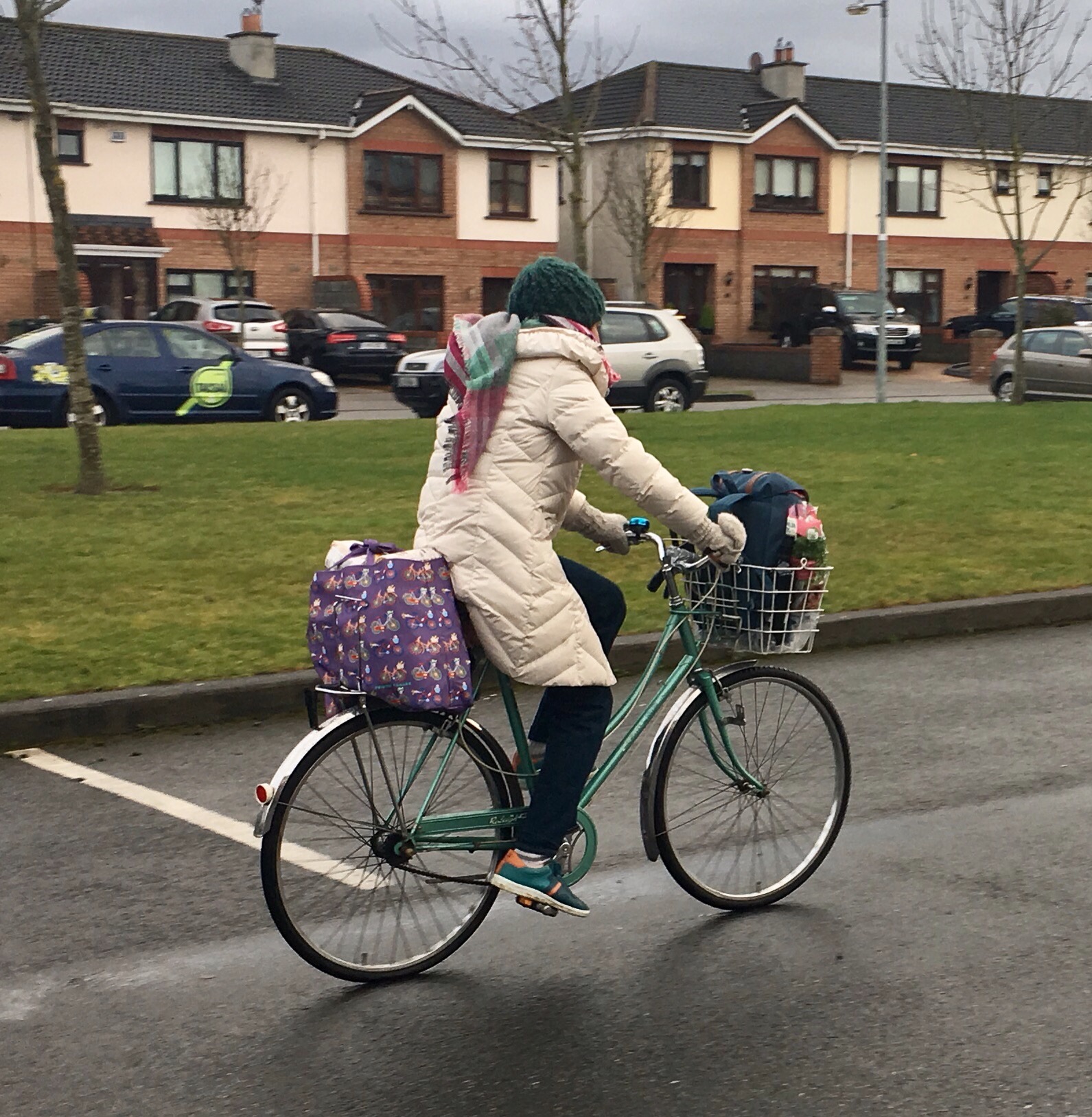
And here I am on my bike, graciously loaned to me by our friend Alena. That’s about 20 pounds of groceries I’ve got loaded on, not atypical before we discovered grocery delivery service, thank goodness.


If it seems that I’m dressed for a nuclear winter, I am. The weather here has been cold and misty in a way that seeps into your bones. Rain comes with wind such that umbrellas are useless against the damp, flipping themselves inside out as if to commit seppuku in the face of their futility. Van Morrison sings much of water, whether it be “streets wet with rain,” “misty morning fog,” or “oh, the water” and it makes sense after being here, where so far the sun has been a reluctant friend. [confessional side note – this seems a good a place as any to finally admit that it wasn’t until I met Eric that I learned that Van Morrison was Irish. I had thought he was Dutch, in the vein of “Van Halen” or “Van Helsing.” You may now mock me for this. It is deserved.]

Living in the mist, as it were, I think often of the Ray Bradbury short story “All Summer in a Day.” [Click to read, it’s a short four pager.] I think I first read this in high school, and it’s stuck with me ever since, a haunting read. Set on Venus, where the sun shines for one hour every seven years, it focuses on a classroom of children who cruelly lock a student in the closet during this one hour, depriving her of her moment of sunlight. The children realize their horrific act, but no matter, the time has passed and won’t recur for another seven years. 

I’m told it’s not quite so infrequent here as that, though it feels it, and I await its appearance with bated breath. 
-s

In which I begin my path of Irish Scholarship

I’m going to be honest with you here, and share what may be an unpopular opinion. Upon hearing that we were going to go to Ireland, many people would get slightly misty-eyed and exclaim, “Ah, Ireland! I’ve always wanted to go there!” Or alternatively “Oh I love it there!” reflecting on happy times spent on the Emerald Isle. “Yeah, I can’t wait.” I would lie halfheartedly. So here it is – I was just not that interested in Ireland. 
I mean, I thought of it as a place of grass and sheep and shamrocks and Guinness but still Westernized and English speaking, and as such not nearly as interesting or different as say Japan or Spain or anywhere. I usually am excited to go to new places, so I’m not sure why I wasn’t really thrilled to come here in the first place. 

But I’m here now, and given that I know little about the history or the culture, when the opportunity came up to take classes at the University, I jumped for it. So I’m now taking a full course load on Irish culture and history, of course. Sapana says that this means I’ve failed at my goal of being a lazy, bonbon eating, soap opera watching housewife, but I’m such an overachiever that I think I can be BOTH a lazy housewife and a full time student. Being a student again is SO FUN. Partly because it’s been almost 20 years since I’ve been in a humanities course, and it’s the first time that I’m learning something purely for fun and grades don’t really matter. It’s giving me a new appreciation for the culture and history here too. 


The courses I’m taking are: Intro to Irish Culture, The Irish Manuscript Tradition, Heroic tales (myths/legends) and Archaeology and History of Newgrange, which is an ancient tomb site. I’ve had a few classes so far and am loving it. Where possible, I’m going to try and weave in some of the things I’m learning with the sites we’re seeing around Ireland to give it more background.
We’ve been taking almost weekly trips into Dublin to see the sights there, and it’s a lovely, if not drizzly, city situated on two banks of the Liffey River. 


The name of the Liffey comes from “Liphe,” meaning Life. The buildings along the banks are generally brick and mortar in the older districts, notable for windows that get smaller as they move skyward. One of the main tourist attractions in town is Trinity College, and specifically going there to see the Book of Kells and the Long Room of the Old Library. Trinity was established in 1592 as a Protestant only institution, only allowing in Catholics beginning in 1793, and not women until 1904.

The Book of Kells is what is called an illuminated manuscript. What’s an illuminated manuscript? I wondered. I was hoping for a book drawn with radioactive inks so that it glowed, or perhaps one which changed when light was cast upon it. In this I was slightly disappointed – illuminated is just another word for illustrated, however the illustrations of the ancient book are truly marvelous to behold. 


A book of the gospels of Matthew, Mark, Luke and John, filled with intricate drawings and lettering, believed to have been written around 800 AD, and has somehow survived the years. It really is magnificent, and the exhibition that precedes it does a fantastic job talking about the manuscript tradition in Ireland and the hisotry of writing in general. 

While you can’t take pictures of the Book of Kells while in the exhibit, here’s the entire manuscript online. I recommend. checking out the following folios (folio is the word for page, r means “recto” or right side, v is “verso” or reverse) – for images, 28v,, 29r, and 291v. For a nice example of illustrated lettering, check out 182v.

Whatever else they may have brought, the Christians coming to Ireland brought with them writing, which previously had only existed as rudimentary stone markings known as Ogham. Some of the earliest known writings are from St. Patrick himself, but do not include a recipe for green beer. From around 500 A.D., they established monasteries and scriptoriums, where scribes would copy out various works. These ranged from religious texts, to legal notices, and some myths. For many Irish scholars, the Book of Kells is indeed quite pretty, however the real interest and cultural history lies in the manuscripts that tell olden tales of yore, such as Lebor naHuidre, or “The Book of the Dun Cow.” After all, it’s pretty easy to get your hands on a copy of the gospels to read, but finding ancient texts that describe historical and mythical tales is rare. Many of these manuscripts were not cared for as the Book of Kells, and have been found in various stages of decomposition in the airless bogs of Ireland when peat farmers excavate the land. 
These have lasted partly because of the oxygen deficient environment of the bogs, and also because they are written on vellum, made from prepared calfskin from a calf no older than 3 months. Any older and the skin is too tough to use for bookwork. Here’s me in class holding up a sheet of vellum, it feels almost like a thin, flexible plastic. 

When the professor said she was passing around the vellum, a blond girl behind me started squealing “Awe, calfskin?! That’s so sad! We have to touch it? Ew, I haven’t even had lunch yet!” I couldn’t take it. Turning around, I glared at her, “Do you eat meat? Are you wearing leather, because if so, you’re already touching cow skin.” “Well,” she replied lamely, “I’m, like, half vegetarian…” But at least it got her to shut up about the vellum. It was incredibly cool to get to feel up close this ancient material, imagine the scribes sitting down with a new fresh sheet, ready for inking. 

The ink came from various minerals and natural substances and were quite laborious to prepare. Oak galls for black, colored lead for reds and whites, copper acetate for greens. Quills came from geese or swans and were cut in precise ways for the different letterings. Styli would be used to draw lines on the paper to keep things straight, and they would also use markings as placeholders for larger first letters or large drawings.

A fantastic interactive site about manuscript writing is found here: Making Medieval Manuscripts.  It’s done like a fun little game and worth five minutes of your time to see how they’re made. My favorite little tidbit about these is that the scribes would often write little snarky notes in the margins, such as “Now I’ve written the whole thing: for Christ’s sake give me a drink.” See? Medieval scribes were just like you and me. 

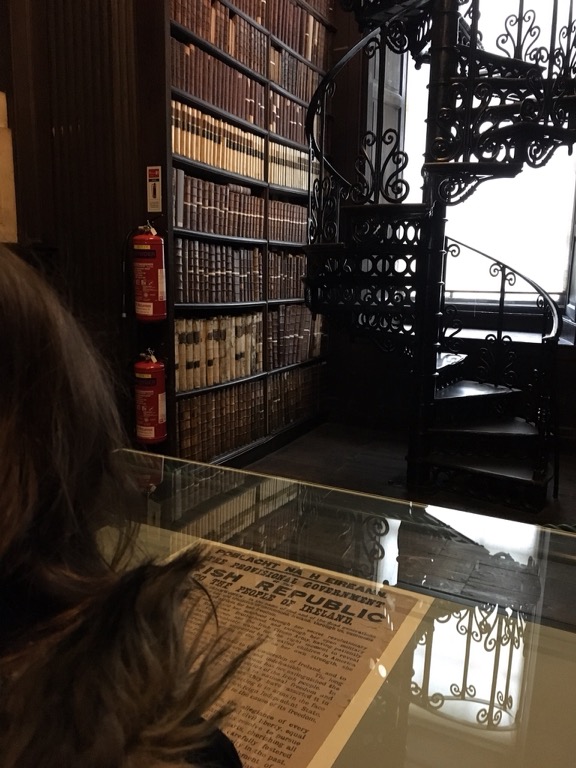
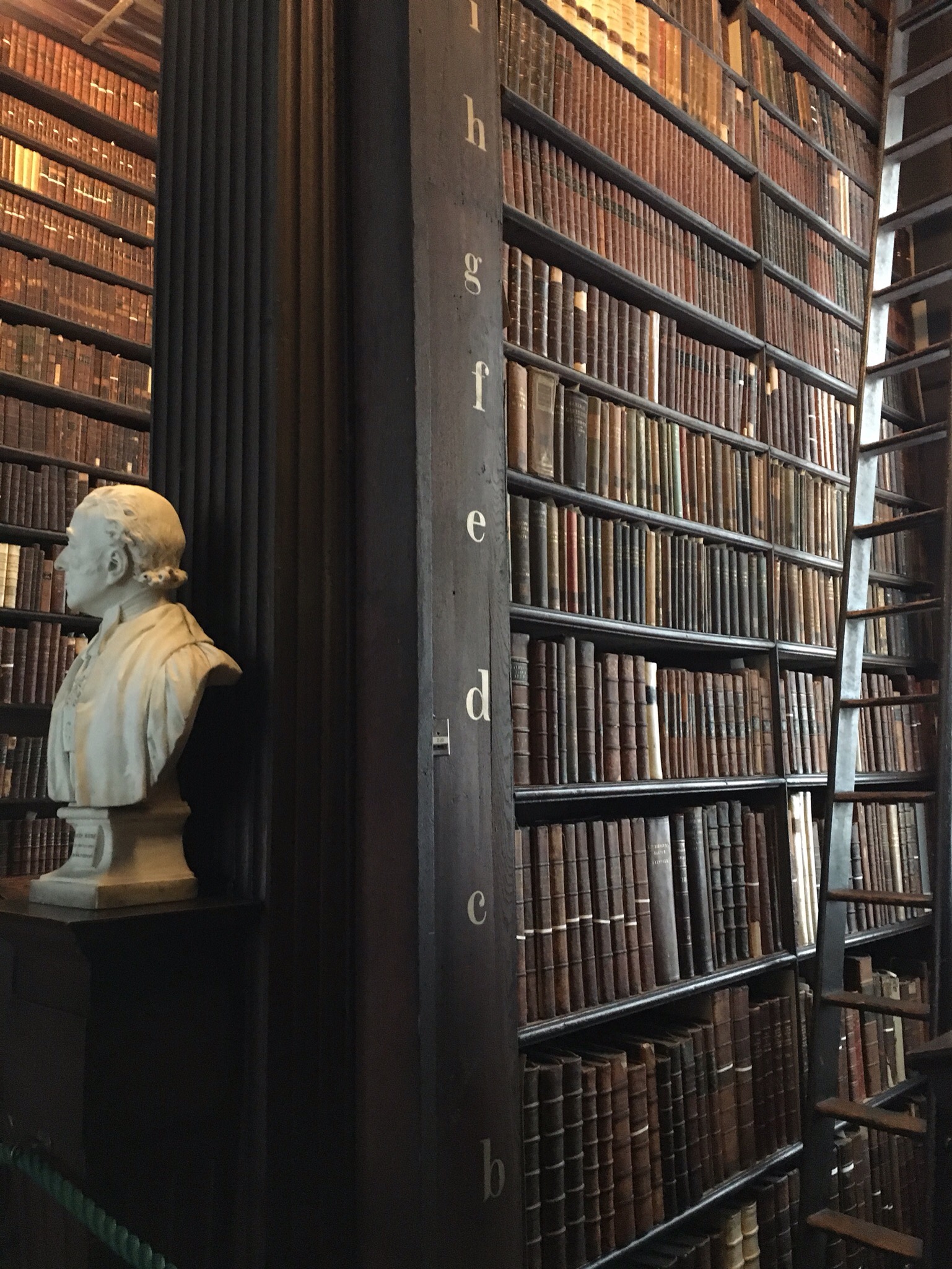
After the Book of Kells viewing, you walk through a narrow passage to enter the Long Room of the Old Library. Friends, this feels magical to walk into, as if you’ve stepped into a past time where bald pated scholars in robes would carefully examine the leather bound tomes held within. Two floors of wall to ceiling books and busts line the central pathway. A security guard gave the boy’s hat ears a friendly flick as we walked by, and we stopped to ask him if the books were still read. Indeed they are, by appointment only. A copy of the 1916 Proclamation of the Irish republic resides here as well. 


The Jedi Archives in the Star Wars prequel movies looks almost EXACTLY like the long room, such that the college considered a lawsuit against LucasFilm, but the producers of the movie said that the Long Room wasn’t the inspiration, so the college basically decided to drop it. You be the judge, but I think the college would have had a preeeetttyy strong case here. 


-s

In which the children become slightly feral

Living in Irish suburbia means that things have slowed somewhat. It’s not every day that we’re out and about seeing different things, eating different foods. Our lives resemble that which we have back home, where the kids go off to school in the morning, come home in the afternoon, we eat dinner at home, then have our evening routine.

img_1547

after school homework time


It’s been hard to write much partly because of that, and also because of being consumed by the political situation back home. I know I try to keep politics out of the blog, but it’s impossible when that is what dominates your life. It’s of course on all versions of social media, and even in Ireland is all over the news and in conversations you hear around you. Despite what seems terrifying on the news cycle with the new slew of executive orders, the fact is that most of our lives haven’t changed all that much from a day to day basis. Therein lies the danger of these things – it can be easy to ignore the issues especially if they don’t directly impact your life. I spent a week in New York, and other than the charged atmosphere, life proceeded largely unchanged from before the election happened. I shouldn’t be surprised, really. We’ve traveled to a few authoritarian states on our journey, and the reality is that there, too, life proceeds as typical on a day to day basis. But people are aware that there are limits to their freedom, and that speaking out can be a dangerous thing. We’re not there yet in the US, but I think it’s heading in that direction very quickly. I think that if you feel completely safe with this current government, then you’re okay with ignoring the suffering and difficulty of others because you don’t feel that you’re at risk at all, which to me is simply morally incomprehensible.

Back to blogging as usual over here. As I said above, I flew back to the States for a week to New York to visit my sister, Sapana, and attend her baby shower! She’s due in March with her first baby and I’m over the moon excited for her. She’s excited, too, though sometimes I think she feels as though she’s been handed a complicated IKEA cabinet to put together, with no instructions and just a shoddy allen wrench. Don’t we all feel this way with the first baby though? I’m sure the child will be fine, and to continue the weak analogy, will be assembled and functional at the end of it, though will have a bunch of spare bits and bobs left over. I usually end up taping these to the back of the piece with some masking tape, as if by osmosis they will provide whatever essential function they were meant for. This works for children too. The shower was so fun! Rakhee, Sapana’s sister in law, did a fabulous job arranging it. It was the best attended shower in the history of baby showers.

img_1747

I also met up with my friend Ulcca from Denver, who was in town for a work meeting and stayed an extra day so we could hang out, my friend Rebecca from medical school who lives in the suburbs, and even my in-laws drove up from Pennsylvania to see me, which was delightful. Both sides of expectant grandparents were of course in attendance. It was great to see my parents again! It’s been so long since we were all together and we all had a fun time being together. We’ve made a lot of friends along the way, but it was just wonderful to see and spend time with family and old friends, to feel that sense of comfort from other people. Texting and social media help while I’m far away, but they’re pale comparisons for actually being with people who are important to you.

IMG_1750.JPG

I was worried that it would feel odd to be back in the States, but well, I haven’t been away that long and it’s a known entity. I love New York City, and spent most of my time (when not with family) wandering around, going to shops, stocking up at Trader Joe’s, and just enjoying the atmosphere. I find New Yorkers to be friendly and helpful everywhere, if not a bit matter of fact.  There were people who offered help when I clearly needed it, and many with whom I chatted just around town. I also think I personally helped to save a New Yorker’s life. This was a checkout clerk at The Strand Bookstore, where I was buying a sloth enamel pin for the girl. As he completed my transaction, he gave a little shudder and said, “Sloths scare me, man. Those eyes…” I gave him a grave look and said that for the sake of his health, I would not tell my daughter about this apostasy, as she would find a way to track him down and cut him. Thus far, I have kept my promise. I hope that I will be recognized for my efforts, if only here.

The one exception to New York friendliness was an Uber pool ride I took while there. I slid into the back seat, and said hello to the other passenger. The car was silent, without music. The other rider next to me didn’t acknowledge my presence, nor did the driver, both women. With traffic, it was a long 30 minutes to my destination, and easily the quietest ride I’ve taken in six months. What was strange for me was that while I previously would have been quite happy with this, I’m not used to it anymore. I’ve become one of those people who likes to talk to strangers now, in a way that I never did before. Meeting different people and interacting with them has become something fun and enjoyable, not something to be avoided. I kept trying to think up different ways to chirp in and start a conversation, but the oppressive silence cowed me until the car spit me back out onto the welcomingly noisy streets of the East Village.


——-

Back to Ireland, where the children run amok…

One day a few weeks ago, the kids had returned home from school. Still in their uniforms, they were sitting at the kitchen table and working on their homework. The doorbell rang, and Eric and I looked at each other, as if to ask “Were you expecting someone?” I went to answer it and there stood a young girl and a very small boy. “Hi! Is E here?” she asked. My girl ran up and said happily, “This is my Bus friend, S! I invited her to come over to our house!” In came the friend and her little brother, handing me a crumpled piece of paper with her mother’s number on it. I texted to let the mom know that they’d arrived and to ask when we should walk her home. I thought that this was a one off situation until it’s now happened a few other times with other kids as well. My kids will invite a friend over without really telling us, the kid shows up with a crumpled piece of paper and a number, and then we send the kids home by themselves at the end of the play time.

For my friends outside of the States, this is something that absolutely would NEVER happen at home, at least not in Denver. The first time that a new friend comes over to play or goes to another, you arrange a time with the parents that works for them and you and where the kids aren’t involved with some after school activity or sports tournament. Then, if you haven’t met them before, you take the kid over (usually by car because it’s not easily walkable) and hang out for a little bit to make sure that they don’t seem like axe murderers. If you are a really good parent, you’ll be sure to ask if they have guns in the house and if they’re locked up. At a prescribed end time, you will come to pick up your child from the house. Future playdates, because they are always called playdates, are again arranged through the parents for specific times. Occasionally after you know someone, the kid will come over after school for a bit. If kids are out on their own, they usally have a cell phone leash so they can always be contacted. The only friends the kids have where these rules don’t apply are the neighbor friends from down the street, who are now close enough that they all run back and forth. Even then, though, usually it has to be cleared by one of us to make sure that they are not busy doing something.

The freedom of children here is revolutionary for the kids, and us. Despite how “free range” I’d like to think of myself as a parent, I was uncomfortable with this at first, but it’s easing up. The boy the other day went home with a new friend and then walked home by himself at the end of it. The other day, the girl had an afterschool activity, and Eric and were going to be in Dublin for the day. A plan was made: the boy was going to walk to the library, stay for an hour, then walk over to the girl’s school and they’d walk the one and a half miles home together. I suspected they would stop in at the candy shop along the way, and in this I was not wrong, however I underestimated as they also stopped in at the chip shop. It went off swimmingly, and the kids loved having the open space to do what they wish, asking if they can do this more frequently.

Yesterday we may have stretched things a bit far – the boy didn’t want to come to the pool with us, instead his friend V came by and they played outside in the morning. In the afternoon, he went over to V’s house to play a bit more, and I thought he’d be there for quite a while but left after an hour and came home. Eric, the girl and I were in town running errands, thinking that he was at V’s house. When I got home, I found that he was sitting at home with the lights off because he was afraid of robbers and thought we might have been parent-napped. I felt a bit bad, to be sure. Still, he said that he would definitely want to do something like that again, and now is more comfortable with it as well. Besides, I did point out that he could email us at any time, which hadn’t occurred to him.

I currently am not entirely sure where they are. They ran out of the house a bit ago to go play outside and perhaps see if some friends were home and could join them. I love that we can be somewhere where the kids can have their own life without us needing to hover or know exactly where they are at all times, and the growth opportunity it gives them.

-s
In which we move to the burbs…of Dublin

Lisbon reminded me of San Francisco, with its steep hills and angle bottom houses hugging each other in a line, the foggy mornings and misty bay. The Golden Gate bridge replica, built by the same architects to cross the bay, adds to the similarities. My favorite Lisbon detail was the tilework seen covering many of the building walls throughout the city. 

9 of my favorite tile patterns seen throughout the city

Tiles on the building, patterns in the cobblestones. Lisbon is a delight of visual decoration


Now, a true tourist trip to Lisbon should include a visit to the areas of Belen and Sintra, home to beautiful architecture, Unesco world heritage monasteries and a top class modern art gallery. But we were all travel weary, tired of sightseeing, and just didn’t have any motivation to hoof it out to the suburbs. So after the first day which Eric describes, we just wandered around the city for the rest of our time there.
There’s this cool food hall in Libson that has apparently been purchased by Time Out Magazine, where they have many different delicious food stalls surrounding a central dining area, brightly lit and with a large glass skylight overhead. I had pictured a nice walk down there, showing it to the family where we would ooh and ahh over the options, then sit down for a fun meal. What happened instead is that Eric does this thing where he chooses or forgets to eat a meal. This results in hungry Eric. Hungry Eric is a grumpy, snappy Eric who then makes poor food choices. We ended up eating pad thai, which wasn’t bad actually, but I was too annoyed to enjoy it properly. Sigh. 

We rambled our way up to the Duque Brewery, where Eric only consented to go inside if we called it “Du-kay,” not wanting to even hint at the evil University that shall not be named. Delicious beer and we made some delightful friends from Britain who were in Lisbon for New Year’s and I hope that we manage to meet up with them again too!


We’ve settled in Maynooth, Ireland now, about 40 minutes outside of Dublin. I feel like we left these dense urban landscapes and woke up in small town Oregon. The house is a roomy three bedroom duplex, and it feels like we can stretch out again, unpack and set up a house for living, not just staying.  It’s taken some doing to get the house put together, with a lot of time spent running errands and getting things like linens, dishes, and food. We couldn’t have done it without the help from the people at Maynooth University. 
You can tell a lot about what a country prioritizes by its grocery store, and Ireland is no different. I realized that I hate the first time I go into a new grocery store in any country. It’s disorienting to say the least, since nothing is in a familiar place. The kids were along for the first visit, and add to the mental chaos as every five minutes they chirp about something that’s caught their fancy (look! Harry Potter yogurt!), but has nothing to do with the red bell peppers I’m actually hunting for. 
Here’s the flour. Divided into cream flour, plain flour and strong flour. Strong flour? I think it means it’s got a higher gluten content but I’m not sure. I didn’t think I could handle it so I opted for the more compliant cream flour instead.


Wall of baked beans, revolting. Sorry to the Brits and Irish, it’s an acquired taste. Also “salad cream,” not sure what that is either. It’s NOT mayonnaise, since that’s on a different shelf. A wall of custard and a TON of prepackaged jello.  I couldn’t find any ricotta cheese, but if you want cheddar in all Irish varities, you’re covered. 


And of course, and ENTIRE freezer bin aisle is dedicated to potatoes of all types. 


So far our welcome has been warm and people are really friendly and helpful. I keep wanting them to talk as much as possible just so I can hear the Irish accent. They also really say things here like “You’re grand” for “that’s fine, don’t worry!” And my favorite “I’m only delighted” pronounced “I’m onie deloyted” and it is just so cute. I know, I know, I shouldn’t make broad sweeping generalizations and I know Ireland must have it’s share of rude and mean people too, but I haven’t met any yet. 
The kids have started school too, separate schools for boys and girls. They are so happy to be back in school again, and having homeschooled very lackadaisically for the last five months, I have confirmed that you have to be either slightly insane or a very different person from me to want to do that full time, so I’m only delighted too. (See how Irish I’m becoming??) They’re learning a bit of Irish in school, and come home with their newest words. The girl loves not having any boys at school, as she now doesn’t have to spend recess coming up with attack strategies to ward off the packs of chasers as she did at home.  The boy, however, misses the balancing energy of having girls in the school, and finds the place a bit rowdy. He’s learned that he is terrible at Gaelic football and also terrible at soccer, at least how it’s played here, where the ball is largely kept up in the air by skillful feet and hardly gets a chance to roll on the ground. I’m sure he’ll slowly amass a cadre of nerds and reestablish his D&D sessions here. The girl is also making friends in her class. I do have to say that I think she is in a class too low for her. The age cutoffs are done differently here, and the work she’s doing seems to be far too easy for her. The class above is full though, so we’ll just have to supplement on our own. 
I can’t believe how quickly it feels like the last five and a half months have passed, and that we’re at the midpoint of our year away. We’re all of us happy for the time we’ve had, and also to slow down for a while and catch our breath again too, with the new experience of small town suburban living, which will be its own adventure as well. 

-s
In which we learn that the Spanish Inquisition was entirely expected

Madrid wasn’t necessarily part of the initial travel plan at all, but the tickets from Barcelona to Seville the day we wanted to go were sold out, so we figured we’d spend a couple nights in Madrid instead.

Spain’s largest city, Madrid struck me as akin to Manhattan. We stayed in Lavapies, an immigrant and artist neighborhood on the South side of town, which felt like what Brooklyn probably was when it was still Brooklyn. The one time we ventured into center city we were immediately in huge crowds of tourists and I felt like I was in the hell known as Times Square. We shuffled along as quickly as we could and got out of there. I hadn’t planned on it being so unbelievably crowded, but Christmas/New Year’s time is holiday in Spain too, so I wasn’t just fighting foreign tourists but Spanish ones as well.

Eric’s post on our first day in Madrid is excellent and full of details and pictures. We were initially going to leave for Sevilla in the morning, but changed our train ticket so we’d have time to visit the Reina Sofia museum to see Picasso’s Guernica, permanently housed there. Unlike EVERY OTHER MUSEUM in the world, the Reina Sofia (contemporary art) is closed on Tuesday, not Monday, so we were disappointed when we tried to go there the previous day.

Most contemporary art museums in Europe that we’ve been to focus on the movements surrounding the World War, the Cold war, and dictatorship whether of the fascist or socialist flavor. Spain was not directly involved in either World War so this is not part of the history nor the art. They were embroiled in their own vicious civil war from 1936-1939 and that is reflected in the art of the time. A coup by the rightist military (Republicans), led by Francisco Franco, against the ruling left leaders (Nationalists) arose. The military right was supported by Nazi Germany and Fascist Italy, and many civilians were killed in the fighting. Artists and intellectuals fled during the fighting and after the Franco regime won and took power, setting up Spain for a military dictatorship that wasn’t to end until Franco’s death in 1975.

Picasso, in exile in France, followed the fighting in his home country. He learned of the bombing of the northern village of Guernica and was commissioned by the Nationalist government to create a piece of art in response. Covering an entire wall, the painting travelled around the world for its early life to highlight the atrocities of the civil war and fundraise for the losing cause. No pictures of the artwork are allowed, so here’s one from the web. The pain of the people and animals in the painting is evident, and it is considered to be the most important anti-war artwork of the 20th century.
Fun fact: A tapestry replica hangs in the UN, and was in the room where Colin Powell made televised addresses in support of the Iraq war. The Bush government had the tapestry covered during this time, thinking it was unseemly to call for war in front of the Guernica.

We made it into Sevilla in the early afternoon, hopped a bus to our Air BnB and settled in. This time, the neighborhood is Triana. Older, largely residential and working class, but with plenty of bars and restaurants as well.

In the morning, I chirped “Does anyone want to go on a walking tour?” The kids groaned, Eric said he really needed to go for a run instead. I didn’t feel like sitting around the house so thought I’d just go by myself. This turned out to be an excellent idea.

I wish I’d gone on the free walking tours in other cities – they’re great ways to get the lay of the land and some ideas about where you might want to spend more time. They cost nothing to show up, though you are expected to tip your tour guide between 5-10 Euros at the end, and they’re still worth it. Daniel, an energetic guy with the Pancho tours company, walked us around his city and pointed out the sights along with stories.

Seville is interesting from an architectural standpoint as it was one of the later cities to be “reconquered” by the Spaniards from the Moors, the Moroccan invaders. The Muslims occupied most of the Iberian peninsula by the 8th century, and it was years of a slow recovery of homeland lasting until the 15th century, ending with Granada in the south. In most cities, all existing Muslim buildings were destroyed and replaced with Christian/Western style buildings instead. In Seville, where there were large populations of Muslims as well as Jews, the buildings weren’t demolished but instead reformatted to include both elements. The large cathedral is an example of this – it was built on the site of the previous mosque, and the towers that surround it bear clear Moorish influence. The remains of Christopher Columbus rest in the cathedral. One interesting theory is that Columbus was actually a secret Jew, and the date he left for the Indies was also the date of the beginning of the Spanish Inquisition (very much expected) where all Jewish people were either forced to convert or be executed. Fun fact: the inside of the tower has ramps, not stairs, so that during Moorish times, the Imam could ride a donkey up to the top to save his voice for the calls to prayer!

A later pic of the cathedral at night

The tour ended at the Plaza de Espana, which is just incredible. A wide open space built for the Spanish exposition of 1929 it features a large semicicular plaza with tiled murals of all the Spanish provinces bordering it. I went back later with the kids – there’s a guy who makes big bubbles on the plaza and has buckets for you to do so as well. There’s boombox playing pop hits mixed in with classical, and the sunny plaza is filled with bubbles, children laughing as they try to chase them.

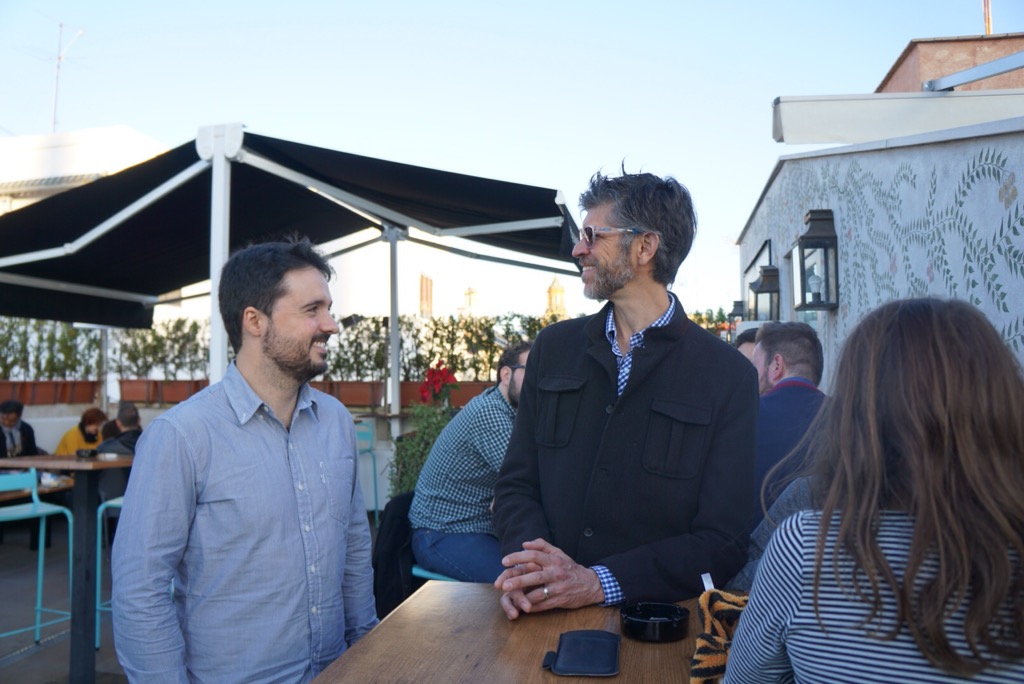
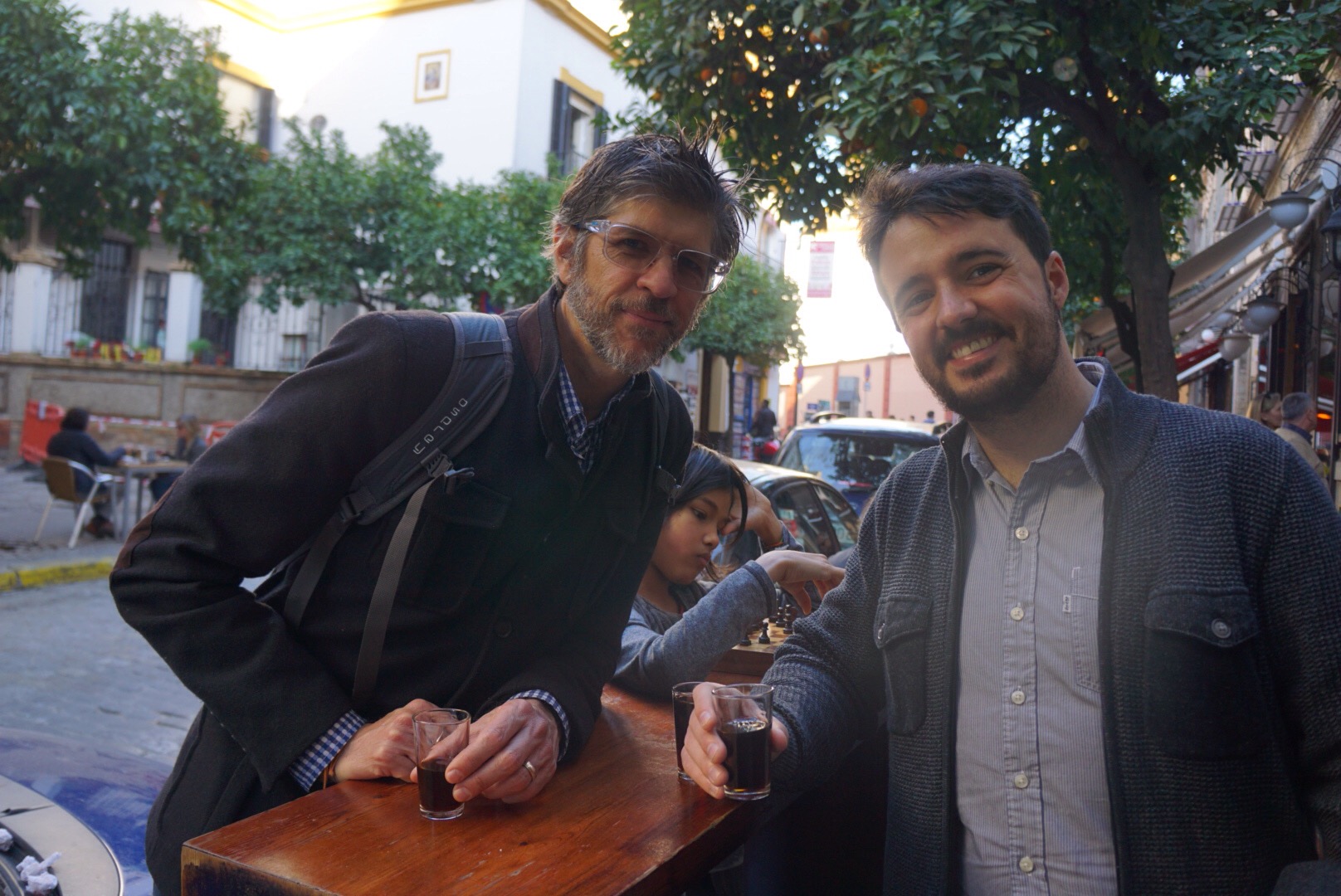
Later that day, we met up with Victor, who we’d met on our rained out bike ride in Cambodia! So, so fun! Victor is originally from Seville and we had a blast together. He took us to a delicious little tapas place in Triana, then we wandered around the Santa Cruz barrio, or old town and had some orange wine, finishing up with a visit to a rooftop bar near the Cathedral where we had a pretty view with the sunset. I loved that we were able to meet up with him and hope we are able to do so again!

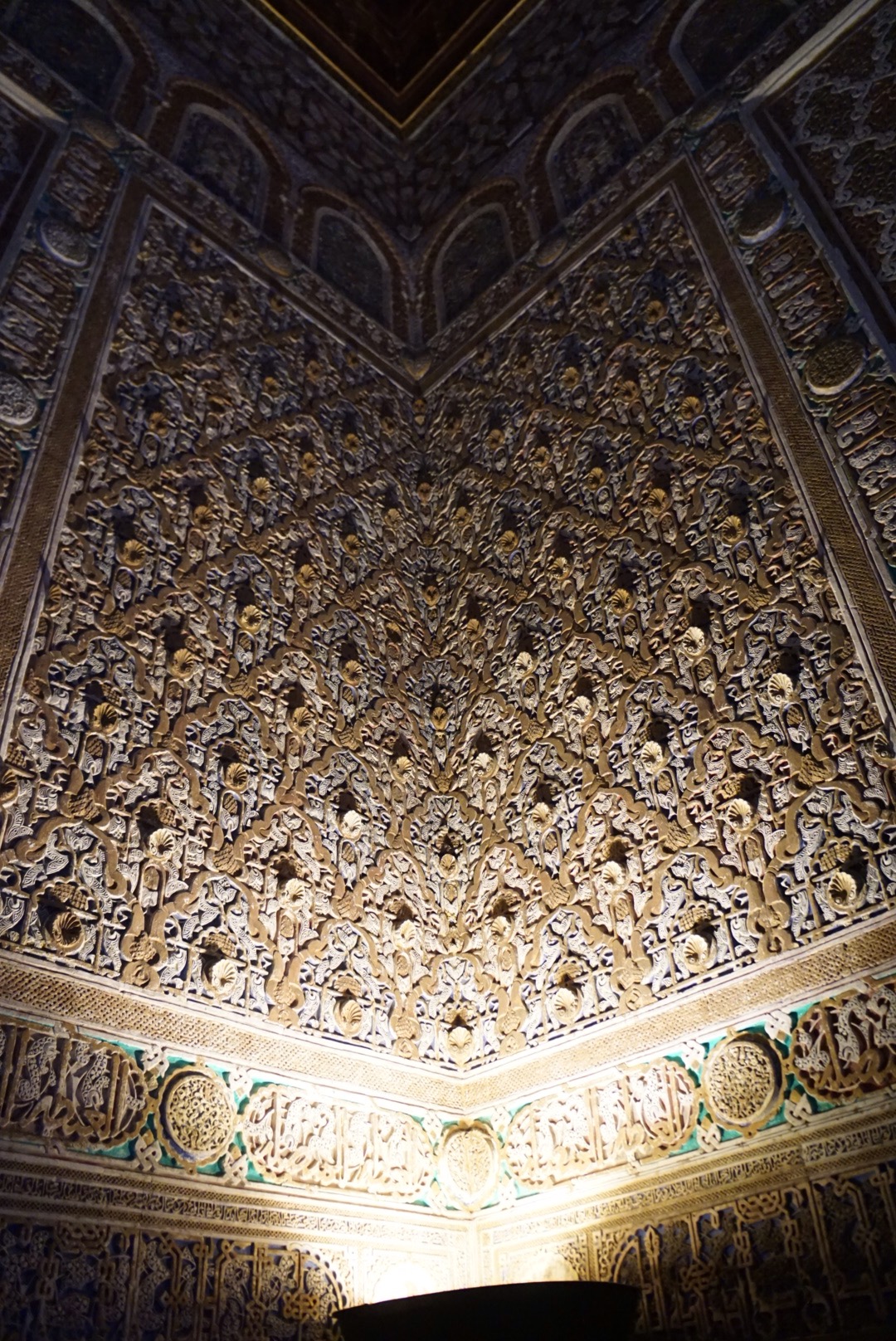
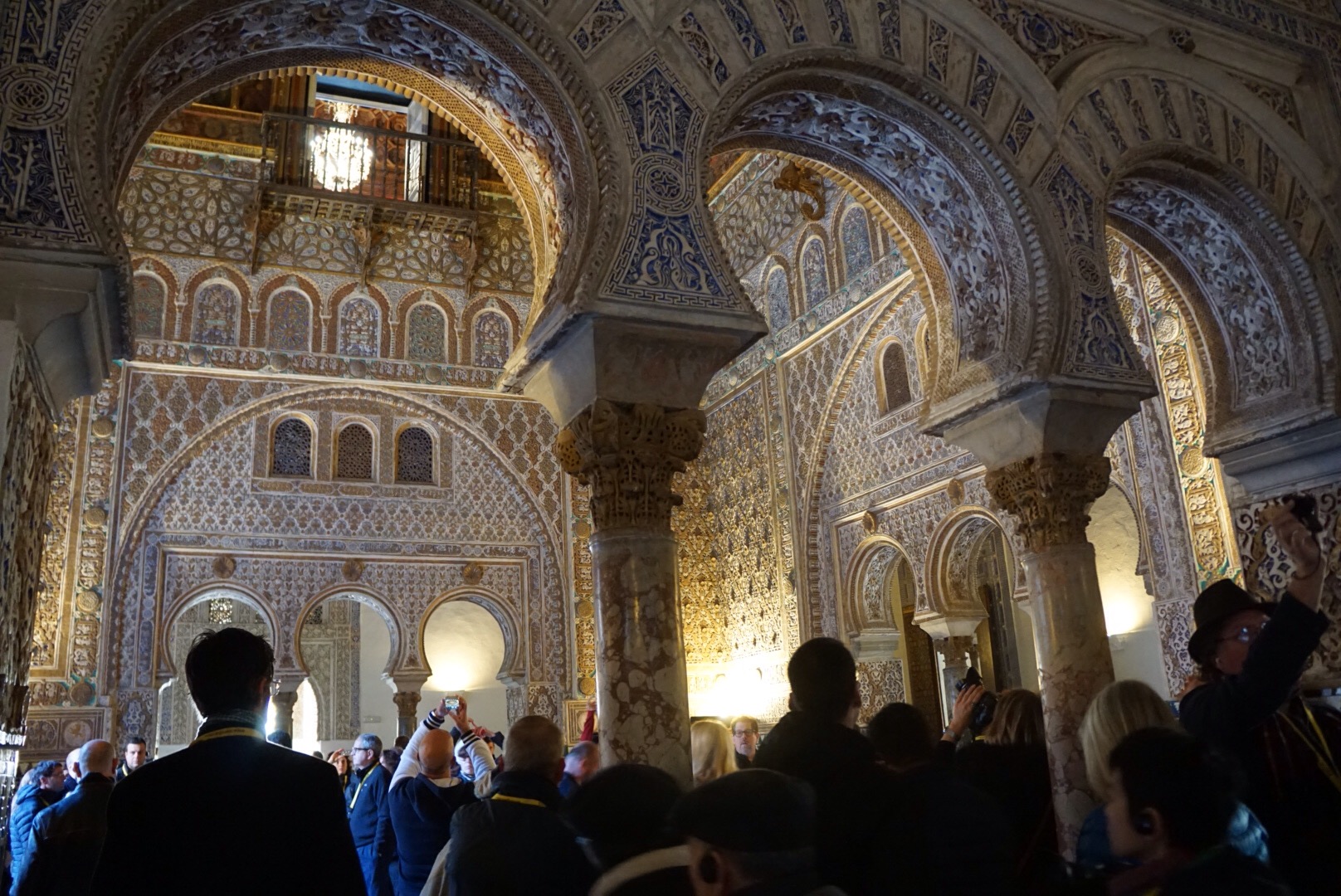
Our next day we booked a tour for the Alcazar, a Moorish castle until it was taken over by the Christians, again the Muslim elements were not destroyed, simply a new level was built on top. The castle is stunning inside. Large rooms and courtyards all decorated with plaster moldwork, featuring nature themed designs and patterns. Colorful tilework lines the ceilings, and the lamps are said to represent stalactites and stalagmites to further imitate nature. The Christian levels, I must say, are rather boring after this. Large tapestries that celebrate various kings and their conquests, somewhat mismatched tilework. It just isn’t as artful. The gardens and some of the interior were used in filming Dorne in  Game of Thrones.

3c2a8141-8072-4181-bcda-fd977c7de3d0

After lunch we walked on the main pedestrian mall and came across this bizarre street performer. What on earth was he doing? We found out a minute later when an unsuspecting woman walked by, not paying attention at all. As she passed the table, he rapped a box underneath to create a sudden noise. The woman gave a small jump and yelped in fear, looked over and then started laughing – she had been had! The rest of us burst into laughter because it was hilarious. We stood there for a good twenty minutes, watching person after person get startled. Kids and dogs were the funniest reactions to watch of course, though I noticed the performer was careful never to startle anyone with a baby or anyone too elderly! Thoughtful, no?

For New Year’s Eve, we managed to get into rather a squabble. I had really wanted to see a flamenco show and there was one right around the corner. We got there in the nick of time, only for Eric to announce that he didn’t really want to see a flamenco show, it was too expensive, and he would just go sit in the plaza instead. Now, one possible reaction to this would have been for me to say, “Sure honey, we’ll see you in an hour,” and head on in with the kids. This is not the reaction I had. Feeling quite rejected, I nearly burst into tears and said something like “Fine! Then we WON’T go!” Unable to be mollified, we spent much of the morning in a tiff as we walked back to the Plaza to Espana so Eric could see it. Along the way, we of COURSE saw sign after sign announcing “Flamenco show for New Year’s Eve!” I mean, really.
We eventually all got over it and ended up back at home for a quiet New Year’s Eve, playing a family game of Dungeons and Dragons. Eric’s role was that of a monk, and he chose to use his first turn to try and tell a story to some doltish orc like creatures, for which he was rewarded with a rap to the head and was knocked unconscious for the next fifteen minutes. After one hour of playtime, we had advanced through just one room in an underground dungeon. The idea to walk around Seville at night was floated, and then summarily rejected by all present, exhausted as we were from a day of strolling about the city, and we bid an early farewell to 2016.


-s

In which we have a Bon Nadal

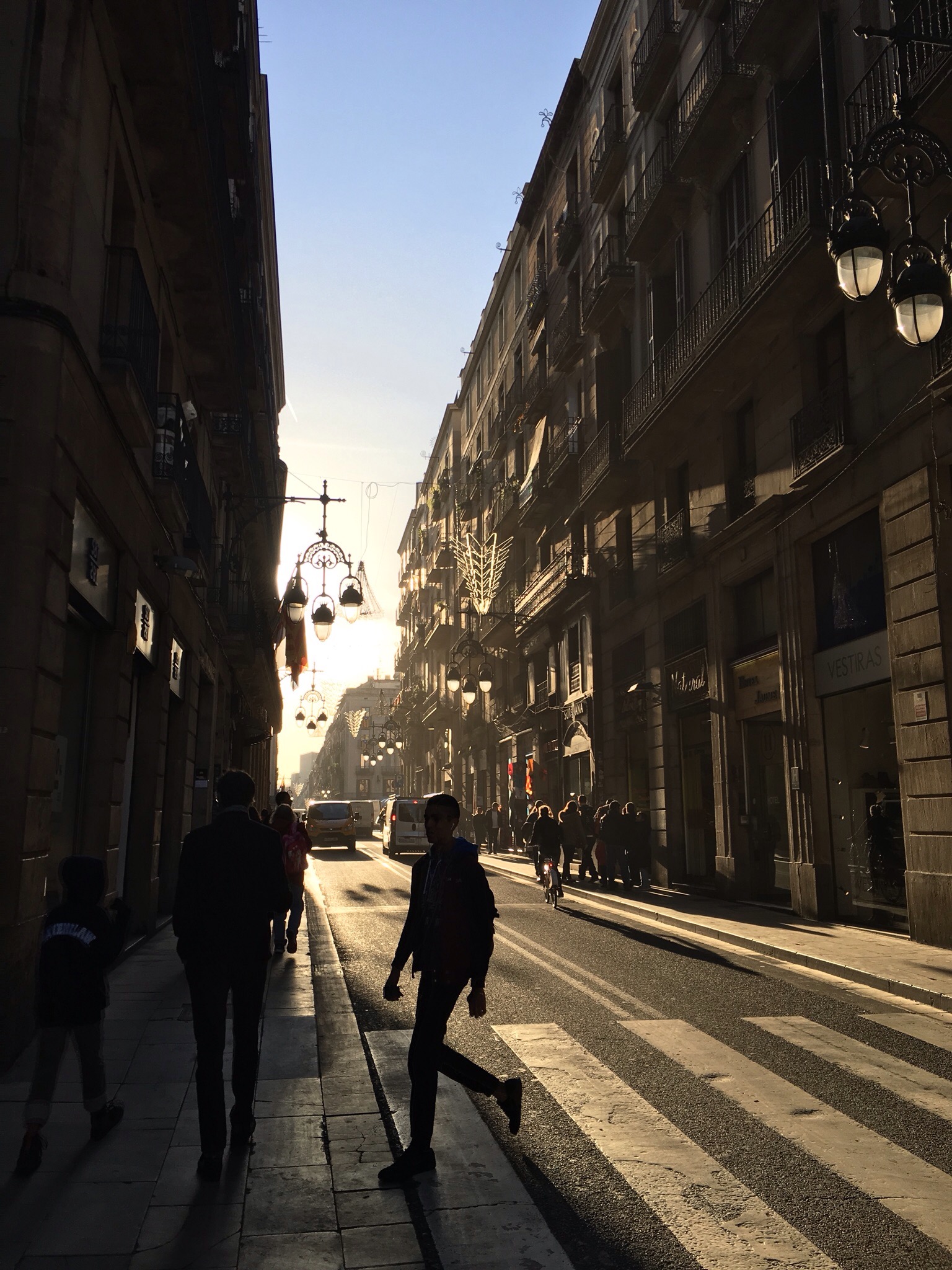
Barcelona for Christmas time, we decided, and booked six nights here to have a more relaxed time of it. The neighborhood here we decided on was Gracia, an area to the North side of Barcelona, again not in the tourist scrum, more residential but still lively. It turned out to be perfect for us, with vibrant streets and lots of families around. 

Patterned tile sidewalk on the streets of Barcelona


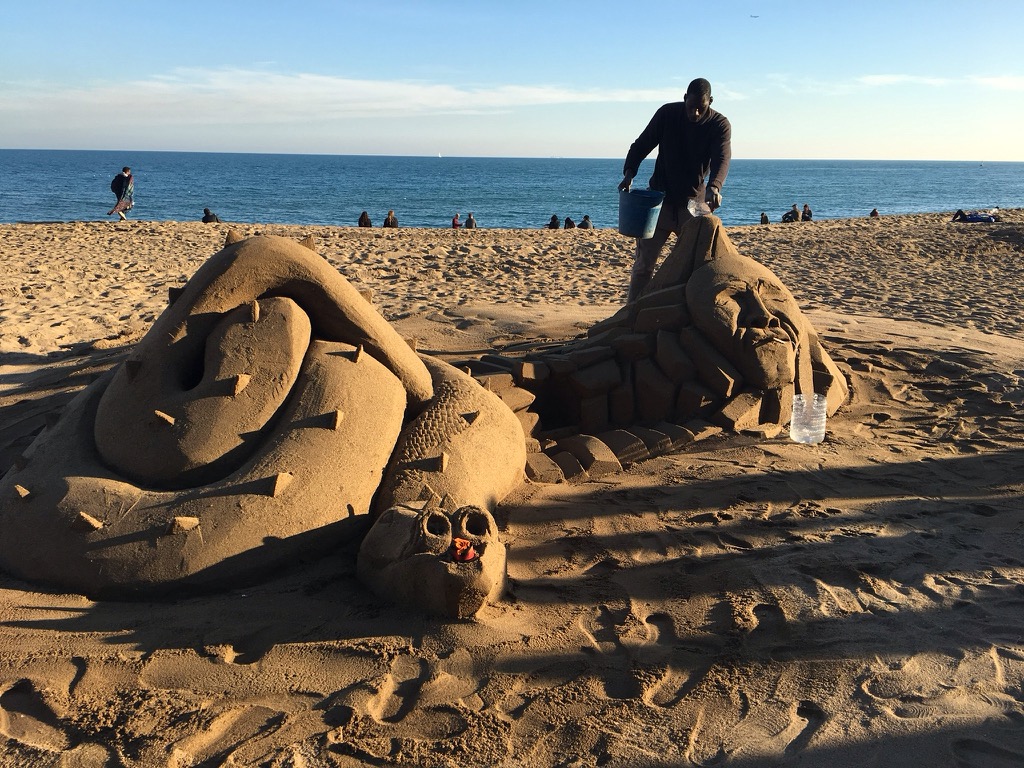
We went to the beach the first day, first walking down La Rambla, the wide boulevard that bisects Barcelona. Ringed with touts selling all sorts of cheap wares and filled with selfie-stick wielding tourists, we escaped as quickly as we could. Finding the ocean, we left the kids at the seaside while Eric and I walked fifty yards away to a boardwalk bar, sipping a beer while the kids became thoroughly covered in sand. Creative sand artists line the boardwalk with their creations, with boxes for offerings set out in front. On the way home, we strolled through small streets of the old city and eventually ended up back home. 


We took a walking architecture tour the following day, overall underwhelming from a tour standpoint, but still with some interesting tidbits to be gained. As Eric describes in his post, Barcelona city planning is such that the buildings are laid out on a grid and the facades are cut across corners so that the intersections form somewhat of a diamond or octagonal shape when viewed from above, opening up the city as a whole and letting more light in. In the courtyards of the city blocks are small parks – these had been filled in with warehouses, but as these fall into disuse they are dismantled and the space opened for public use. 
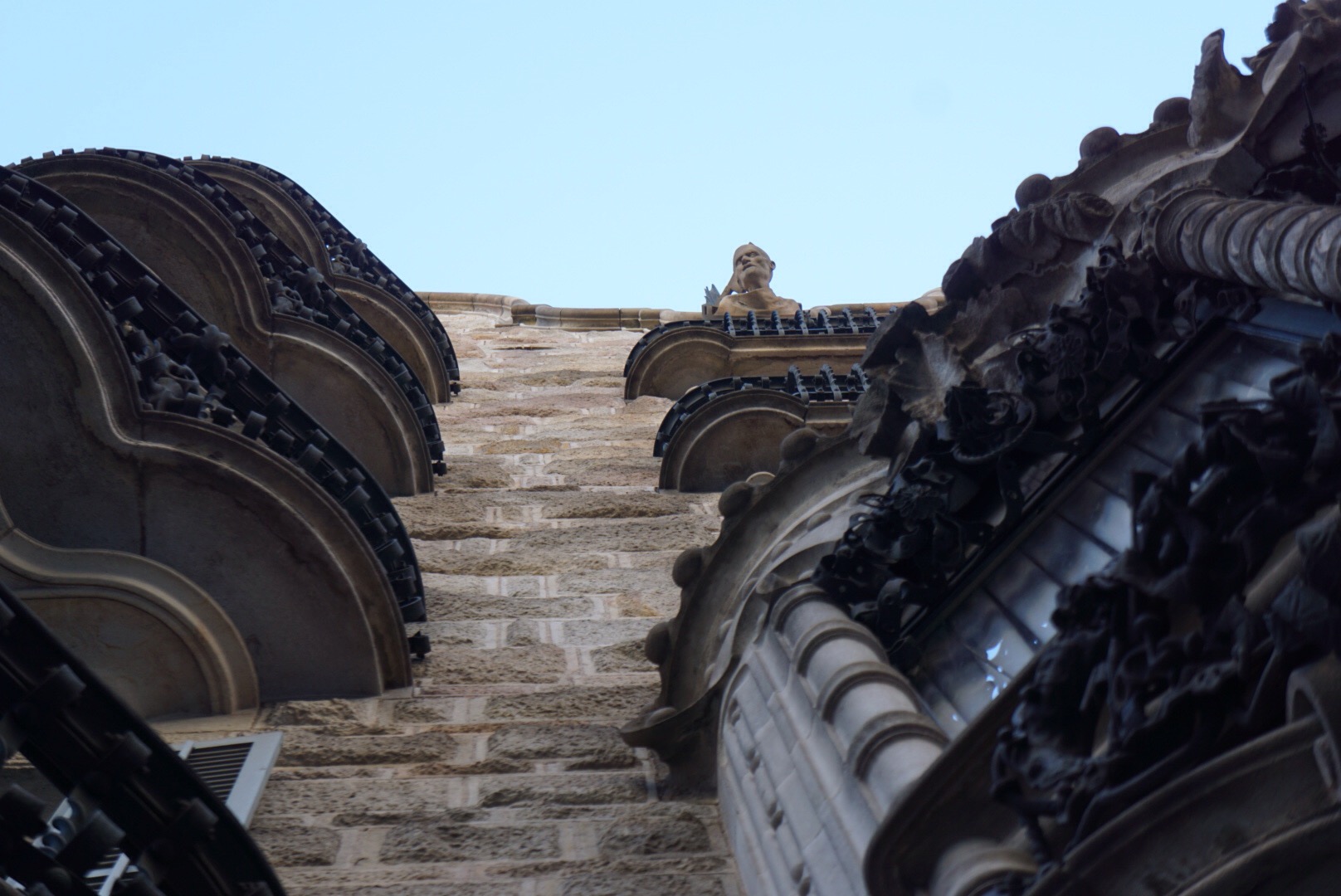
Antoni Gaudi was a Spanish architect who was known for his somewhat outlandish styles, but more so for how he used nature as an inspiration for his buildings. Using catenary arches to support the weight of large buildings was revolutionary, instead of relying on external supporting buttresses as had been done in the past. Here you can see the undulating forms of his buildings, in contrast to the straight lines that had been done previously. The roof of the building follows these waved lines in arcing forms. According to our guide, and somewhat unsurprisingly, Gaudi was hated by his contemporaries.

After the tour, a lunch of tapas was in order and Cerveseria Catalan did not disappoint. We decided to make a Gaudi day of it and headed to the Sagrada Familia basilica after this, Gaudi’s last civic project before getting run over by a tram at the age of 72. I didn’t really know what to expect, the outside is a bizarre mishmash of styles and scaffolding. It’s now predicted to be completed by 2026, but my guess is that people doubt it will ever be finished. 

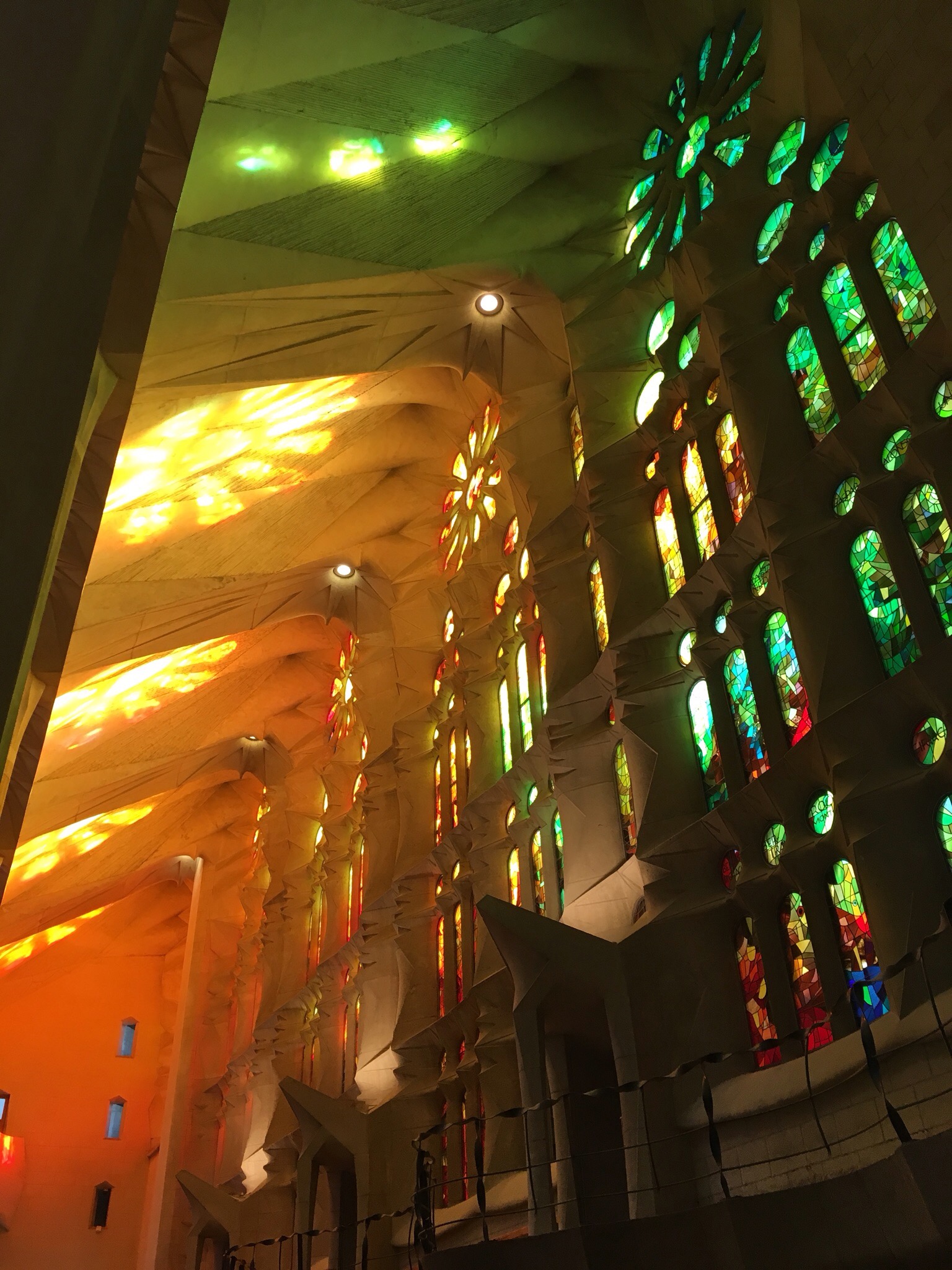
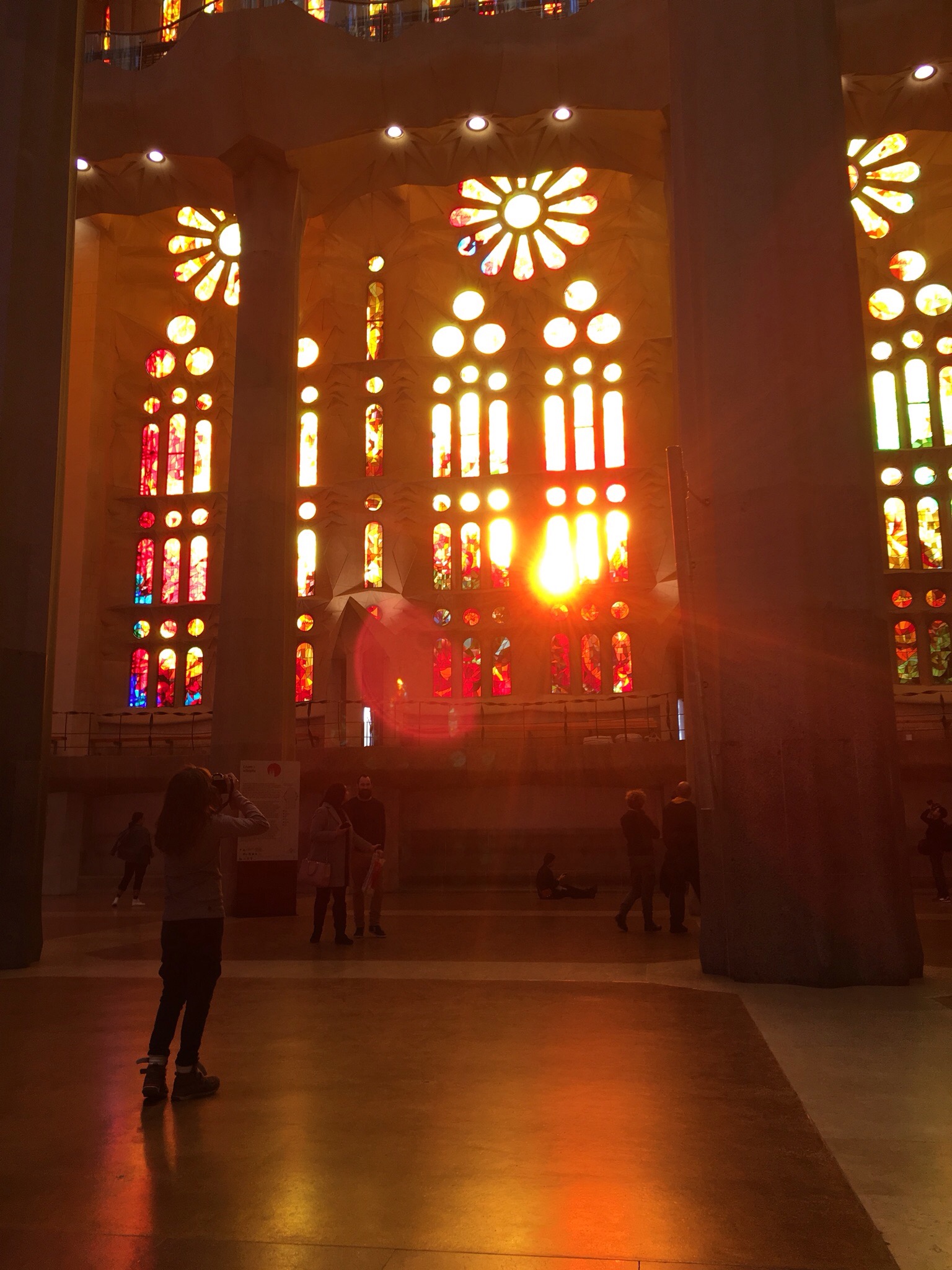
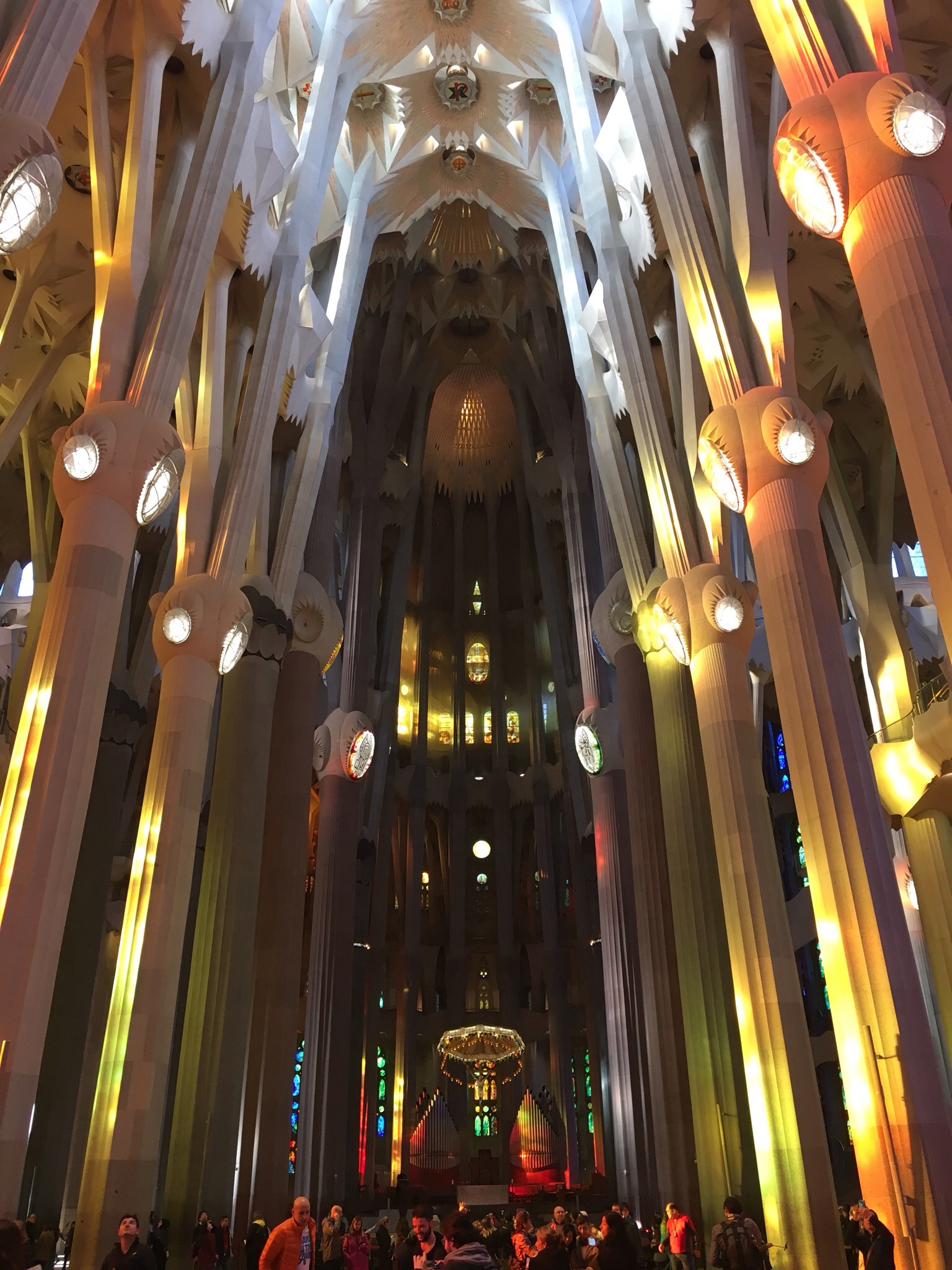
Once you step inside, however, the effect is magnificent. An open space formed by white catenary arches is surrounded by stained glass windows of deepest rainbow colors. You feel as if you’ve wandered into a fairyland forest and the effect is mystical. The low afternoon light streamed in and threw colored reflections throughout the cathedral. Other than the natural decorations from the light, there was little else in the main room to show power and wealth, unlike the other cathedrals we’ve witnessed so far, and as a result felt truly holy. Interesting that the most religious space I feel I’ve been in is the one that reflects nature as it is, instead of the creations of Man at their most ornate. 

———-

The next day was Christmas Eve, and the girl was clamoring to go back to the beach, so we made that our plan. I know that it means we skipped more sightseeing in Barcelona, and the list of things we didn’t really get to see is long, but sometimes everyone has more fun if you just relax and don’t make it about having to “see” everything. Despite the water temperature being 60 degrees, the girl was undeterred and went for a swim, harkening back to her past life as a polar bear. 

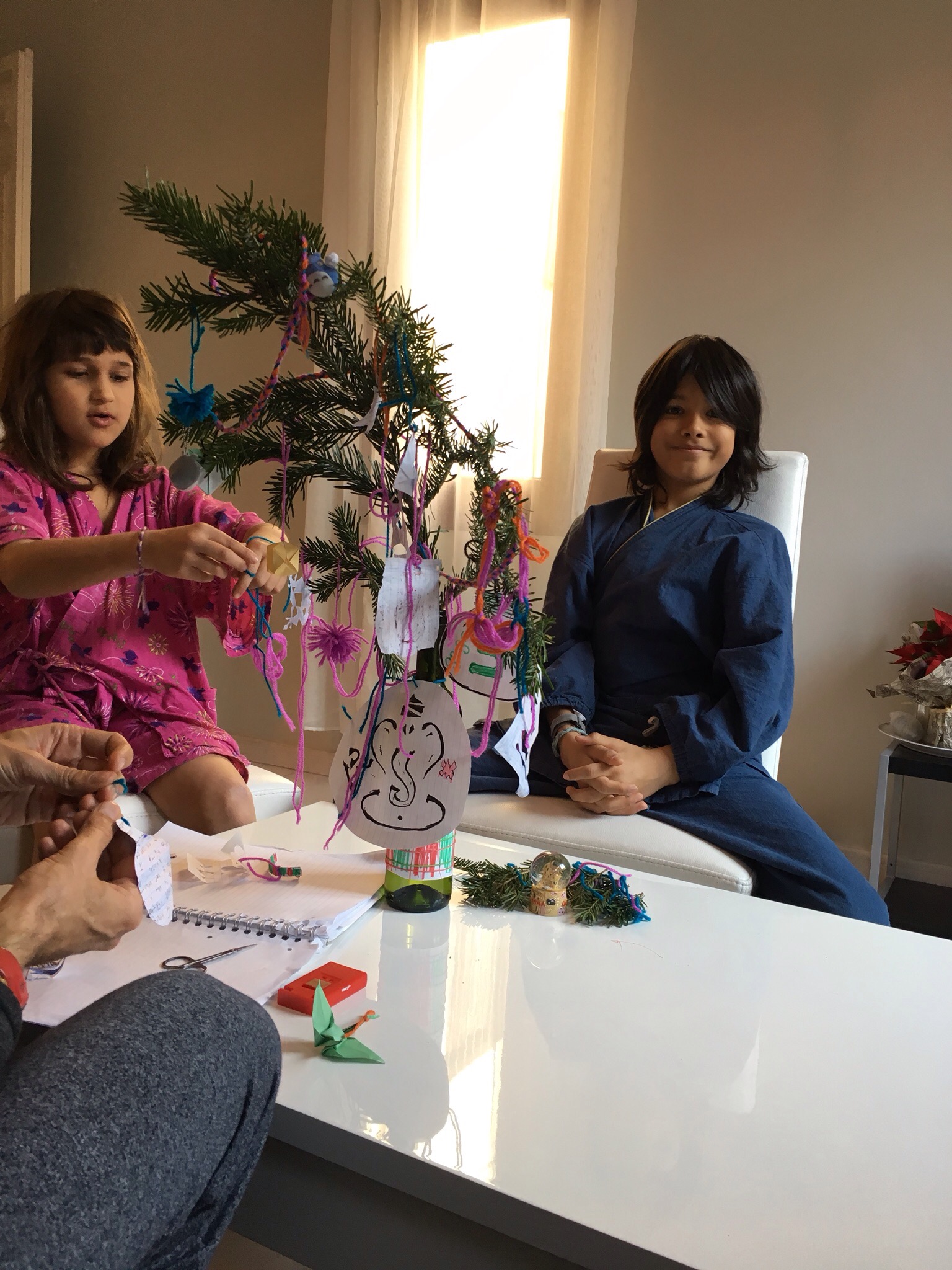
The kids had found a discarded pine tree branch in a pile near the Sagrada Familia, and spent the morning making paper and string ornaments to decorate it. We played Christmas music on my phone and finally felt like we were getting into the spirit a bit more. I haven’t been homesick much on this trip, but this was a harder time. For the last eleven or twelve Christmases, my sister has flown out to Denver for the holiday. The last few years have included my sister’s husband and his sister as well, so the group has happily grown. We make pierogies together, try to go out for a trivia night, once went to a hockey game (my first!) and always go skiing on Christmas day before coming home, taking showers and opening presents in our pajamas. We listen to Christmas music and get our tree the day after Thanksgiving, put up a sparkly wreath, and decorate together. I look forward to it all year, and I know Sapana does too. This year all of us felt wistful at missing a home Christmas and our traditions that usually go with it. 

A bit late but we managed a little tree, sure. Pierogies too, then, must still be part of the menu. The ingredients weren’t particularly difficult to find, though a rolling pin wasn’t available at the apartment. I continued my series of improvisational cooking by using an unopened wine bottle and it did a serviceable job.


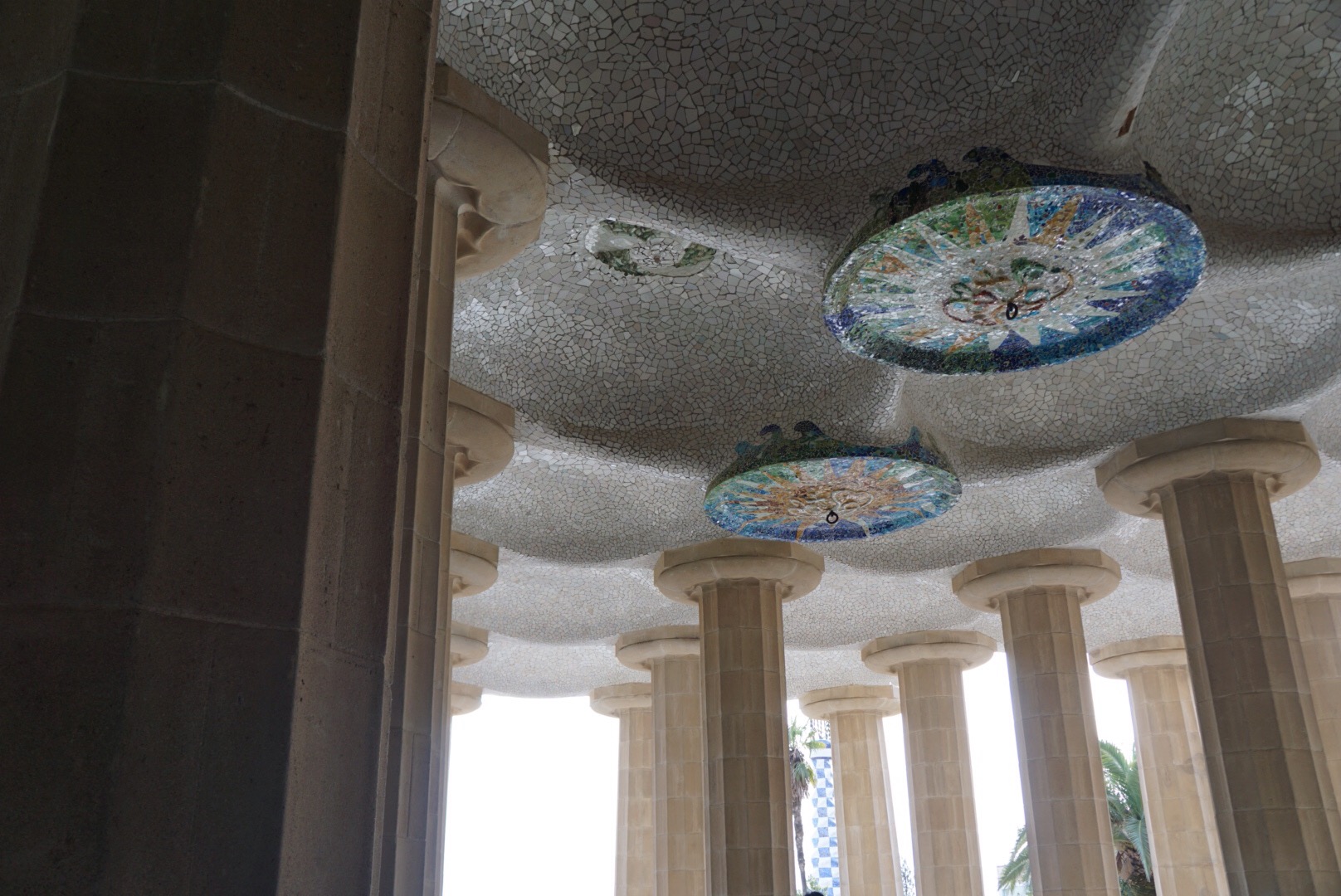
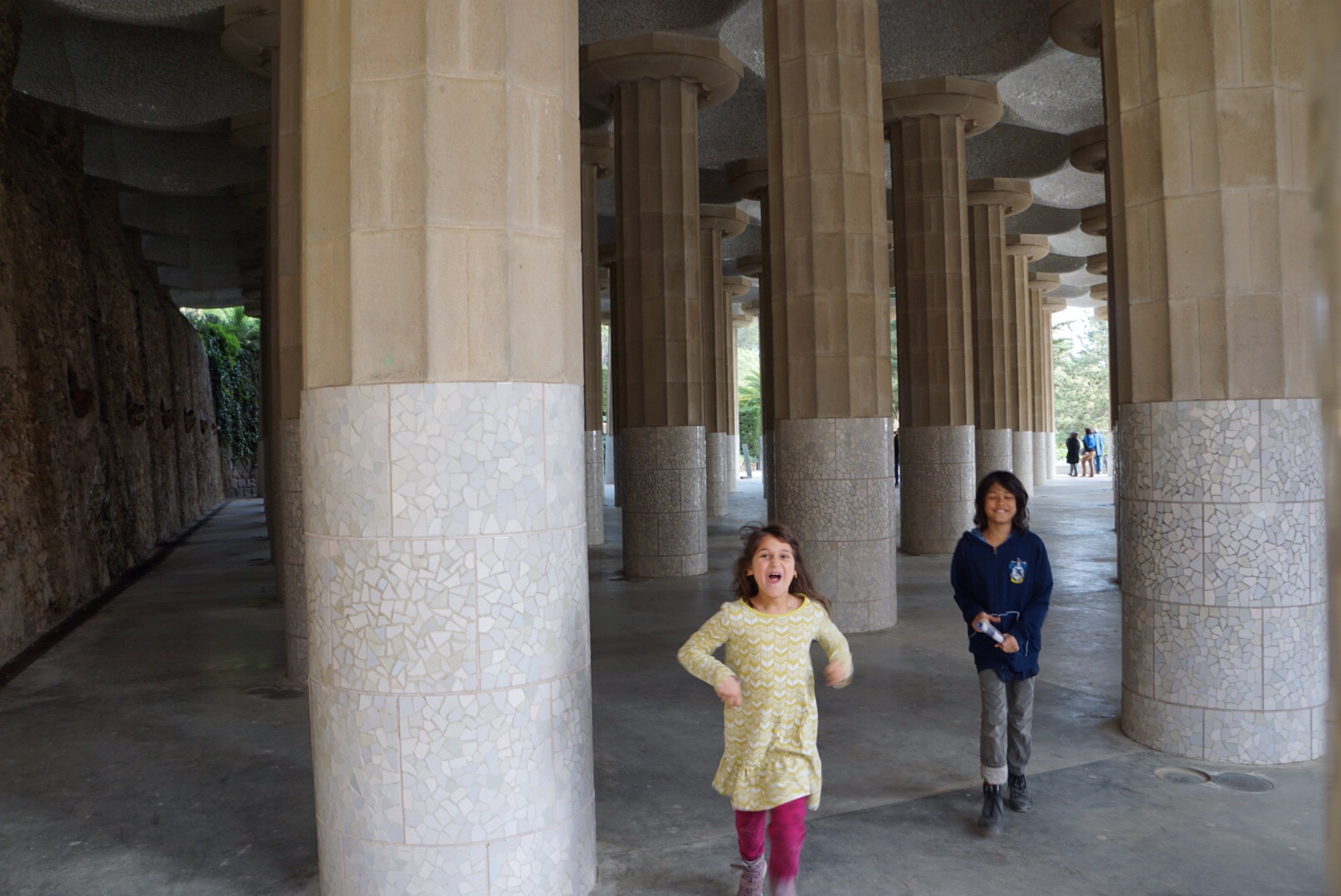
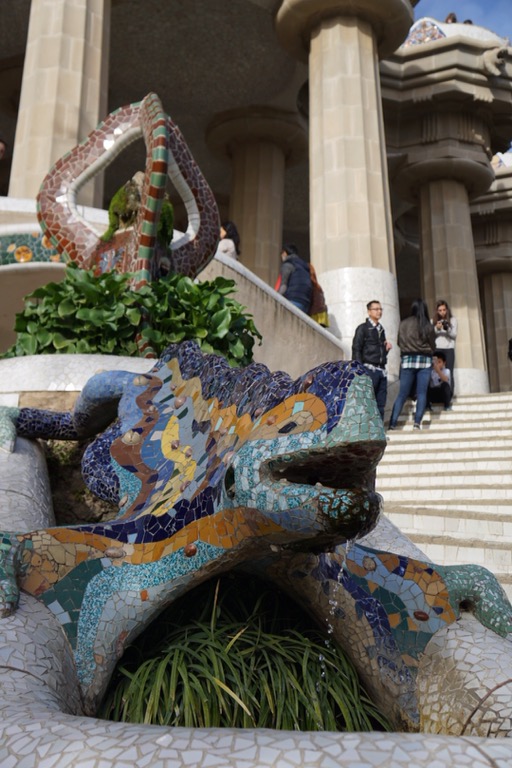
Santa managed to find us and brought a small bag of candies for the kids, and Eric and I found them each a present too. We went out to Park Guell for our last day of Gaudi. Initially conceived as a high-end housing development, it never took off as a residential area. The park features several Gaudi designed elements in a large hillside pavillion leading down to two houses at the base, again in his nature inspired style. Among the columns we played hide and seek, and I must say I did quite well at this. 

 . 
A lovely walk around in the sun, then back home to eat our pierogies, open the wine bottle rolling pin, and hang out before the next day took us to Madrid.
-s