Summer Tank

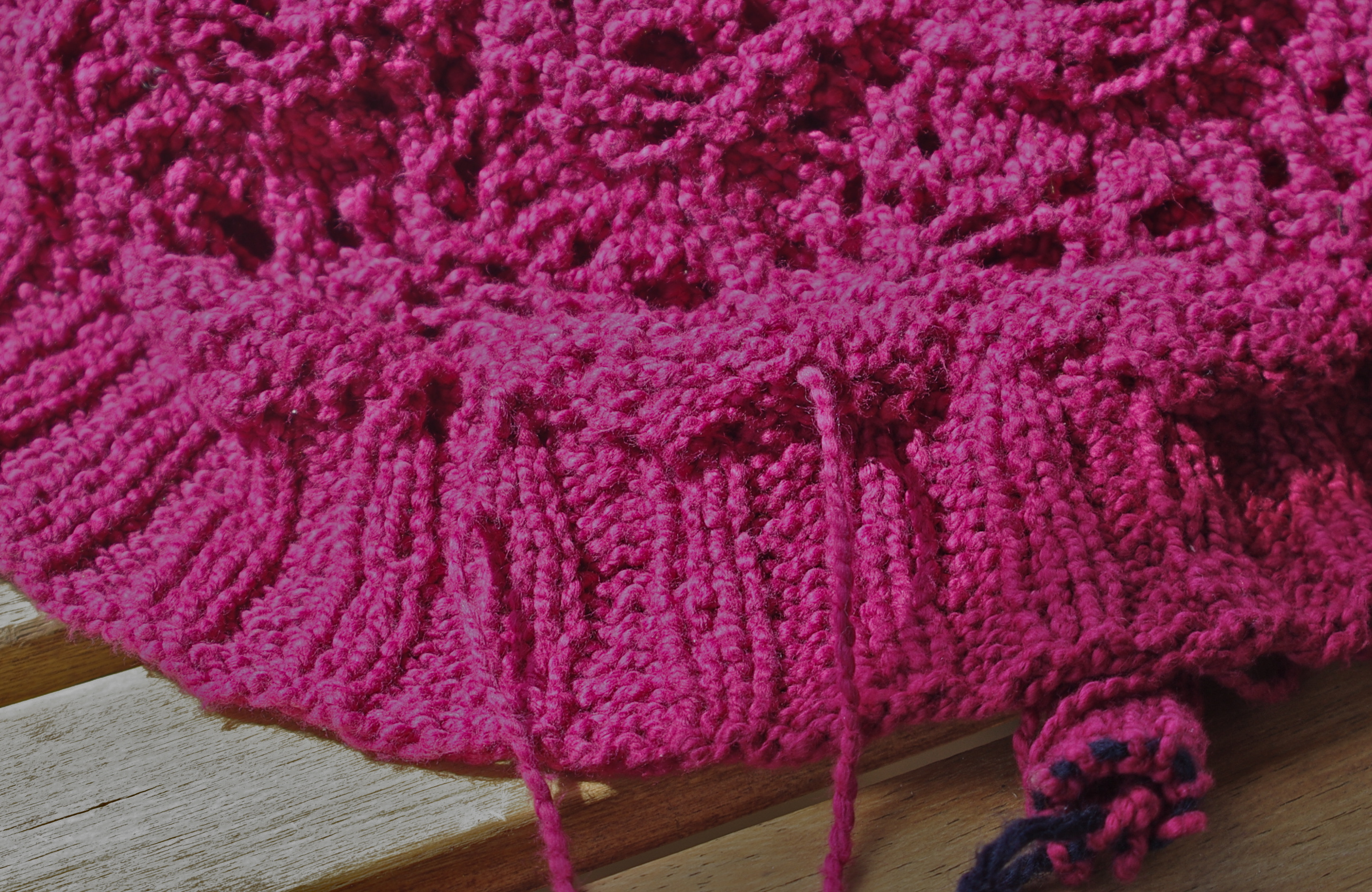
I finished my latest knitting project, Spidery Tank, and threw it in the washing machine.  It’s made of cotton, don’t worry!  You finish the straps last so you can adjust to them to exactly the length you want.  I think I must have much shorter shoulders than the rest of the general population, because for the most part when I buy tanks online, they are seriously lower cut on me than on the modeled pictures.  I wanted to wash this first before I finished the straps to see exactly how long they would be since washing can change the size of the garment.  But when I pulled it out, I realized something:

See it? No? Here’s a closer look:

Still no?

Here:

See those three little loops? Somehow I managed to drop a stitch waaaay in the beginning of the piece!

At first, I panicked.  Then, I was grateful that it wasn’t a very slippery yarn so that the whole rows didn’t fall apart, and set about to fixing it.

First, I gathered the necessary tools:

Yarn needle, crochet hook, spare yarn, and the pattern.

First, I secured the stitches with the nearest handy thing:

Then, I used the crochet hook to pick up the dropped stitch in the middle, and then looked at the pattern and realized that the three stitches were part of a k3 together so used the hook to pull them all together.

Now there’s just one stitch left on the needle.  I took my yarn needle, threaded with spare yarn, and looped it through this stich and wove the ends in throughout the piece.

Then, when you turn it over, looks perfect!

Then I just knitted the straps to the perfect length, kitchenered them together, and…a great summer tank!

Though my favorite part of that picture is the boy, looking really pissed off that the picture isn’t about him.

Garden, Stage II

Next step for the garden was irrigation. Now, I know there were some comments about stripping the grass out, but I’d like to leave that in for a couple reasons, one of which is so that the entire area doesn’t turn into a mudpit in the fall.  We had a suggestion to border the lawn with plastic edging to keep it from spreading, and I think I’ll try that.  I realize it may send out creepers, but we’ll deal with that when we get there.

Also, one commenter (thanks, Susan) had me running for the geiger counter, but I’ve since been talked off the ledge.  I haven’t gotten the lead testing done yet, though it’s somewhere in the list of things to do.

Here’s how it looks now!

I think it sort of looks like Medusa now, or a bacterium with pili.

One thing is for sure.  Anything I plant will get a GOOD drenching.

The individual little tubes put out 2 gallons a MINUTE, which seems like a whole lot of water to me. Once plants start coming up, we’ll adjust them to water right at the base.

The spray heads around the center spray the grass and do a decent job of soaking the middle, too.

If we need to, we can put another soaking tube into the middle.  I’m a little concerned that the grass sprayers are going to spray the leaves of the plants in the center and hurt them, but then I remember that that’s basically how I watered the same plants all last year and they survived.

Once all this was in, we put in some seeds! Carrots, peas, and lettuce.

Hopefully the next pictures will be of some little sprouts coming up and the starts going in!

Language Lessons

My parents were in town this past weekend for the girl’s birthday, and everyone had a great time. My mother outdid herself making delicious food for every meal that both kids gobbled up eagerly, and both grandparents enjoyed playing with the kids.

One of the things I do with my parents, often without knowing it, is slip into speaking Marathi. Once, at the lunch table, my parents and I were having some rather simple back and forth in Marathi (“Can you pass me the pickle?” “Here, take it”) and the boy started to hyperventilate in his dramatic way and wailed, “When am I going to learn that?”

“What are you talking about?” I asked.

“When am I going to learn to speak Indian?” he replied. “Aaji,” he said, turning to my mother, “Where did you learn to speak Indian?”

I had a twinge of guilt over not being better about teaching him any Marathi, but the truth is I’m not very good at it anymore after years of not practicing it, and was never fluent in the first place. And another truth is that, well, it simply isn’t that useful to know Marathi.

In a country with hundreds of beautiful melodic languages, Marathi is like the German of the Indian languages, in sound and in culture. It’s just rough. There is no common way to say, “Please” or “Thank you,” and no one would say it anyway. The typical greeting when you answer the phone is not “Hello,” or even the elegant “Moshi Moshi” of Japanese, but is instead, “Kon aye?” which means “Who is it?” I recently learned that there isn’t even a true word for the color brown–everyone just says “chocolatey.” This in a country where EVERYONE IS BROWN. How does that make any sense? (My father told me that there is technically a word for “brown,” but no one ever uses it.) Even the way to say “I love you” is somewhat convoluted and people just end up saying it in English.

We use Marathi when we wish to gossip about someone who is right in front of us without them knowing. This works poorly for two reasons. First of all, in accordance with the language, Marathi speakers are not typically subtle. This means that we will walk up to a grocery checkout line speaking in English, then see the lady with the crazy curly red hair wearing large polka dots in line, look her over, make eye contact, and then promptly switch to Marathi. When gossiping about how her hair and clothing makes her look like a clown, we will speak the word “clown” in English, which the woman will overhear and be able to deduce that we are talking about her, which makes the entire switch to Marathi completely pointless in the first place.

Now of course, Marathi is apparently the 17th most commonly spoken language with 70 million speakers worldwide (surprisingly, more than Italian)–I don’t mean to say that the language shouldn’t exist. After all, people still learn Latin and it’s not like you ever have a riveting chat about how the Nuggets are doing in Latin. But the sad fact is that my kids will probably find cause to speak Marathi about 20 times in their life. Even when my sister and I TRIED to speak Marathi with our cousins in India growing up, they generally mocked us for our poor grammar and we ended up just using English–in this lies the big problem, which is that most Marathi speakers we would interact with speak English just as well. Many first-generation Marathi kids speak less Marathi than I can and it’s doubtful that they would be able to speak to each other in Marathi without a great deal of effort. If kids that are raised by two native Marathi speakers don’t speak Marathi fluently, then there’s no hope for my kids at all.

From a cultural heritage perspective, it would be great if they spoke Marathi but the reality is they won’t. Of course, I could just focus on the more useful vocabulary and mild swear words that I know so that at least we could insult each other in Marathi when necessary. That would probably stick.

730 days

The girl turns two years old today.  This means that, give or take, she has eaten about 400 waffles (faffels!), given 200 kisses, used 4,825 diapers (take that, environment!), and has watched maybe 20 hours of TV thus far (she never misses “Tool Academy”).  Every night she has heard me sing “All You Need is Love,” or Eric sing “My Darling” (by wilco, of course) and recite the Loving Kindness mantra.  She’s incredibly loving and sweet, especially towards her big brother, whom she usually awakens with a back rub and a kiss on the cheek.  She’s also a feisty little scavenger, and will try to steal your food from you by looking as cute as humanly possible and saying, “BIIIIIITE!!!!!” as loudly as she can.  Her morning ritual is to name all the animals in her crib before allowing you to take her out: “Beaaw!” (Bear) “Rabbit!” “Efant!” (elephant) “Srufa!” (Scruffy).

She also loves to sing, and usually wakes up and sings to herself in the crib for quite a while before she wants someone to come get her.  She also sings as she goes about her business, as you can see in this video below.  It’s done with a super secret stealth technique, because if she were to SEE the video camera, she would march over and demand to see the baby inside.

Happy birthday, little girl! We love you and hope you keep singing the rest of your life!

Garden–Help!

Remember last year, when I talked about putting the garden in the front yard?  Well, the time has come to start! We’ve ripped out most of the sod, leaving some grass in to act as a path.

And by “we,” I clearly mean Eric.

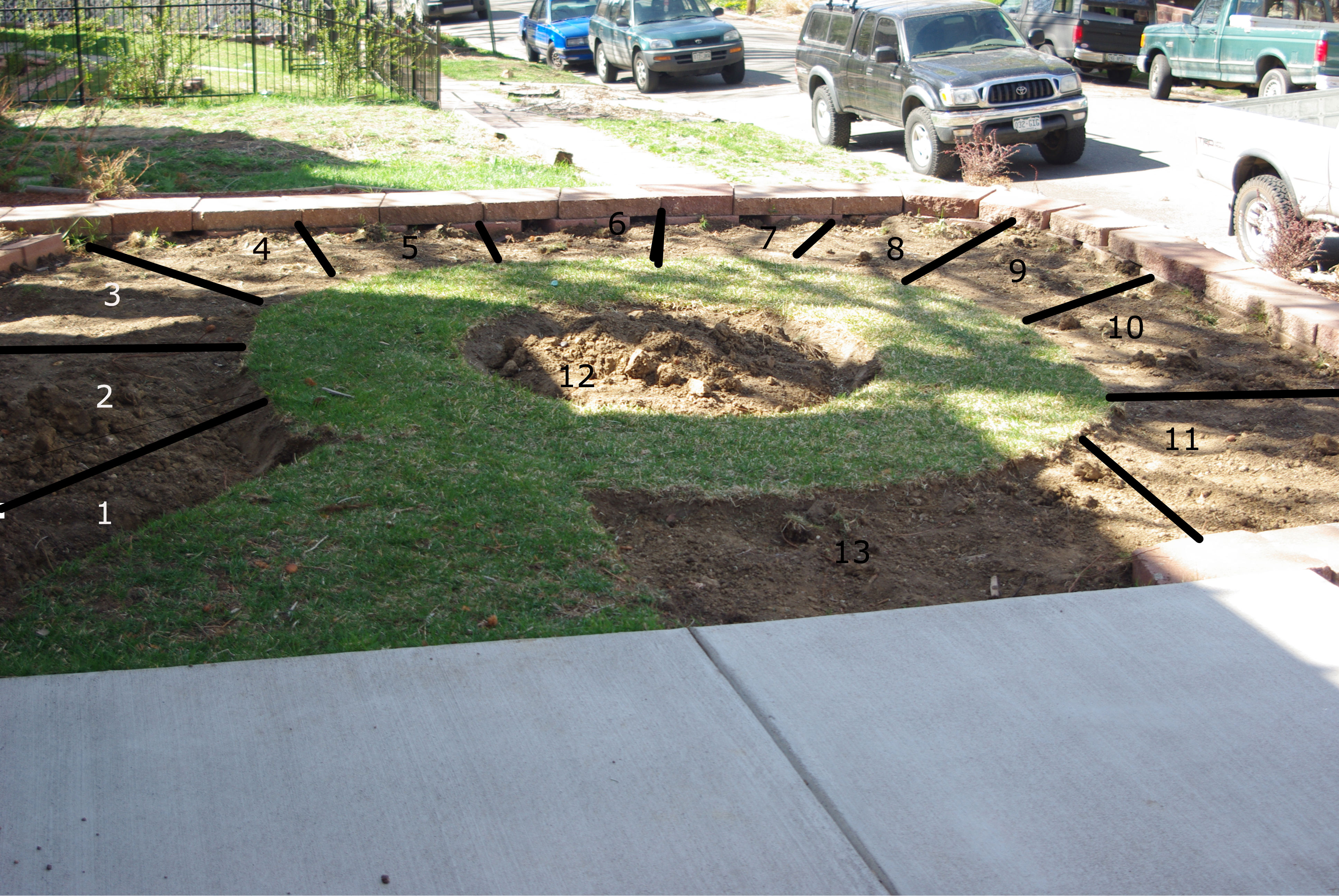
Here’s the thing–the way I approach most things is just to start them and figure it out as I go along.  I’m not much of the planning sort.  This has tended to be how I do just about everything–knitting, parenting, and this garden.  So far it’s worked out, but I’m realizing now I don’t really know much about how this will work! So I’m asking those of you out there who are much better gardeners than  me for some advice.  Here’s the front lawn as it is now, picture taken at 10:30 AM:

I definitely envision a squash/cucumber tepee in the center (#12), and some shade flowers or lettuce in #1 and #13, which will be pretty along the walk.  But what to do with the other sections?  Each one is about 3′ x 3′ in a wedge shape and the sun is coming from the south.  I know it doesn’t seem like a ton of sun, but we got decent veggies in our backyard last year and that patch only gets about 4 hours of direct sunlight daily and this is much more.  Some shade is cast by a large pine tree that we’ll be trimming, so I’m not worried about that. (I am worried, though about thieves,  animal and human.)

Thoughts? Suggestions? Am I crazy? Anyone else out there with a front lawn veggie garden and how did it go?

Genius, If I Do Say So Myself…

When I was a child, my family would travel to India frequently.  One of the things I remember from those trips is how small the garbage cans were.  The average kitchen garbage can was about the size of a small bathroom can here.  Compared to the U.S., where the average garbage can is the size of a small child, this was surprising.  At the time, there wasn’t the same disposable culture that we had in the U.S. and far less packaged goods.  The packaging we brought with us didn’t fit into the cans! (Of course, sanitation services were not the greatest, so the dumpster at the corner was always overflowing, but that’s another story.) You’d buy your vegetables from the walla who would roam the streets, pushing around eggplants, beans, tomatoes and the like on a flat wooden wheelbarrow.  As he walked along he would shout out the names of the vegetables on his cart and I remember my grandmother yelling out the balcony for him to stop so she could come down and haggle.

Milk arrived daily in thick plastic bags, fresh from a water buffalo.  These bags were not thrown out but carefully washed, dried, and saved.  The day or two before we would leave to come back to the States, my grandfather would fill these bags with chaklibakarwadi, and various pickles that my grandmother and aunts had prepared.  To seal them, he would fold them over, pass the folded edge quickly through a candle flame and press the melted plastic down to create a seal.  He’d repeat this and then you’d have an airtight package ready for travel.  I tried doing this a few times and burnt my fingers and overmelted, creating holes.

Cut to today, where I’ve started a new knitting project where I’m basically knitting with thread.  See?

I’m knitting with the center two yarns–the “normal” sized yarn and twist tie are there for comparison.

I’m at the part of the pattern where you knit with two of them held together, and they were forever getting twisted and tangled.  I thought about just putting them into a plastic bag but figured that they would still just get knotted up in the bag.  What I needed was something to keep them apart.  Then, I remembered my grandfather carefully melting plastic bags to seal them, and I thought I might be able to do that with a Ziploc bag to create a partition.  So I found a birthday candle, lit it on the counter, folded a bag in half, and gently passed it through the flame and squeezed the melted plastic.

It worked!! Now I can keep each cone of yarn separate but still work with them together.  This technique could work for other stuff, too, like if you wanted to divide a bag to take separate snacks, or storage–one side for nuts, one side for bolts.  Martha Stewart, are you listening?

The project itself is the Kusha Kusha shawl, and you knit it with one strand of the merino wool and one strand of the silk stainless–a fine stainless steel core wrapped in silk give the scarf a tactility and memory.  Here’s how it looks so far–see how it stands up by itself?

Since this project will take, oh, forever, I’m also working on a cute summer tank top made out of a thicker yarn, post to come later.

Spring Break 2010

Monday Zoo Day:

Exploring brambles

Proudly scratched up

Waiting for Carousel

Why is it moving?

Tuesday Art Museum:

Dazzled

Building together

Wednesday hiking and painting:

Trailhead

Love!

Dueling Picassos

Which is the masterpiece?

Thursday… I messed up my schedule requests and had to work, so the boy went to the office with Dad and the girl stayed home with a sitter.

Friday, we went to the Dino Museum in the morning (sorry, no good pictures) and then, in the afternoon, I was so exhausted from the week I just put Sesame Street on and sat on the couch with the kids, intermittently nodding off until the girl sat on my face to wake me up, which she thought was a hilarious game.

Hats off to the stay at home parents–while it was really fun to be home with the kids, it is a lot of work and I was tired by the end of the week.  I worked on Saturday and Sunday, and that felt like a break.  Still, sometimes I feel guilty that we both work and aren’t home with the kids more, but the truth is I get a lot more quality time with my kids than a lot of working parents, and for that I’m grateful.  I also have the advantage of having a lot of weekdays off, so I can use that time to do errands and have time to myself so that when we are home with the kids we can just hang out with them and not have to get a lot of work done.  All I’m saying is I’m pretty lucky to have so much flexibility.  Eric would probably prefer if I didn’t have to work so many weekends (two out of four every month) but you can’t have everything, no?

Today I took the kids to school for the first time in nearly 2 weeks.  I was prepared for tears, a struggle, leg-clinging. Instead, I had two children who happily picked up their lunch boxes, ran into their classrooms, smiling and happy to see their friends and teachers, and ready to start learning again.