Garden Stage III

The garden is planted, save a second row of carrots, bush beans, lettuce, and some spinach (though it’s late for that, I know).

The trellis went up and we put out all of the starts where we wanted them to go.  My hope is that the climbing plants wind their way up the bamboo poles to make a structural focal point for the garden.  I also conscientiously picked plants that have unusual colors or feature to add interest.  For example, the cucumber is an extra long variety, and the pole beans are purple with purple leaves.  There’s a purple and white striped eggplant, a patch of rainbow chard,  and I planted a variety of tomato colors, in the hopes that when everything grows it will be an explosion of color to rival a flower garden.  Of course, that all depends on whether anything grows or not, since I didn’t pay any attention to how these plants do in Denver.  I purchased all of my starts from a neighborhood woman who grows them organically in her backyard.  Everything that I got from her last year grew amazingly well despite the crappy location.  I think it’s because she spends a lot of time hardening off the plants, so when they go into the ground outside they’ve got a better shot at making it.  (Local folks, if you want her info leave a comment or send me a note and I’m happy to pass it along.)

Clearly, the girl was impressed by my brilliant idea.  Her basic function during the planting was to act as reluctant cheerleader, occasional digger, and mostly a general hindrance.  But then she’d give you this super cute face and you couldn’t possibly be upset with her.

The boy helped by planting dahlias in the center section:

As for things growing, the pea sprouts from a few weeks ago are up to a good start:

And the final layout of plants ended up like this:

Oops, I forgot to add the spinach in the center of the trellis.  I read somewhere that you can put spinach in the middle of a trellis arrangement because it’s shaded and keeps the ground cool and prevents the spinach from bolting early.  It’s worth a shot since I’ve got the seeds anyway.  I put dwarf sunflowers and zinnia as well as flowering chives along the walkway to have flowers along the path, and also to grow some cutting flowers.  I’d love to have flowers in front of my house I could snip anytime I wanted to brighten up the house or take to a friend’s as a bouquet.

We looked into some grass borders as suggested to keep the grass from encroaching into the garden, but everything I found needed to be dug in before we had planted, and it was too late for that.  Ah well.  That just means more ripping out of grass this year and remembering to do it next year.

And now waiting, watering, occasional fertilizing, and crossing fingers! I’ll try to post picture updates every 2 weeks or so to follow how things are progressing.

Milestone!

Before I move on from the topic of the last few posts, I do want to clarify that I don’t think what B said to my son was racist, or that it means his parents are prejudiced in any way.  I mean, he’s four. He could have just as easily said, “I don’t like your shoes” and B’s father was probably right that he didn’t mean anything by using skin color, other than to be mean, which all kids will do at some point or another, even my precious little angels.  As adults, we know that race is a far more sensitive topic than shoe choice, but I don’t think that the little kids are necessarily aware of that.

Speaking of shoes (how’s that for a segue?), the boy can tie his own shoes now!! He desperately wanted a pair of lace up shoes, and we got him a pair of Converse.  He started doing the lacing work at school and can now tie his own shoes–yay, Montessori!  Here’s a short video–he’s so proud of himself.

You may have noticed that in the video he is wearing a three piece suit.

He LOVES this suit.  He wears it as often as possible, which is usually about twice a week, since we can’t do laundry much quicker than that.  He first started wearing suits last year, when he finally fit into a size 3T suit that my parents had purchased for him ages ago.  He wore that until it was in tatters, and my parents just bought him this new one, which he wears constantly unless it’s in the wash.  Whenever we’re in public, I feel compelled to tell others that he dresses himself this way and I do not force the kid to wear a suit.

Places to wear a suit you might not think of–

On the playground:

Riding a bicycle:

Climbing:

Or just going to school:

He’s my own little Alex P. Keaton.

Aftermath

Thanks to all who left such insightful comments, and those whom I spoke to in person.  We spoke to the teacher’s aide, whose face just dropped when we mentioned what the boy had said.  She told us the incident was over a month ago, but had happened basically the way that the boy related to us.  She had overheard them, and immediately talked to B about how different people have different skin colors but are all the same.  She then talked to the boy, too, and all seemed to be well until the other day.

I felt strongly, as did most people that both Eric and I spoke with, that we should talk to B’s parents and let them know what had transpired.

Eric caught up with B’s father as they were leaving school, and here’s how the conversation went, after pleasantries exchanged:

Eric: “A while ago B said something that really hurt the boy, and I wanted to let you know about it”

B’s dad: “Oh, what was it?”

Eric: “Well, he said he didn’t like brown skin, and it really hurt the boy’s feelings.”

B’s dad: “Oh.  Well, I’m sure he didn’t mean it.”

And then walked off.

The next day, B’s mom walked right by Eric in the morning without making eye contact or saying a word.

I was dismayed by this seeming utter lack of concern and even questioning–I mean, if someone ever told me the boy did something like that, I’d at least want to ask more questions about it to know what had happened and express concern for the other kid.  I can’t say I was entirely surprised. Even before Eric spoke with B’s dad, though, I steeled myself because I know from experience that when you approach people for conversations like this, the response you get is NEVER satisfying.  It was important for them to know, but I can’t control what they do afterwards. Who knows, maybe they’re working on some elaborate apology card for the boy at home, but I’m not saving any space on the mantel.

We also spoke to the teacher’s aide who overheard the conversation, and did say that we wanted to know if anything like that ever happens again.  We love her in general, but I do think she should have at least talked to the head teacher about what had happened–maybe they could have had some conversations in class, or songs, or something.  Now that I type that, I realize that I’m asking the teacher to teach something because I don’t think the parents are.  We ask a lot of our teachers, no?

In the end, I think this has been a good thing.  It’s made us more aware of the need to actively teach both our children about race and that despite living in what I perceive to be a fairly liberal, open-minded city that seems to have a lot of mixed couples, they will still have to deal with issues about their skin color.  Now that I think about it, it shouldn’t be that hard to talk about.  I mean, we talk about how there are all different kinds of families–two mommies, two daddies, adopted, etc., how women can do most anything that men do and vice versa, why not expand that to include talking about how people of different races can do anything, too?  It sounds sort of dumb to my ears to even say that as an adult, but maybe that’s what the kids need to be hearing.

I’ve got to think that it’s better than saying nothing at all.

Colorblindness

This morning, while brushing his teeth, the boy says, “Mommy, don’t I look white?”

I wasn’t sure what he meant–like, was he white from his toothpaste.  I asked him to clarify.

“My skin, it looks white, doesn’t it? Not brown.”

“Well, no, honey. It looks brown, and it will always look brown.” I said.

“You mean I’m never going to turn white?!” He cried, upset.

“No, you’re going to stay brown your whole life.” I was beginning to wonder where this was going.

“But, I want to be white! I don’t want to be brown anymore!!”

Oh boy.

“Why not, sweetheart? What makes you say that?” I asked.

“Because B—* told me he doesn’t like brown skin and that made me sad.”

Oy.

Eric walks over and says, “You are beautiful, inside and out.  You have a beautiful heart, and you are a wonderful person, no matter what color you are on the outside.”

I tell him that is true, and that sadly, he may always hear people say bad things about his skin.  “I think your skin is perfect, and I love it, and I would never want it to be any other color.”

This brings a big smile to his face, and we hug, and things seem to be fine again.

Po Bronson wrote a book recently called “Nurtureshock,” and while I haven’t read the entire book (and don’t know that I agree with everything in it based on what I’ve heard), the chapter about race is excerpted in Newsweek here.  In a nutshell, it says that the trend towards NOT talking about race at all or using phrases such as “everyone is equal” have the opposite effect, and do little to instill the colorblindness that they are intended to teach.  According to the studies cited, children as young as 6 months see racial differences, and certainly the 4 year olds in my son’s class do.

Still, what does it mean exactly to talk about race?  I’ve read the examples in the article, and understand those, but I have to think that there’s more than that.  It’s easy to talk about religious differences and say how people believe different things, but it’s not quite so easy to do that for race, is it?  I think the take home point is to make sure that you teach your kids that people DO look different, DO have different skin colors, but are all the same on the inside.

I’m not sure exactly what happened in the classroom.  The boy tells us that he told one of his teachers what happened, and we’re going to ask her about it tomorrow.  Depending on what she says we may or may not talk to B’s parents, but the truth is that the boy has an excellent memory and doesn’t make stuff like this up.  B’s parents are very nice people, and my guess is that they may fall into the category of people who simply don’t talk about race at all, and that it may not be something that they have to deal with much. I mean, I was recently called “the prettiest little colored girl she’d ever seen” by a VERY elderly patient, am asked on a regular basis “where I’m really from,” and have had people comment on how I “don’t have an accent at all”!  I’m quite certain that neither of B’s parents, both Caucasian, have ever had anything like that happen! Bronson mentions a statistic that most white parents don’t talk to their kids about race, and most non-white parents to.  He fails to mention that this is because if you are the majority race, you simply don’t have to deal with the same racial issues as someone of a minority race, and the questions are less likely to arise.

I think we handled it okay so far, but we’ll see how it goes with B’s parents.

And, on a side note, if there is a patron saint of parenting, could you PLEASE slow down on the difficult questions? What’s next? Where do babies really come from?

*name changed to protect the toddler.

Mexico…in Words

Our flight started with some of the worst turbulence that I’ve ever experienced, and I’ve flown quite a bit.  I used to actually love flying–the excitement of going somewhere, that feeling of accelerating down the runway.  Ever since 9/11, though, it’s just terrified me.  When I fly alone I can premedicate with a drink at the airport bar, but downing a vodka martini while swatting away at two small children is generally frowned upon.  In public, anyway.

I won’t lie–my usual lack of religious fervor takes a backseat to my desire to live when planes swing from side to side.  Even the boy looked at me and said, “Mom, you said this would be fun.  This is NOT fun.”  I did my best to keep my calm face on despite the severe internal panic.

After the flight, the flight attendant told us that had been the worst turbulence she’d experienced in decades, which made me feel a bit better.

We had a nice condo on the beach, and our days consisted of hanging out at the beach in the morning, swimming in the pool in the afternoon, and just relaxing.  One thing that surprised me was how much the kids needed the relaxing, too! I mean, what’s stressful about their lives? But I think that school is hard for them–they work hard and are exhausted by the end of the day, and I couldn’t believe how much their little bodies just un-tensed.  We had few issues with the boy and conflict while we were there, which made me realize that a lot of the problems arise when we need him to do things right away during stressful times–in the morning before going to work, and in the evenings before dinner.  On the beach, there really wasn’t much he needed to do, and there were few time restrictions.

Despite all the relaxing time, though, I managed to learn a little travel lesson while I was there.  I thought it might be nice to take a boat trip to some of the nice beaches, and snorkel.  I went to the corner travel agent, whom I THOUGHT was with the registered tour place (mistake #1) and booked a 5 hour boat trip.  The guy was sketchy and I had a bad feeling, but I brushed it off (mistake #2).  That night, Eric said that he didn’t want to take the kids on the trip, he thought it would be too much for them. (Wise decision #1).  In the morning, my sister and I went to the booth where Carlos had agreed to meet us to pay for our transportation to the boat and back, which I had been told would be a private van.

When we got there, Carlos walked us up a block and practically shoved us onto a public bus, told the driver to drop us off at the Marina, and then jumped off at the next stop after handing us a slip of paper with the words “Hector, #10” written on it.  As we ride down the highway, I tell Sapana, “I hope this ends up being a fun story, and not a funny story.” (Insight #1)

We get off where the driver gestures and find ourselves standing amidst a LOT of really, really fit looking people scrambling to get onto bicycles.  Turns out the bus driver had left us in the middle of the Mexican National Triathlon!!  We looked idiotic wandering around the race area for a while, and then just got into the spirit and started cheering people on as they came in from the run and transitioned to riding.  I even asked someone where the ships leave from and he told us that the marina was closed for the next 4 hours!  We figured we’d hang out for a bit and then just hop a bus back (which would have been wise decision #2) but then I spied a passel of white people waiting on the other side of the marina and figured that was where we were supposed to be. (Correct, but actually unwise decision)

Indeed, there we found Hector waiting at gate #10, and got in line with a bunch of Mexican vacationers and a few foreign tourists.  The boat itself was fine initially, the snorkeling was awful, and the beach we went to was actually stunning.  The ride back, however, was painfully slow and when we asked what was going on, we found out that the boat crew had failed to bring enough oil for the journey and so could only run the engine at quarter-speed.  I mean, WHO forgets to bring OIL when you do this as a daily activity?!  Thus, the 5 hour boat trip turned into a 9 hour journey.  The entire way back the boat “captain” had people playing ridiculous games that consisted of “sexy dancing” and yelling “andale” a LOT, with blaring speakers.  Our ears hurt.

When we got back, Eric was worried sick and livid, which was rapidly cured by a few margaritas. (Wise decision #3)

Still, I can’t believe I got duped like that! I think of myself as a very savvy traveller, so it just felt like salt in a prideful wound.  Ah well. Next time, we’ll just hire a private boat (with oil) for about the same price.

Another thing that struck me–we went to the MegaMart there to go grocery shopping, which was larger than and more confusing than Wal-Marts here.  I couldn’t believe the MASSIVE amounts of produce that people bought!  The little plastic bags in the produce section here were about 4 times as large, and people filled them up with literally 20-30 fruits or vegetables at a time!  Partly, I think it’s because of larger family sizes and just that people cook more at home rather than go out, but it was still astonishing to watch.

It was also wonderful to spend time with my sister, though I feel that every time she spends a week with the kids she feels less and less motivated to actually HAVE children of her own.  Don’t get me wrong–she loves her niece and nephew, but they are a lot of work, too.  A few references were made that I should consider being the sole grandchild producer for my parents, and when we went to the airport to leave (our flights left at the same time) she chose to go and wait by herself at her gate half an hour early.  I can’t wait until the kids are old enough to simply drop off on her front doorstep for a week or two while Eric and I take a vacation by ourselves–she’ll love it.

All in all, a great trip.  I think we’re going to try for a yearly vacation, and alternate beach vacation years with more adventure travel years to get it all in.

Once the girl is potty trained, of course.

Musings

I was going to write about how difficult the boy has been lately.  Defiance, tantrums, and disrespect are just the beginning.  He also thinks he’s always right and won’t believe anyone that he’s not unless it’s disproven by another source.  For example, he recently insisted that summer comes before spring, and nearly threw a fit when I tried to tell him otherwise, and STILL didn’t believe me until I pointed it out to him in a book of his.

But then tonight he asked me something that made my heart skip a beat.

We’d actually been having a nice evening, playing with blocks and walking outside.  Out of nowhere, he turns and asks, “Mommy, do kids die?”

I was momentarily stunned–not the question you expect from your four and a half year old son.

“Why do you ask, honey?” I inquired.

“I was just wondering.  Do they?”

I have a general policy of not lying to children, but trying to tell them the most appropriate truth for their age.  “Well,” I said cautiously, “Sadly, yes.  Sometimes kids get sick and die.”

“Oh. Mommy, do you ever want me or my sister to die?”

Holy crap.  “Never! I love you both so much, it would make me so sad if you died.  It would break my heart! I don’t want you to die until you’re a very very very very very old man.  Why are you asking this?”

“No reason.  I was just wondering.”

I couldn’t get any more out of him than that.  He doesn’t know any kids that have died, certainly hasn’t seen any movies that feature kids dying.  Still, the whole thing shook me up a bit.

As I thought about it more, I think what happened is this–we’ve been watching a lot of nature videos lately, and of course, something always gets eaten.  Tonight we watched one where a lion killed and ate a baby zebra, and I wonder if that got the wheels in his head spinning and making the connection between baby zebras and baby humans.  So much for Discovery Channel being safe watching ground.

How do you all deal with the little ones asking about the big D?

Summer Tank

I finished my latest knitting project, Spidery Tank, and threw it in the washing machine.  It’s made of cotton, don’t worry!  You finish the straps last so you can adjust to them to exactly the length you want.  I think I must have much shorter shoulders than the rest of the general population, because for the most part when I buy tanks online, they are seriously lower cut on me than on the modeled pictures.  I wanted to wash this first before I finished the straps to see exactly how long they would be since washing can change the size of the garment.  But when I pulled it out, I realized something:

See it? No? Here’s a closer look:

Still no?

Here:

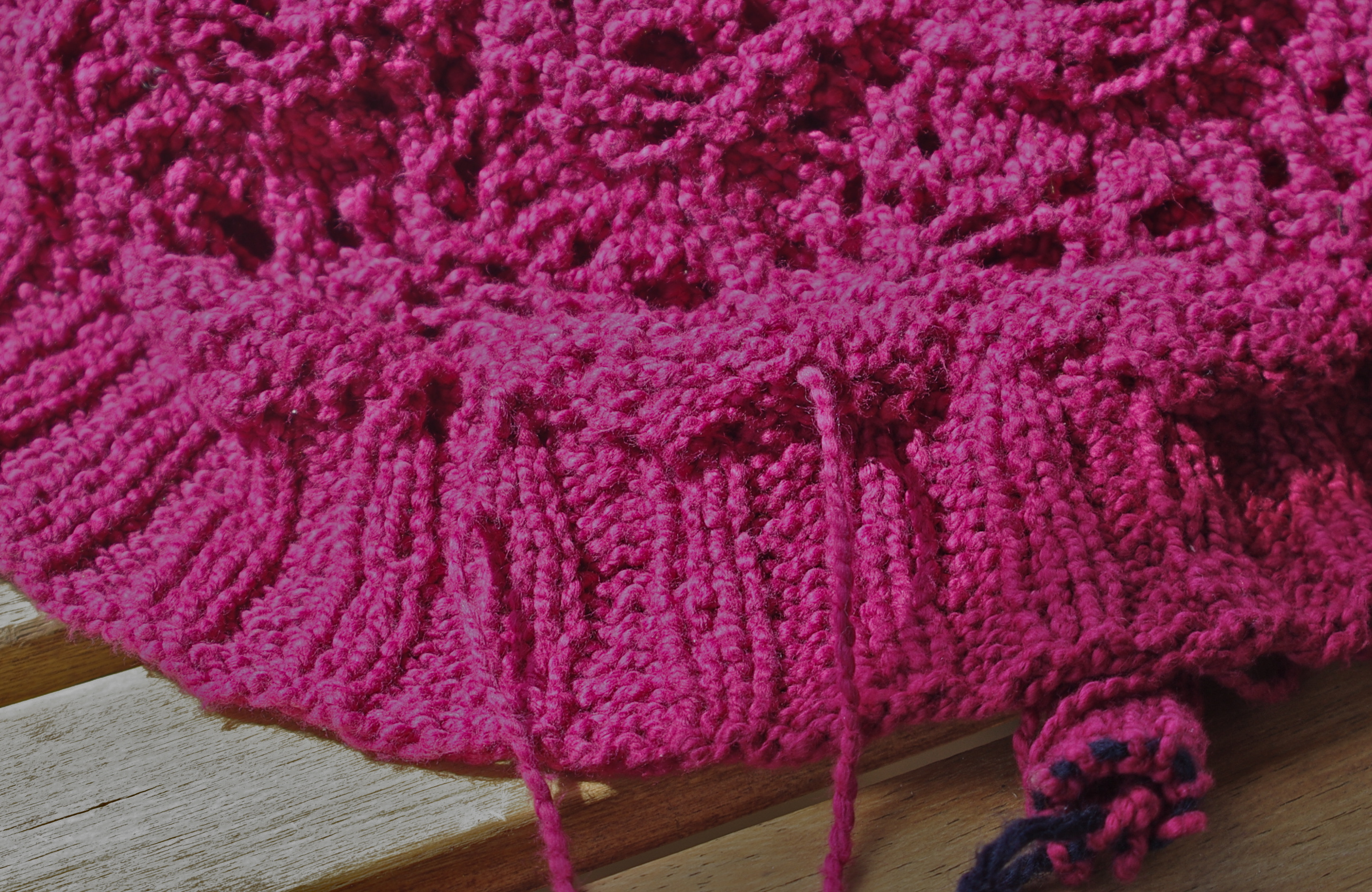
See those three little loops? Somehow I managed to drop a stitch waaaay in the beginning of the piece!

At first, I panicked.  Then, I was grateful that it wasn’t a very slippery yarn so that the whole rows didn’t fall apart, and set about to fixing it.

First, I gathered the necessary tools:

Yarn needle, crochet hook, spare yarn, and the pattern.

First, I secured the stitches with the nearest handy thing:

Then, I used the crochet hook to pick up the dropped stitch in the middle, and then looked at the pattern and realized that the three stitches were part of a k3 together so used the hook to pull them all together.

Now there’s just one stitch left on the needle.  I took my yarn needle, threaded with spare yarn, and looped it through this stich and wove the ends in throughout the piece.

Then, when you turn it over, looks perfect!

Then I just knitted the straps to the perfect length, kitchenered them together, and…a great summer tank!

Though my favorite part of that picture is the boy, looking really pissed off that the picture isn’t about him.

Garden, Stage II

Next step for the garden was irrigation. Now, I know there were some comments about stripping the grass out, but I’d like to leave that in for a couple reasons, one of which is so that the entire area doesn’t turn into a mudpit in the fall.  We had a suggestion to border the lawn with plastic edging to keep it from spreading, and I think I’ll try that.  I realize it may send out creepers, but we’ll deal with that when we get there.

Also, one commenter (thanks, Susan) had me running for the geiger counter, but I’ve since been talked off the ledge.  I haven’t gotten the lead testing done yet, though it’s somewhere in the list of things to do.

Here’s how it looks now!

I think it sort of looks like Medusa now, or a bacterium with pili.

One thing is for sure.  Anything I plant will get a GOOD drenching.

The individual little tubes put out 2 gallons a MINUTE, which seems like a whole lot of water to me. Once plants start coming up, we’ll adjust them to water right at the base.

The spray heads around the center spray the grass and do a decent job of soaking the middle, too.

If we need to, we can put another soaking tube into the middle.  I’m a little concerned that the grass sprayers are going to spray the leaves of the plants in the center and hurt them, but then I remember that that’s basically how I watered the same plants all last year and they survived.

Once all this was in, we put in some seeds! Carrots, peas, and lettuce.

Hopefully the next pictures will be of some little sprouts coming up and the starts going in!

Language Lessons

My parents were in town this past weekend for the girl’s birthday, and everyone had a great time. My mother outdid herself making delicious food for every meal that both kids gobbled up eagerly, and both grandparents enjoyed playing with the kids.

One of the things I do with my parents, often without knowing it, is slip into speaking Marathi. Once, at the lunch table, my parents and I were having some rather simple back and forth in Marathi (“Can you pass me the pickle?” “Here, take it”) and the boy started to hyperventilate in his dramatic way and wailed, “When am I going to learn that?”

“What are you talking about?” I asked.

“When am I going to learn to speak Indian?” he replied. “Aaji,” he said, turning to my mother, “Where did you learn to speak Indian?”

I had a twinge of guilt over not being better about teaching him any Marathi, but the truth is I’m not very good at it anymore after years of not practicing it, and was never fluent in the first place. And another truth is that, well, it simply isn’t that useful to know Marathi.

In a country with hundreds of beautiful melodic languages, Marathi is like the German of the Indian languages, in sound and in culture. It’s just rough. There is no common way to say, “Please” or “Thank you,” and no one would say it anyway. The typical greeting when you answer the phone is not “Hello,” or even the elegant “Moshi Moshi” of Japanese, but is instead, “Kon aye?” which means “Who is it?” I recently learned that there isn’t even a true word for the color brown–everyone just says “chocolatey.” This in a country where EVERYONE IS BROWN. How does that make any sense? (My father told me that there is technically a word for “brown,” but no one ever uses it.) Even the way to say “I love you” is somewhat convoluted and people just end up saying it in English.

We use Marathi when we wish to gossip about someone who is right in front of us without them knowing. This works poorly for two reasons. First of all, in accordance with the language, Marathi speakers are not typically subtle. This means that we will walk up to a grocery checkout line speaking in English, then see the lady with the crazy curly red hair wearing large polka dots in line, look her over, make eye contact, and then promptly switch to Marathi. When gossiping about how her hair and clothing makes her look like a clown, we will speak the word “clown” in English, which the woman will overhear and be able to deduce that we are talking about her, which makes the entire switch to Marathi completely pointless in the first place.

Now of course, Marathi is apparently the 17th most commonly spoken language with 70 million speakers worldwide (surprisingly, more than Italian)–I don’t mean to say that the language shouldn’t exist. After all, people still learn Latin and it’s not like you ever have a riveting chat about how the Nuggets are doing in Latin. But the sad fact is that my kids will probably find cause to speak Marathi about 20 times in their life. Even when my sister and I TRIED to speak Marathi with our cousins in India growing up, they generally mocked us for our poor grammar and we ended up just using English–in this lies the big problem, which is that most Marathi speakers we would interact with speak English just as well. Many first-generation Marathi kids speak less Marathi than I can and it’s doubtful that they would be able to speak to each other in Marathi without a great deal of effort. If kids that are raised by two native Marathi speakers don’t speak Marathi fluently, then there’s no hope for my kids at all.

From a cultural heritage perspective, it would be great if they spoke Marathi but the reality is they won’t. Of course, I could just focus on the more useful vocabulary and mild swear words that I know so that at least we could insult each other in Marathi when necessary. That would probably stick.