Garden Apathy

I don’t know what it is about September, but I lose all motivation for the garden.  I stop watering, I stop picking, I really don’t pay it any attention. It’s terrible, I know, especially since things really only start growing at the end of July. I just get unmotivated because, with the exception of the grape tomatoes and the butternut squash, I feel like I’m the only one that really tries to eat everything that grows. I even told Eric the other day that I wasn’t sure if I’d do the garden next year. His response, “Yeah…maybe just do flowers and some basil.” Way to be encouraging.

Garden at the end of August

Of course, I know that next year I’ll get all excited again and plant far more than is good for me.

Scorecard:

Winners: Butternut squash, chard, most tomatoes, eggplants, radishes, spinach, all herbs, chard, and holy god the tomatillos! We had near a gazillion tomatillos.  I didn’t think we’d get any since I only planted one plant and you’re supposed to need two, but there must be one near by that bees cross pollinated. This must be especially true since I planted a purple tomatillo plant, but got only green ones.

Tomatillo plant--grew twice this big by the end

Runners up: Corn. We didn’t get hardly any yield, but what we did was very tasty and it was just fun to watch it grow, and have a little living screen on our porch.  

There was also something that nibbled at the corn.  I suspect the squirrels, but can’t entirely exclude the birds.

Peppers–now, I didn’t get very many, but what I got were delicious and it’s the first year I got any at all, so it just makes me want to try harder next year. Lemongrass–grew well, made a few nice cocktails, but, really, I didn’t use it that much. (Note: If you want some free lemongrass, come and harvest it before it dies.) Beets–the few that grew were great, I need to start them a bit later and water more. Roma tomatoes–you know, I just didn’t get enough from one plant to bother. Maybe if I plant a few next year I’ll get enough to make sauces and freeze.

Losers: This year the cucumbers and beans were pathetic. Just pathetic. They grew late, yielded little, and the cucumbers were bitter to boot. Not sure what happened since they were both amazing last year. One of the problems was I tried to plant scarlet runner beans with the purple beans, and I think they only succeeded in making sure that neither grew well.  The watermelons were a joke. Once we harvested them they were gross and mealy.  Grass–not marijuana, people. The grass ring around the center has finally died. Next year I’ll just plop some flagstone over or something.

Second-to-last harvest


Despite my current apathy, I’ll miss the garden, as I do every winter. The last harvest portents the first snows, the perpetual cold, and the winter gloom. As a Californian transplant, I’ve never loved winter even though Colorado tries to tempt me with the mountains. I’ll wait for the joy in the kids faces as they tumble through the waist high snow and stay out far too long until they can come in pink-cheeked and ready for hot chocolate, which I’ll have been happily stirring over a warm stove.

What the Hell do I do with all this Chard?

If you planted chard, chances are pretty good that you’re asking yourself this question.  There is only so much chard risotto and sauteed chard one can possibly stomach, and that tends to be the end of my repertoire of chard recipes, until this summer when I saw my friend Rebecca make some crispy kale chips that we gobbled up before dinner was even done.  Since kale and chard are often interchangeable, I thought, why not try it with chard?

First of all, gather chard.  I’m getting about this much chard twice a WEEK.

Next, wash and dry the leaves thoroughly. A helper makes this job much easier.

Next, remove the thick center ribs and then slice into one inch strips. I find that folding the leaves in half makes this much easier. You can save and sautee the stems for later, though I’m so sick of chard stems that I just put them into the compost.

Next, mix with olive oil, salt, and fresh pepper. Go easy on the olive oil. Place in a single layer on a baking sheet and roast at 425 for 7-10 minutes. If they’re too thickly layered, you end up with steamed chard. When done, you want some of the edges to be dark brown and almost slightly burnt.

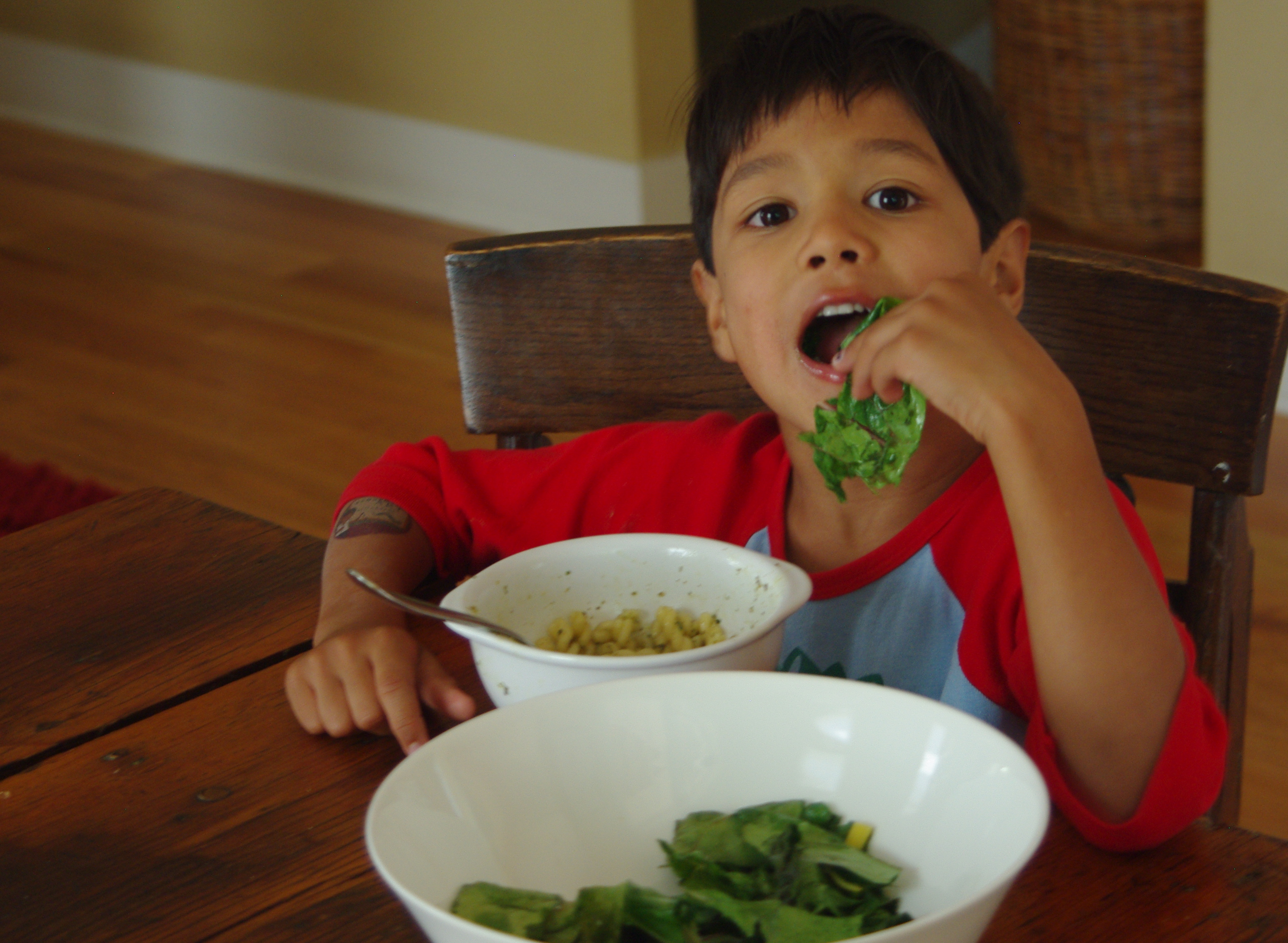
All of that chard? Roasted nicely down into a more manageable bowl of crispy tastiness. It’s like potato chips, but healthier.

Then gobble away!

*sheepish garden*

I’m almost a bit reluctant to post this, to tell you the truth. The last few weeks of weather have not been kind–severe late afternoon thundershowers have kept everything a bit too drenched, though that’s really the least of it.  Last week a hail storm ripped through the city, and friend after friend was posting on Facebook about how their entire gardens were destroyed.

I didn’t get any hail at all.

I haven’t wanted to post anything about the garden because a)it seemed a bit in-your-face to those who have tatters left, and b) I felt like I was challenging the weather gods.

Well, I think enough time has passed and I’m hopeful that the worst of the storms are over.

The little grass circle around the plants looks awful.  We’re going to reseed it this fall and hope for the best.  Somehow, the grass seems perfectly willing to invade into garden space but has no interest in growing into the brown patches.

The corn is growing nicely, though shorter than I’d anticipated.  There’s two varieties–the tall ones to the back are a popcorn and the ones in the front are some usual yellow corn. Maybe I planted a compact variety? I can’t remember. It’s fun to see them finally tasseling and flowering! They were initially leaning far, far over so you can see where I constructed a little twine support for them.  I staked the ends of the rows and then pulled twine across the front and around the back of the stalks to hold them up while they grew.

Here’s how they looked 15 days ago. Kind of unbelievable how fast they grow:

The squash have taken over their little rectangle, as expected. Next year probably 2 mounds will be plenty. There’s even a few baby butternuts on the vine, safely nestled under the lilypad leaves.

We even have a few red tomatoes!

Here’s another one, growing tall:

If you compare this year’s plants to last year’s, you’ll notice that the tomato plants I had last year were complete monsters. This year I was diligent about picking out the suckers, and I think my plants are a lot healthier, though a bit less bushy, than they were last year.  I also had a lot of problems nearer the end of the season with fungus and aphids, and so far that hasn’t been an issue which I think is because the plants aren’t as crowded.  I’ve also been feeding them fish emulsion once a month to fertilize them. It’s a bit stinky, but the plants don’t seem to mind.

The pole beans and cucumbers don’t seem to be doing quite as well this year, and I’m not really sure why.  I planted both scarlet runners and purple pole beans around all 4 poles, hoping that they would snake their way up and create a profusion of color, but it hasn’t been all that great so far.  It may just be a bit early, or perhaps I didn’t water them enough initally.  And the cucumbers are languishing, though again I’m not entirely sure why.

We do have chard coming out of our ears and have been eating it at least twice a week, though you’d never know it by how big the plants are.  It still cracks me up that both kids love to eat chard, not knowing that they’re not supposed to. We’ve also been eating a bunch of carrots, almost too pretty to eat.

The peas are pretty much done and I got behind on the harvest so I let the remaining pods dry out and now have a handful of dried peas to throw into a soup. The cilantro also bolted fairly early as it usually does.  This year I realized that cilantro seed is coriander, and if I let my plants go to seed, could I possibly harvest coriander seed? The answer is yes, and the first seed that I plucked and broke open to sniff blew me away.  All of the other packaged coriander seed I’ve ever used tastes like cardboard compared to a fresh one.  I’m considering planting more of it next year–it draws a ton of bees to the garden and then I can collect the seeds as well.

The other thing I need to be better about is planting stuff in crops so that we’re not trying to finish 10 pounds of spinach in a week.  I say this every year and fail to be more organized about it, because it’s too hard to restrain myself from planting all the seeds at once, which I should just accept is the kind of gardener I am.

Next time–maybe more ripe tomatoes to show y’all?

Farmer Jane

The whole time I was in New York, I had quite a bit of anxiety about my garden. It was cold and gloomy in Denver, and I was worried that my little plants wouldn’t survive. As you know, I’d already planted too early. When I returned, the tomato plants were droopy and spotted. I began to panic. I hastily took off all the walls of water, convinced that they were making the plants too soggy.

I brought a few leaves into the local nursery. The two ladies at the “Plant Doctor” stand looked at me suspiciously. Both are older Caucasian women with close cropped, no-nonsense haircuts and expressions that show clear fatigue of idiot questions from novice gardeners such as myself. “When did you plant these?” one of them barked at me.

“Umm…two weeks ago…” I lied. I sure as hell wasn’t going to tell them I planted three weeks ago.

“Mmm-hmmm” they both said and nodded in unison. They reminded me of those Sesame Street aliens that go “Yipyipyipyip. Uh-huh. Uh-huh” “Ya planted too early. It’s STILL too early to plant.” (This was about 2 weeks ago) “Nighttime temperatures have to be over fifty degrees consistently to plant.”

“What about the walls of water I used?”

They gave each other a knowing look. “When did you set them out?”

“Ummm…” I tried to think of a good lie, but couldn’t. “Well, I just set them over the plants when I put them in.”

“Wrong!” She gave me a bug-eyed look. Now she sort of looked like Large Marge. “Ya need ta put ’em down a few weeks before to warm the soil.” This drubbing continued for a bit longer until, gardening ego battered, I retreated to my car. The last piece of useful advice was to keep picking off the spotted leaves and give the plants a few weeks more in the walls of water.

I went home, put the walls of water back on, and checked on the little plants every day. I also got an essential oil spray to help with aphids and powdery mildew which has always been a problem with my squash and cucumbers and gave everything a nice drink of fish emulsion, hoping to combat the nitrogen poor soil I’m told I have (also by the snooty plant ladies).

A few weeks later…and everything has survived with minimal casualties! I did lose an eggplant, sadly. As you can see, I mulched the plants with newspaper and then covered it with straw mostly so it didn’t look ugly.  It holds in place fairly well except when it gets very windy.

The peas have just exploded and we already ate a few!

The squash is coming up nicely, as is the watermelon. And the corn looks strong, though leans forward to get the sun. The cilantro and spinach already bolted and I’m going to let them go to seed and see if anything comes up in the fall.

The tomatoes are growing nicely, too, and seem to have recovered completely. See the little wooden stake next to the plant? That’s how big they were when we brought them home! And now look at them.

Take that, you snooty garden store “doctors,” you!


Nail-Biting Gardening

Sunday and Saturday were beautiful. 80-90 degrees, sunny, perfect for frolicking outside, and just the sort of weather to lull a gardener into a false sense of security.

Needless to say, I was fooled.

We got a bit more ambitious with the garden this year–tearing out the front patch between the sidewalk and the street to make way for squash, watermelon, and chard.

Breaking up the plot of dandelions and dead grass was tough, backbreaking work that I watched while sitting on the porch drinking margaritas. Eric borrowed a pickaxe from a neighbor and swung it through the heavy clay soil for about 2 days. Even so, much of it is still hard as rock and I’m hoping that it’ll get better just by planting. Using an online calculator, I learned that I’d have to purchase 16 bags of compost to till in 3″ into that area. I settled for 4 and mixed it in. We left a patch of ground cover along the road and in between the two plots to maintain access for people to get out of their cars.

Saturday, I bought all my starts from the same person as last year.

Sunday, I couldn’t wait any longer. I planted, even though the snooty woman at Echter’s told me to wait.

A few years ago, I was talking about Colorado gardening with a friend, I can’t remember who. They said something along the lines of, “You know, I’m not really a ‘walls of water’ gardener.” Ever since then, I figured it was really really uncool to be a “walls of water gardener” and never gave them a second thought. Then last year I went to a different friend’s house, someone I think of as pretty cool, and she had walls of water up. I reconsidered my self-image and bought walls of water to protect my little seedlings this year.

Planted this year: 2 types of corn, rainbow chard, 2 types of pole beans, 3 types of cucumbers, 4 types of tomato, 1 tomatillo plant, 2 types of eggplant, 3 types of peppers, basil, oregano, dill, rosemary, onions, lettuce, peas, carrots, radishes, butternut squash, watermelon, thyme, lemongrass, chives, and beets.

The next day, it rained. And rained and rained and got down to about 32 degrees.

I was scared for my little plantlings. I texted Eric from work and told him to cover the cucumbers and squash.

Two days of cold and rain later, everything is fine!! I’m sort of ridiculously happy about that.

One of the cucumbers got a little crispy, but I think will make it:

And the tomato and tomatillo plants were snug in their homes:

The spinach that overwintered is probably ready to pick, with the new seeds doing okay.

The cilantro has grown into little trees, and the last of the radishes are ready to harvest:

The first of the pea blossoms are here!

The lettuce and onions are doing well, too:

And we even had a blessing from the garden butterfly/fairy:

Looking forward to watching everything (and everyone) grow this year!

(And as a last note, here’s a comparison where things were last year. So many more green plants this year, and so much deader grass. I don’t think it’s going to make it–I see some sort of gravel/flagstone in the future. I know, I know you all told me so.)

Harvest/Planting

I love surprises, no matter how small.

Like these, for example, which I first noticed about six weeks ago:

Cilantro

The radishes I planted in April have done wonderfully.

I know there are many of you out there that abhor radishes. I used to be one of them. But if you toss them with a bit of olive oil and roast them, they are absolutely delicious. The boy gobbled them up.

The peas are also looking happy:

This year I wanted to know exactly what the dirt was made of, so to speak. I took a few clumps of soil from very different parts of the garden and took them to Echter’s Greenhouse for a soil test.

It took about 20 minutes and was $4 a test, which I thought was a worthwhile investment, though I’m sure the results are not particularly surprising to Colorado gardeners who actually know what they are doing. (For example, I was resoundly mocked by my neighbor for going over to borrow “the flat spade-y thing”.)

And the results? Well–the pH of the front garden soil which has had dying grass and dandelions for years was near perfect at 6.5. The newly dug up area near the house that hasn’t been touched for 2 years is not terrible at 7. And the beds I so diligently dug up and amended last year?  The pH is 8! Maybe that’s why things didn’t seem to grow as well as the community garden. Or it could be that none of the soil has any nitrogen. Potassium and phosphorous were okay, which seems to be typical for Colorado soil.

I’ll be adding blood meal for nitrogen, but are there any fixes for the alkalinity of the soil? Googling tells me that my choices are basically sulfur or adding compost yearly and waiting a few years for it to correct, neither of which sounds terribly appealing.

Buying starts tomorrow and hopefully getting them into the ground over the next week! Yay for Spring!

Spring Awakening

Can I just start by saying that I must have tempted the blogging gods with my last post because the kids have been nothing short of terrible.  Horrible. The girl throws tantrums at the drop of a hat.  Or the suggestion of a hat, as in “Let’s go pick out your clothes!” This results in a drop-to-the-floor-and-kick-mommy tantrum, screaming at the top of her lungs, and all I can do is walk away until she calms down.  Once I start to walk away, she purposefully PEES ON HERSELF so that I CAN’T walk away and have to go attend to her and then think about how much it’s going to cost to replace our upstairs carpet. Grrr. I guess that’s what the terrible twos and threes are all about.

This post, however, is not supposed to be about the children:

So those are expected, right? I mean, I planted the bulbs on purpose.

What I was excited to see was the stuff that is the result of sheer laziness:

Oregano

Cilantro

Spinach


Chives

You may remember that I briefly mentioned the fall crop I tried to plant in this post last year which yielded absolutely nothing.  I intended to mulch them heavily but never got around to it.  Over the winter I figured the few days we had of -10 below weather would have killed them all off, so I was pleasantly surprised to see the little bits of green. The stuff that is growing is hardy–I’ve never seen spinach leaves quite that sturdy before.  The ground around it is dry and barren, so I’m not sure that they’ll do well in the long run, but if these plants have fought to make it through winter they deserve a chance to live…so I can then kill and eat them.

I guess it’s time to start thinking about the garden again, especially the early stuff like peas and such. I need to redo the topsoil and the compost, but I can’t bring myself to kill these little sprouts so I’m going to let them run their course and redo those patches when the next round starts in May.

For the real gardeners out there, are these little guys going to grow at all or should I just turn them over and get new soil now? And do I need to start watering them now or should I wait?

I’ve got some new ideas planned for this year–corn, squash, and more bean varietals. Looking forward to getting started!


Decay

For a few weeks, it was this:

after this:

after this:

after this:

Then it got cooler and the aphids moved in, and things looked a little less happy.

The dahlias finally bloomed, though, adding a nice fall surprise.

I’ve tried to plant for a fall crop as well, radishes, spinach, mache, chard, broccoli, and brussels sprouts, with some sprouts coming up.  Other than the radishes, though, it’s all a bit small and I’m not sure if I’ll get much.

There’s still a few cucumbers holding on, so I haven’t pulled that out yet, but I with the freezing temperatures coming next week that’ll have to go, too.

I was hoping to leave the beans to dry on the vine, but I’m not sure how that’ll do with the freeze.  I may have to dry them in the oven instead.

All in all, I was pretty happy with how everything turned out considering that I have no real idea what I’m doing.

Things I learned this year:

1) I am the major consumer of tomatoes in this household.  The girl only eats the small ones fresh off the plant.  The boy only eats the “big juuuuuicy red” ones.  Eric hates tomatoes.  There were days I ate a LOT of tomatoes. I never had enough to can, and, let’s be real here–I’ll never can anything.  (I did find them useful to barter.  I got a few delicious acorn squash for a bag of tomatoes–I clearly got the better end of that deal.) So next year, maybe not 3 tomato plants and definitely not the grape yellows.  Those were blah. Oh! There was what I’m calling a Darwin tomato in the backyard that sprouted from seed dropped from last year’s plant.  No water, fertilizer, anything, and it still grew.  I’m planting those seeds next year.

2)  I need new topsoil.  Next year, we are borrowing a truck and getting better dirt. This is one of the reasons I’m not planting a cover crop since I’m hoping to get largely new dirt next year anyway.

3)Peas.  I’m planting a LOT more peas.  They were very tasty.

4)I might give squash another year, but if I plant squash one more year to yield 2 tiny little fruits, it’s sayonara.

5)Who knew that the boy would love swiss chard so much?

6)Sad, but true: the pesto from Costco tastes better than the fresh pesto made from homegrown basil.

Anyway.  We’ll see if we get any fall/winter veggies, but I doubt it.

And now, for a few cute pictures of the girl because it’s been a while.

Energy Audit

A little over a month ago, Eric started looking into solar panels for the house.  The process yielded some interesting information.

I’d always thought of ourselves as relatively energy aware people.  I mean, we don’t run the air conditioning much, don’t leave lights on and are generally mindful of how much power we are using.  I didn’t think of our bills as ludicrously high.

I was wrong.  Though it’s not entirely all our fault, you’ll see.

As it turns out, the average kilowatt hour usage monthly (averaged over the year) for a house of our size is 632 kWh/month.  We had been using an average of 1033 kWh/month.  Jeez.  And now I feel like I’ve revealed something like my weight.  Anyway.  We got an energy audit from Xcel Energy, during which I learned that our biggest electricity drains were our electric dryer and our electric water heater.  Seeing as how we do at LEAST one load of laundry a day, our dryer gets a lot of usage.  (As a side note, you always assume that you’ll do more laundry after you have kids because you’ll have their laundry to wash.  What no one tells you is that they also manage to make your clothes filthy as well,  so your overall laundry quintuples.)  I’d always thought our water heater was gas.  Of course, this explains why our gas usage is so much below the average–34 therms instead of an average 70 therms.  In the summer, our only gas usage is our stove and the pilot light for the fireplace and our bill is only 7 therms/month.

So, a few changes.

First:

Using this tutorial, I put up a couple clotheslines.  (The lady may be a jailbird, but she’s got some good ideas.) We started the time-honored activity of hanging our clothes out to dry.  Of course, since Colorado is well-known for late afternoon thundershowers, we also got to engage in the time-honored activity of scrambling to pull your clothes off the line before they get soaking wet again. And there was a minor emergency when a wasp got stuck in the corner of a fitted sheet and popped out of hiding while I was making the bed.  A few times, we left the clothes on the line overnight and forgot it was sprinkler night.  And yes, that’s practically our entire backyard, but the clothes never seemed to get in the way of kids playing.  We managed to use the dryer only once.

We also made a concerted effort not to turn on the A/C at all.  We’d have to open the windows every morning when it was cooler, then shut them and close all the blinds when the sun came up.  It kept it fairly livable, though we did turn on the air conditioning one day when my mother-in-law was here.  (See? Not my fault.  I was forced to use more energy for the sake of family peace.)  We also turned our water heater down a bit more and turned the fireplace pilot light off because, well, it was idiotic to keep it on in the summer anyway.

I eagerly awaited our September energy bill to see what the effect would be.  I was expecting that the total would go down by around 100 kWh, but not hugely.

Our bill dropped by 300 kWh from July.  Thirty percent. Our gas usage went from 7 therms to just 3.  Our bill overall dropped by $46.  Holy energy savings, Batman!

Obviously it’ll go up significantly in winter since we’ll have to use our dryer more and will have to run the heat.  Of course, now that we don’t have little babies in the house anymore we can keep the place a little cooler and use more sweaters and blankets.  Keep that in mind if you stop by this winter.  We’ll never get below the average year-round simply because of the water heater and dryer, but I feel a lot better about cutting our usage at least in the summer months.

Now I just have to wait until the kids are tall enough to hang clothes themselves and then I’ll personally be able to expend less energy.

Garden Stage VI

So the garden obituary was a little premature:

I’ve actually had to cut down the tomato plants several times because they were getting too big.  My wonderful neighbors, a couple in their 70s and avid gardeners, counseled me that my plants were putting too much into green growth and not enough into fruit, so I lopped off branches and branches.  And now look at them!

Nothing red yet, but there’s still time.  My neighbors tell me their tomatoes are slow to come in this year, too.

I couldn’t believe how much the cucumber grew in just two weeks.  It covers the trellis now!

July 15

July 29

And there’s flowers, carrots, and an eggplant just waiting to fruit.

I also love the deep purple color of these beans.  Apparently they cook up green just like regular ones.

The peas had done their job and were exceptionally delicious.  I’ve replanted in hopes of a fall harvest.  I also tried putting in some brussels sprouts seeds where the dead tomato plant was and have reseeded the center of the trellis with spinach.  The irrigation is a bit tough to manage with the new seeds.  I can’t just have them get drenched three times a week like the bigger plants, so I’ve capped off those drips and am hand watering daily until they sprout.  The bush beans in the front are almost done, too, and I plan on planting broccoli seed there.

A few things already for next year–I’m definitely putting in many many more peas.  They were so tasty but not enough.  I’m also going to buy larger plants for the things that take a longer time to grow.  And more lettuce–I’ve been harvesting once a week, but twice weekly would be better.  I’m going to try and plant cold-hardy plants to overwinter for early spring fruit once the tomatoes and cucumbers and such are gone and plant some other ground cover in the other areas to add organic material and to prevent having brown dirt all winter.  Another option would be to allow some of the fruit to fall and just mulch over it to see if anything comes up on its own in the spring.

Also, the pole beans are clearly not “trellis beans” but pole beans.  The plants sought out anything round and wound themselves around it and laughed at my attempts to train them along the horizontal trellis wires.

Hopefully there will be some red and yellow tomatoes in the next installment!