Summer Tank

I finished my latest knitting project, Spidery Tank, and threw it in the washing machine.  It’s made of cotton, don’t worry!  You finish the straps last so you can adjust to them to exactly the length you want.  I think I must have much shorter shoulders than the rest of the general population, because for the most part when I buy tanks online, they are seriously lower cut on me than on the modeled pictures.  I wanted to wash this first before I finished the straps to see exactly how long they would be since washing can change the size of the garment.  But when I pulled it out, I realized something:

See it? No? Here’s a closer look:

Still no?

Here:

See those three little loops? Somehow I managed to drop a stitch waaaay in the beginning of the piece!

At first, I panicked.  Then, I was grateful that it wasn’t a very slippery yarn so that the whole rows didn’t fall apart, and set about to fixing it.

First, I gathered the necessary tools:

Yarn needle, crochet hook, spare yarn, and the pattern.

First, I secured the stitches with the nearest handy thing:

Then, I used the crochet hook to pick up the dropped stitch in the middle, and then looked at the pattern and realized that the three stitches were part of a k3 together so used the hook to pull them all together.

Now there’s just one stitch left on the needle.  I took my yarn needle, threaded with spare yarn, and looped it through this stich and wove the ends in throughout the piece.

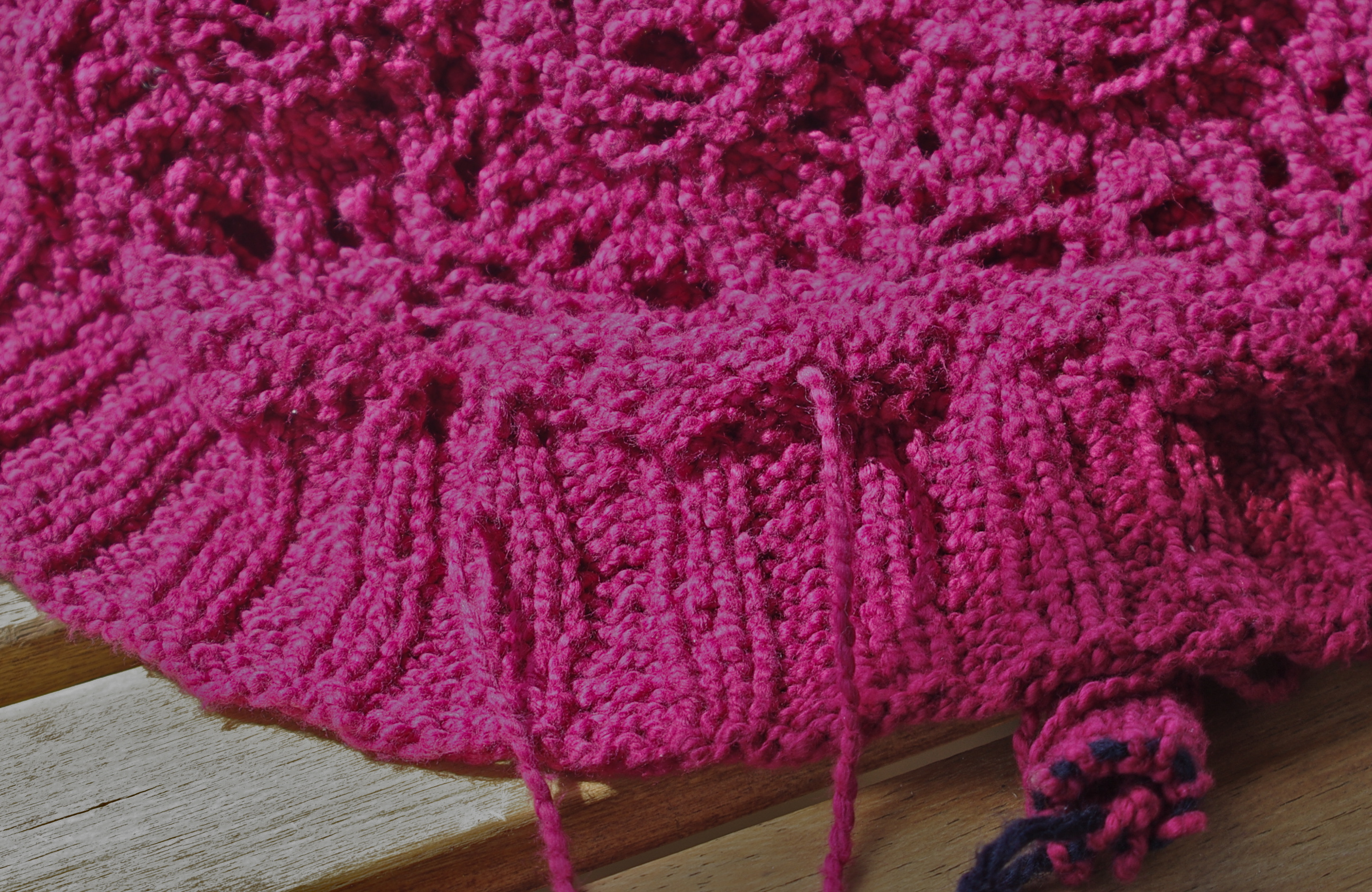
Then, when you turn it over, looks perfect!

Then I just knitted the straps to the perfect length, kitchenered them together, and…a great summer tank!

Though my favorite part of that picture is the boy, looking really pissed off that the picture isn’t about him.

Genius, If I Do Say So Myself…

When I was a child, my family would travel to India frequently.  One of the things I remember from those trips is how small the garbage cans were.  The average kitchen garbage can was about the size of a small bathroom can here.  Compared to the U.S., where the average garbage can is the size of a small child, this was surprising.  At the time, there wasn’t the same disposable culture that we had in the U.S. and far less packaged goods.  The packaging we brought with us didn’t fit into the cans! (Of course, sanitation services were not the greatest, so the dumpster at the corner was always overflowing, but that’s another story.) You’d buy your vegetables from the walla who would roam the streets, pushing around eggplants, beans, tomatoes and the like on a flat wooden wheelbarrow.  As he walked along he would shout out the names of the vegetables on his cart and I remember my grandmother yelling out the balcony for him to stop so she could come down and haggle.

Milk arrived daily in thick plastic bags, fresh from a water buffalo.  These bags were not thrown out but carefully washed, dried, and saved.  The day or two before we would leave to come back to the States, my grandfather would fill these bags with chaklibakarwadi, and various pickles that my grandmother and aunts had prepared.  To seal them, he would fold them over, pass the folded edge quickly through a candle flame and press the melted plastic down to create a seal.  He’d repeat this and then you’d have an airtight package ready for travel.  I tried doing this a few times and burnt my fingers and overmelted, creating holes.

Cut to today, where I’ve started a new knitting project where I’m basically knitting with thread.  See?

I’m knitting with the center two yarns–the “normal” sized yarn and twist tie are there for comparison.

I’m at the part of the pattern where you knit with two of them held together, and they were forever getting twisted and tangled.  I thought about just putting them into a plastic bag but figured that they would still just get knotted up in the bag.  What I needed was something to keep them apart.  Then, I remembered my grandfather carefully melting plastic bags to seal them, and I thought I might be able to do that with a Ziploc bag to create a partition.  So I found a birthday candle, lit it on the counter, folded a bag in half, and gently passed it through the flame and squeezed the melted plastic.

It worked!! Now I can keep each cone of yarn separate but still work with them together.  This technique could work for other stuff, too, like if you wanted to divide a bag to take separate snacks, or storage–one side for nuts, one side for bolts.  Martha Stewart, are you listening?

The project itself is the Kusha Kusha shawl, and you knit it with one strand of the merino wool and one strand of the silk stainless–a fine stainless steel core wrapped in silk give the scarf a tactility and memory.  Here’s how it looks so far–see how it stands up by itself?

Since this project will take, oh, forever, I’m also working on a cute summer tank top made out of a thicker yarn, post to come later.

Old Man Winter’s Last Stand

Yesterday, at 8 am, our street looked like this:


Like the rest of us, this little red-breasted robin below thought that it was supposed to be Spring.  Undaunted, he scampered among the snowy branches.  Robins are a hardy sort.


So are the kiddos, who had a ball with this (hopefully, right, winter?!) last snow of the season.

Okay, so the girl had a bit of a rough start.  She must be from my school of thinking when it comes to winter, which is this: If we were meant to live in cold, snowy weather, we would have been born with thick fur.  Like yaks.  (I cannot claim originality for that line.  It came from a college roommate, who may have stolen it herself.)

Like the robin, the girl is a hardy sort and soon found her footing:

A VERY serious shoveler, there.  Note the pink and purple sparkly scarf, created as requested.  I held one strand of Cotton-Ease with one strand of some cheapo acrylic sparkly yarn and just knitted garter stitch lengthwise until it was wide enough, and attached a sparkly fringe.

Here’s a closeup:

Back at the snow day, after a few finishing touches, came….FrankenSnow!!

You know what’s great? Frankensnow is wearing the itchy mohair scarf that I had made for Eric! He didn’t seem to mind.  Sadly, he was not long for this world, as here is what our street looked like at 5PM THAT EVENING.

The best part of the day, though, was that some of the other kids and parents came out in snow gear and we all played together.  That’s one of the things I love most about my neighborhood–it’s a very porchy, neighborhy, impromptu playdate sort of place.  Everyone seems to hibernate in the winter, and then come spring and summer we’re all  out in our front yards and hanging out.  Much like the return of the robin heralds the beginning of Spring for nature, I hope that this gathering signals the beginning of the outdoor season for those of us in Denver, even if it did take place in almost 2 feet of snow.

Manly Scarf

Would you believe I’d never knitted anything for Eric? That’s not entirely true, I suppose. I did once make him a scarf out of a wool/mohair blend yarn that was so prickly and itchy he couldn’t even wear it over turtlenecks.

He’s been after me to make him a scarf, so I went about looking for a pattern that would be more interesting than just plain knitting, but not feminine like lace. I came across this pattern for a herringbone-like stitch scarf and thought it would be perfect.

Here’s a closeup of the stitch pattern:

Yarn: Cascade 220, 1.75 skeins

Needles: Size 8

Pattern: Night on the Town Scarf

And here it is on the intended wearer:

Okay, okay, I’m not really married to a stuffed bunny with a human head.  It’s just that getting a picture of Eric actually wearing the scarf won’t happen for a few days and I wanted to get this post done today.  Maybe…this photoshop disaster is a bit better:

Doesn’t it look nice on him? Okay, that pic is awful, too.

The pattern is surprisingly easy and knits up fast, too. The edges do curl in a bit despite the seed stitch edging, but the only way to combat that would be to knit a back side of the scarf and attach it, which I’m not going to do.

Next project underway: A pink and purple scarf with sparkles, for the boy, at his request.

Remember the Narwhal

A couple weeks ago, my sister popped up on my gchat and we had a conversation that went something like this:

Sapana: Have you heard of narwhals?

Me: Yes, of course.

Sapana: What?! Seriously?

Me: An arctic sea mammal with a single long tusk, thought to be the inspiration for unicorns.

Sapana: WHO ARE YOU?!?  Do you know an animal that starts with “x”?

Me: Oh, there’s a small African rodent–Xerxes or something like that.  (It ended up being a Xerus)

Sapana: Again, WHO ARE YOU?!?

I’m fascinated with strange creatures, and happen to know quite a few of them.  I love tapirs, narwhals, coatis, and especially okapis.  I was delighted to learn that the Denver Zoo has okapis–I’d never seen them in real life before. I also love echidnas–an egg-laying mammal!  How cool is that?

I know all this mostly because I had a subscription to Zoobooks as a child, and some of the weirder animals stuck with me.   Sapana’s whole line of conversation came up because a guy at her work was wearing a shirt with a graphic of animals beginning with each letter of the alphabet, and they couldn’t figure out what the “n” animal was.

Of course, after this, I wanted to make sure that she never forgot about narwhals, so I set about crocheting one for her.

Here’s another angle:

I wrapped it up in a little package with this note:

And sent it off to her work address.  That’s right, her work address. I debated it for a bit, since I didn’t initially want to make her seem weird her at work, but then decided it would be much funnier if she opened up an unexpected package at work to receive a…narwhal.  And that it would be funnier if I did make her seem weird at work.

She has assured me that the gift has firmly cemented her in the workplace as quite bizarre, but she thought it was funny nonetheless.

I love that I can embarrass my sister from 1,800 miles away.  After all, what are big sisters for?

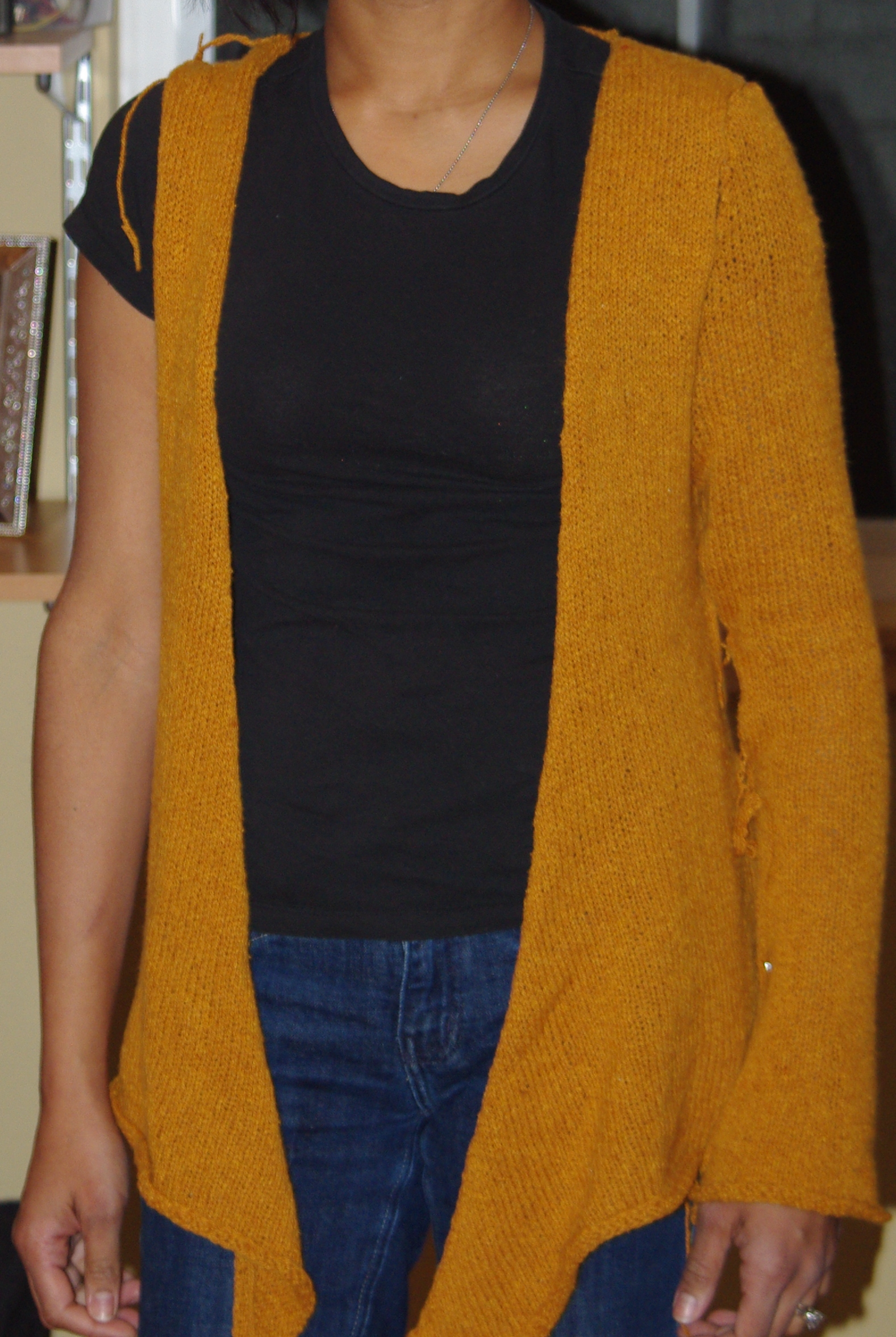
Slouchy Cardian, Finished

So after all that wrangling about the shoulders, I then tried the thing on partway and felt that the part that goes over the chest was waaaay too small. And, yes, I cut my head off in the picture because I just looked that bad:

I figured then I would just sew it all together and pick up and knit a border, but when I got it all constructed, it worked fine! I figured out that the problem wasn’t the narrow fronts, but that the sleeves were too short and I kept pulling them down to come halfway over my palms which is how I like them.  I unpicked and reknit the sleeves an additional 40 rows and then the fronts were fine.

The boy took all the pics! Nice job, no?

The hood attaches far down enough that it helps to prevent the sweater fronts from rolling inward which also makes them wider.  The little details on this sweater are nice–I especially love how the front ends curl in and the bell shaped sleeves.  The yarn, being a wool/silk blend is also surprisingly warm and this will be the perfect sweater to throw on for Spring nights where it’s just cool enough to want your shoulders covered.  I would consider making this again, but I would definitely make the sleeve circumference just a bit wider so that I could wear it over a long sleeved shirt.  As it is, they’re pretty tight and I can only wear the sweater over tanks or short sleeved shirts.

Nevertheless, I foresee this sweater getting a lot of wear.

Slouchy Cardigan

I have learned that there are a few of you out there who actually come here for the knitting and not just the cute kid pics.  This post is for you.

I’ve been working on and off on this cardigan for almost a year, which is sad.  I got to a point where I’d finished the fronts and backs and then moved on for a while.  Anyway, it’s almost done, which I’m happy about.

A lot of people have had trouble with the armscyes on this particular pattern, and with good reason–they simply do not fit the way that traditional set-in sleeves are supposed to unless you knit them significantly longer.  Even in the pattern measurements, the height of the sleeve cap is only 3½ inches and is supposed to fit into an armhole that’s 9 inches high.  I knitted the sleeve caps longer than in the pattern, but not quite long enough so I just fudged it.  Suprisingly, this has not been corrected even in the errata for the pattern.

I used the tutorial for set in sleeves found here, but here’s how I did it with this particular cardigan.

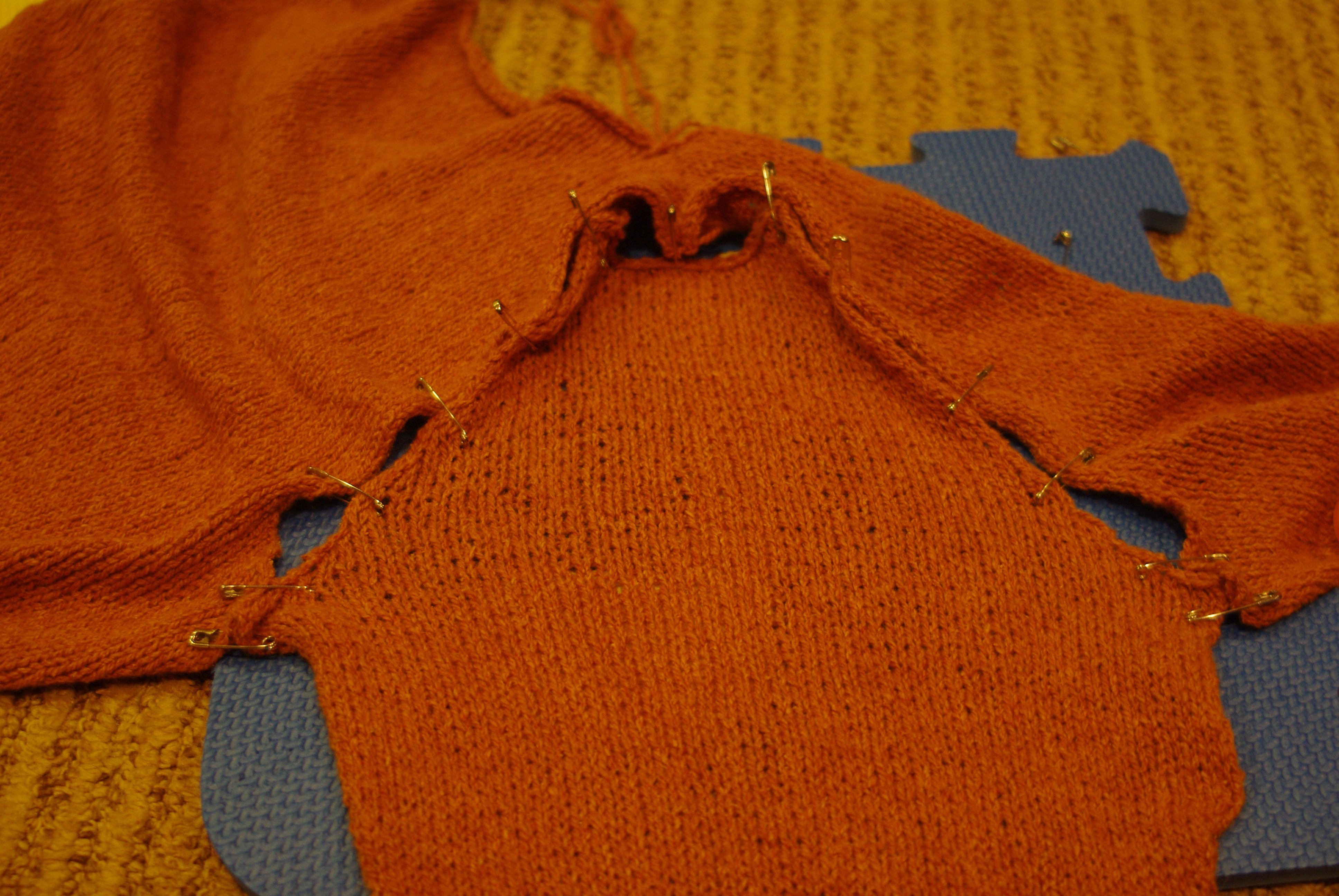
First, you lay all BLOCKED pieces out, after seaming together the fronts and backs at the top. The center of the sleeve cap must match the the seam where the front and back join, and the bound off edges of the sleeve must meet up with the same on the front and back as well.:

At this point, nothing looks like it fits together. That’s okay, because you’re trying to make flat objects into a three dimensional one which only comes easily to physicists.

Next, I measured the length of both sides and pinned them evenly spaced.  Start with the centers of both, then pin at halfway points between those two and then halfway between those pins:

You can still see the fabric puckering where it doesn’t quite meet up.  At this point, you have the option to rip and reknit, or just wing it like I did.  Here’s the fun step where you make it 3-dimensional and see how it all fits together.

Next comes the seaming, using a standard mattress stitch.  How to deal with the not-quite-even areas?

Just pick up more stitches from one side than the other evenly spaced and your problem is solved.

Finish the other side as the first, and you’re left with a set in shoulder, nicely seamed.  This one does pucker a bit but I’m hoping that will even out with blocking and wear and frankly isn’t all that noticeable.

Here’s a closeup of the shoulder seam, which I think I ripped out and redid because of the irregularity in the front, but you get the point.

After all that, I realized the fronts were waaaay too narrow, and I had a momentary bit of panic about having to redo the entire fronts, but I’ll save that for the next post!

Perfection Mitts

Well, that didn’t take long.

Remember this hat? It took a lot less yarn than I thought it would, so I had plenty left over and thought it would make a nice pair of fingerless mitts.  I found this pattern, which I loved as you could unfold the mitts to be longer for extra warmth, or fold them back if you needed to use your fingers.

I wanted to make them longer than the pattern but wasn’t sure if I’d have enough yarn to make them even, and I didn’t want to knit an entire mitt only to find that I didn’t have enough yarn to make the second one as long as the first.  So I divided the yarn into two equal balls by weight first.  Then, I cast on with a provisional cast on, finished the mitt, and then picked up from the bottom and kept knitting until it was as long as I wanted, adding another cable to the wrist to fit with the pattern.  As it turned out, I had quite a bit of yarn left over and just started the second one from the bottom up.

Pattern: Axel Fingerless Mitts

Yarn: Cloud City Fibres thick and thin, 89 yards

Needles: 8

I don’t typically consider myself much of a perfectionist, except when it comes to knitting.  My sister said that part of the charm of handknits is the imperfections, but I think that if you’re going to spend that much time making something it should be perfect–otherwise, why bother? Of course, this is generally impossible and drives me batty because nothing I make is ever completely perfect.

In the case of these mitts, I did the first mitt as above and then cast off with a regular cast off.  When I started the second one, I realized that I could start in a tubular cast on, which looks so much nicer.  I finished the entire second mitt, and then couldn’t stand how the original one didn’t have a tubular cast on/off, unraveled it entirely and reknit it with the appropriate technique. Much better. See?

Now I’ve got 97 yards STILL left over, maybe enough for a little neckwarmer, perhaps?

Wise Old Ravenclaw

Believe it or not, I haven’t stopped knitting during the last few months.  I was making a few scarves for dear friends of ours and couldn’t post about it because they occasionally peek in on the blog and I didn’t want to ruin the surprise.

As usually happens when I give away something I knit, I manage to do so before I get the usual pictures of it to post on the blog.  Since I’m a full-time worker bee, full-time parent, and only part time knitter and blogger, these things get a bit of a short shrift.

Anyway.  Anne and Susan are two friends who I love for many reasons, not the least of which is that I now have someone in Denver to go see all the Sci-Fi/Fantasty/totally geeky movies that I love and Eric detests.  Eric will rarely go see any of these films with me and when he does, he’s one of those types that keeps asking questions like, “Why is that pointy curly thing sticking out of his head?” which just drives me up the wall.

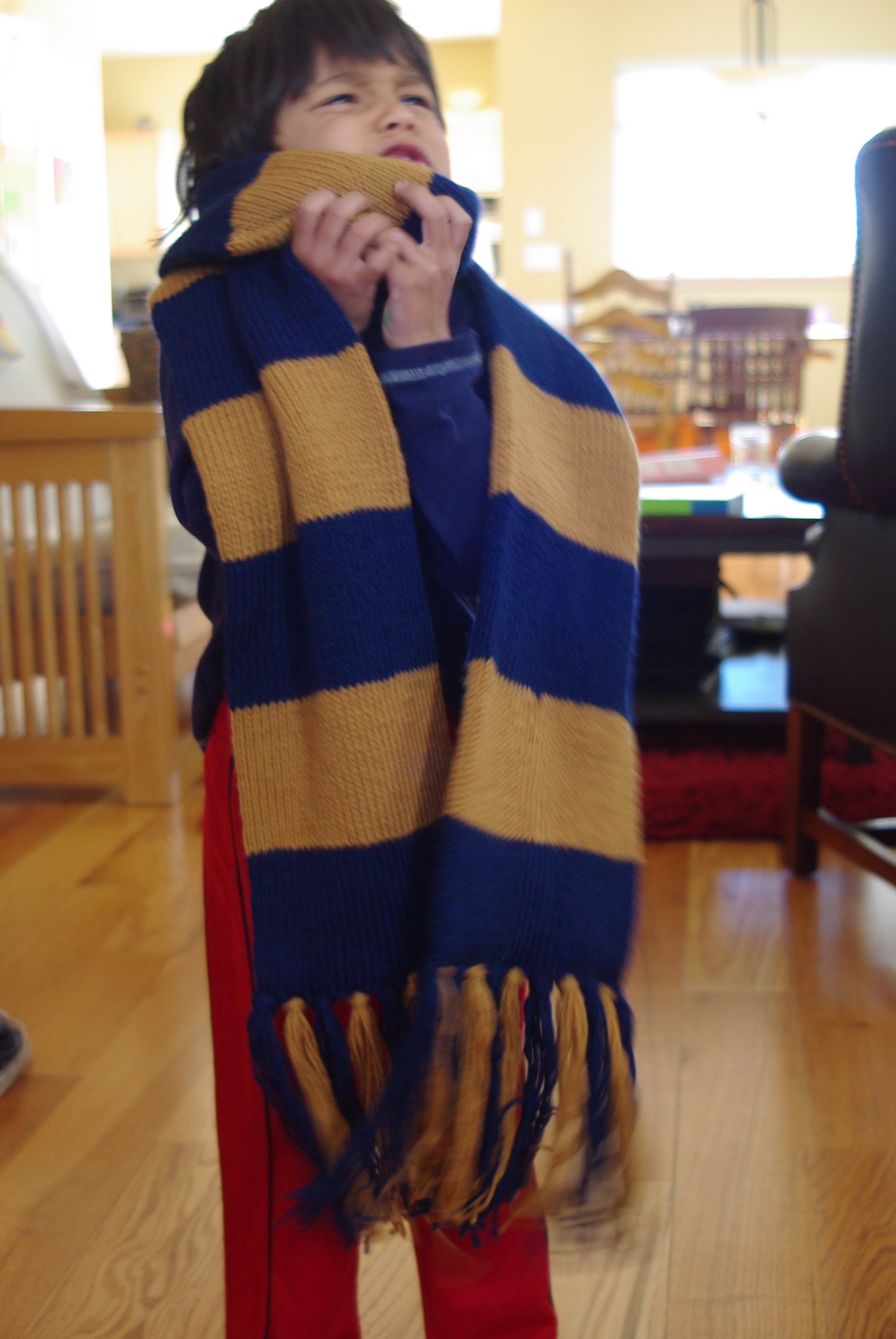
So over the summer, we went to see the new Harry Potter movie and loved it.  At drinks afterward, I casually asked, “What house would you be in?” Susan immediately replied, “Ravenclaw!” I raised a quizzical eyebrow to Anne, who tilted her head towards Susan and said, “I’d be in whatever house she was in,” which was just incredibly sweet.  Now that I knew which house they were in, I could set off on making them house scarves.

The scarves in the movies vary from Year 1-2 and Years 3+, so I thought I’d make one of each and then they could decide which one they wanted to wear.  Also, then they wouldn’t have matching scarves, which is a bit too geeky even for me.  Ravenclaw house colors differ from the book (bronze/blue) to the movie (silver/blue), so I chose the book colors out of a sense of authenticity to the source material.  Yes, I do realize I’m talking about Harry Potter here.

My unwilling model for the Year 1-2 scarf.

And my lovely sister models the year 3+ scarf.

Pattern: Hogwarts Scarves (rav link)
Yarn: Cascade 220 colors 9449 and 7823
Size 7 needles

They’re knit as big tubes so they have no wrong side and are doubly warm.  The color switching was a bit fiddly for the second scarf, but I finally figured out the best technique, which was to add in the yellow, knit with the jogless jog method in the round while carrying the yellow along with the center blue stripe, shifting the row over one stitch at each color change to make each stripe 3 stitches high, and then break the yellow after the stripe bundle was done.  I combined this with the method of knitting in the end as you go along, which meant a lot less work at the end.  Here’s another great example where I meant to get good tutorial pictures and just never managed to.  Here is a link to the technique I used.

Anne and Susan were finally gifted the scarves on New Year’s Eve, and loved them as much as I hoped they would.  These were relatively simple, technique-wise, to knit but did take up a fair bit of time.  It feels sort of odd to have them finished, to tell the truth.  I always knew I had these to work on and now that they’re done, I’ll have to pick up a new project.  It’s sort of like that feeling that Eric mentions to me when he finishes a marathon–exhilarating but disappointing at the same time because once it’s over it’s sort of like, well, what’s next?

Oceania

Back in June, I picked up a hank of a lovely blue and green, thick and thin, handpainted yarn at the Estes Park Wool Market. I had always intentioned it for a hat and when the weather turned cooler, it was time to get going.

It was actually tough to find a pattern that worked for the yarn.  Initially I made the Utopia Hat, which looked great until I blocked it, after which it swallowed my head.  I redid it with fewer cast on stitches but screwed up the math and didn’t have an even number of pattern repeats and had to rip that out, too.  I tried the Unoriginal hat, but didn’t really like the pattern and that one would have been too small.  Finally, I found The Cabled Hat of Awesomeness (rav link), and it lived up to its name.

IMGP3841

Yarn: Cloud City Fibres Thick and Thin, 78 yards

Size 11 Needles, CO 72 stitches, one extra pattern repeat

I realize looking at this picture that there is a small bit of schmutz on the second from the left cable.  This is basically how all of my clothes are–there is always some small remnant of child goo attached to it.  If I cared about this, I’d never be able to leave my house.

I was worried that the combination of thick and thin, multicolored yarn and cables would be a bit overwhelming, but I think this really works.  Multicolored yarns can be tough, as they can settle into large blocks of color depending on the pattern.  It was interesting to see how the colors shifted with the number of cast on stitches.  At 96 (with size 8 needles), it looked similar to the one above with hardly any pooling.  When I tried to redo the hat with 66 stitches, it left large blocks of color.  When I tried 60, it basically created stripes. With 72 stitches as pictured above, all the colors mixed together evenly. Here’s a closeup shot (colors are truer in the above pic):

IMGP3857

It was hard, too, to find a good needle size.  The yarn goes from being a super bulky to almost a DK size.  I started with 8s and my hands were cramping up terribly just trying to force it.  I wrote to the people at Cloud City Fibres and they suggested a 13, but the hat looked way too lacy.  I settled on 11s and they worked. (It sort of felt like Goldilocks! “These needles are too big, and these are too small, but these ones are juuuuust right.”)  In some places where there’s a bunching of the thinner yarn, you can see some gaps but it’s not bad.

This also used up a lot less yarn than I thought it would.  To figure out the exact amount, I brought out my trusty kitchen scale.  Weighing the total amount of yarn (287 yards) and then the hat separately, I realized that it only used 78! I’ve got a little over 200 yards left and am trying to decide if I should make matching fingerless mittens or a cowl…